
What if your credit score wasn't a final verdict on your business's future, but simply a sign that you're talking to the wrong people? If you've been searching for an answer to the question, "can i get a sales tax bond with bad credit," the short answer is a resounding yes. It's incredibly frustrating to receive an automated rejection from a standard agency when you're simply trying to stay compliant with state laws. You might feel like your business is on the brink of closure just because a computer algorithm decided you're too risky. We understand that a tax bond is a financial guarantee, and for many, that feels like an impossible hurdle to clear with a less than perfect history.
This guide will help you move past the "no" and discover how to secure a sales tax bond even with a low credit score. You'll learn the specific steps to navigate high-risk underwriting and find out what these bonds actually cost in the 2026 market. We're going to show you how manual underwriting works, why specialized brokers are your best allies, and how to satisfy state requirements quickly. By the end of this article, you'll have a clear path to getting your bond approved so you can focus on growing your company instead of worrying about red tape.
Key Takeaways
- Understand why states mandate sales tax bonds and how they ensure your business remains compliant with tax remittance laws.
- Discover how you can successfully answer "can i get a sales tax bond with bad credit" by accessing specialized markets that look beyond your score.
- Learn how bond premiums are calculated as a fraction of the total amount, making bonding affordable even for high-risk businesses.
- Identify the essential financial documents and transparency tactics needed to build trust with underwriters and bypass automated "no" responses.
- Explore the benefits of manual underwriting and how "storytelling" helps you secure a bond by providing context for past credit challenges.
What is a Sales Tax Bond and Why Do You Need It?
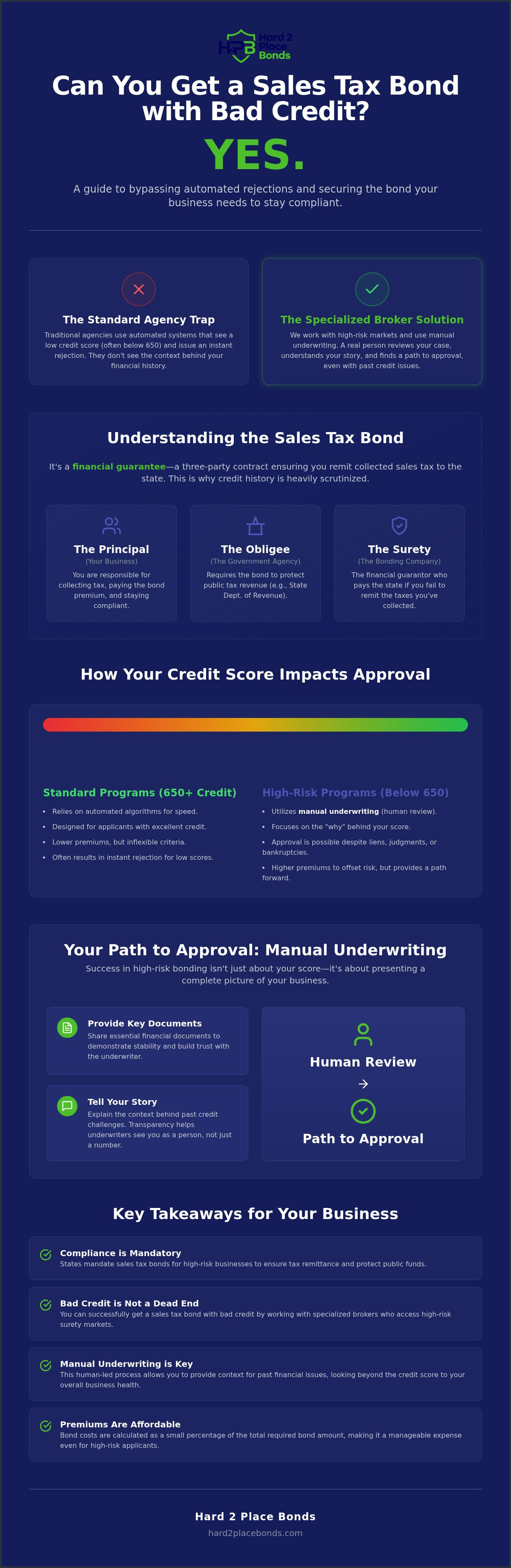
A sales tax bond is a type of commercial surety bond required by state or local governments to ensure that businesses properly collect, report, and remit sales taxes. Essentially, it is a three-party agreement between your business, the state government, and the surety company that provides the financial backing. While many business owners assume all bonds are the same, sales tax bonds are categorized as "financial guarantees." This distinction is critical for anyone wondering, "can i get a sales tax bond with bad credit," because financial guarantees carry a much heavier weight in the eyes of an underwriter.
Unlike a standard license bond that simply ensures you follow industry regulations, a financial guarantee is a direct promise to pay money. If your business fails to remit the taxes you've collected from customers, the surety company is legally obligated to pay that debt to the state. Because the surety is essentially co-signing for your future tax payments, they look much more closely at your credit history and financial health than they would for other bond types. This higher risk profile is why standard agencies often issue immediate rejections to anyone with a low credit score.
The Role of the Obligee, Principal, and Surety
To understand how this process works, you need to know the three players involved in the contract. The Obligee is the government agency, such as your State Department of Revenue, that requires the bond to protect tax revenue. The Principal is you, the business owner, who is responsible for staying compliant and paying the bond premium. Finally, the Surety is the insurance company that acts as your financial guarantor, vouching for your ability to fulfill your tax obligations. They provide the state with the peace of mind that the money will be paid, regardless of your business's immediate cash flow.
Why States Require This Bond for High-Risk Businesses
States don't require every single business to have a sales tax bond, but they often mandate them for those they deem high-risk. This usually happens if you have a history of late tax payments or if you're trying to reinstate a revoked tax license. In some cases, new business registrations in specific industries, like retail or liquor sales, trigger this requirement as a "good faith" deposit. The state wants to ensure that even if your business faces financial trouble, the public's tax dollars are protected. When you ask, "can i get a sales tax bond with bad credit," you're usually facing one of these high-stakes scenarios where the state won't let you operate without this specific security in place. We specialize in finding paths forward for these exact situations, turning a state requirement into a manageable part of your business operations.
Can I Get a Sales Tax Bond with Bad Credit?
The short answer is a definitive yes. It's a common misconception that a low credit score is an automatic disqualifier for business compliance. Most traditional agencies use automated systems that flag any score below 650 or 600 for instant rejection. These algorithms don't account for the context of your situation; they simply see a number and close the door. However, specialized markets exist specifically to serve high-risk applicants. These carriers recognize that a credit score is just one piece of a much larger story. If you've been asking, "can i get a sales tax bond with bad credit," you need to look beyond the standard insurance markets and toward brokers who specialize in hard-to-place cases.
Approval is often possible even if your financial history includes significant hurdles. We regularly work with business owners facing tax liens, civil judgments, or even past bankruptcies. The key is finding an underwriter who evaluates the "why" behind the credit score rather than just the score itself. By focusing on your current business performance and your plan for future compliance, specialized brokers can often secure the bond you need to satisfy state requirements and keep your operations running smoothly.
How Credit Scores Impact the Approval Process
In the surety industry, your credit score acts as a proxy for financial stability. If your score falls into the 500 to 600 range, you're entering the most challenging tier for traditional bonding. This is where most standard agencies stop being helpful. It's important to remember that "hard-to-place" doesn't mean "impossible-to-place." Underwriters in specialized markets look for signs of stability, such as how long you've been in business or your history of industry experience. If you're currently navigating this specific challenge, you might find our guide on how to get a surety bond with a 500 credit score particularly useful for understanding the nuances of this credit tier.
The Difference Between Standard and High-Risk Programs
Standard bonding programs are designed for speed and low cost, relying on rigid algorithms to approve applicants with excellent credit. These programs aren't built for flexibility. High-risk programs, conversely, utilize manual underwriting. This means a human being actually reviews your file and assesses the risk based on the facts of your case. While high-risk programs naturally come with higher premiums to offset the perceived risk, they offer a lifeline to businesses that the standard market ignores. Your choice of broker determines which of these programs you can access. A broker with deep connections in the high-risk space can advocate for you, presenting your case in the best possible light to secure an approval. If you're ready to see what options are available for your specific situation, you can begin the intake process here to connect with our underwriting team.
The Cost of Sales Tax Bonds with Bad Credit in 2026
One of the biggest misconceptions about bonding is that you must pay the full face value of the bond upfront. This isn't the case. Instead, you pay a premium, which is a small percentage of the total bond amount. For business owners asking, "can i get a sales tax bond with bad credit," understanding this cost structure is vital for budgeting. While standard market rates usually fall between 1% and 3%, high-risk premiums for those with credit challenges typically range from 5% to 15% of the bond's value. You pay this premium annually to keep the bond active and your business in good standing with the state.
The premium is essentially the price you pay for the surety's financial backing. When your credit score is lower, the surety takes on more risk, which is why the percentage increases. However, even a 15% premium is often a manageable business expense compared to the alternative of being unable to operate at all. We focus on finding the most competitive rates within these high-risk tiers, ensuring that compliance doesn't break your bank.
Factors That Influence Your Final Premium
Several variables dictate where you fall on the pricing spectrum. First, the total bond amount required by your state plays a major role; a $50,000 bond will naturally cost more than a $10,000 bond. Underwriters also look at specific "flags" on your credit report. For instance, a bankruptcy from five years ago is viewed differently than a series of recent unpaid tax liens. Your industry matters too. Certain business types, such as those in the liquor or tobacco sectors, are often viewed as higher risk by the state, which can lead to higher bond requirements and subsequently higher premiums. Providing context for these flags can help lower your perceived risk during the obtaining a surety bond process.
Is Collateral Required for Bad Credit Bonds?
Collateral is a safety net for the surety company. In some high-risk cases, a surety might ask for cash collateral, which is a deposit held for the duration of the bond. While this can feel like a burden, specialized brokers work tirelessly to avoid or minimize these requirements. Our goal is to leverage our relationships with carriers to secure an approval based on the premium alone. There is often a trade-off: you might choose a slightly higher premium to avoid tying up your liquid cash in collateral. This flexibility allows you to keep your capital working for your business while still meeting the state's mandate. If you are concerned about how your specific history might impact these costs, you can submit your details for a personalized review by our underwriting team.
Steps to Secure Approval with a Low Credit Score
Securing a bond when your credit is less than perfect requires a strategic approach rather than a standard application. If you're currently asking, "can i get a sales tax bond with bad credit," the answer depends largely on how you present your case to the underwriter. Preparation is your greatest tool. Start by gathering your financial documents early. Showing clear profit and loss statements or recent tax returns can demonstrate that your business is viable and capable of meeting its obligations, even if your personal credit history has some bruises. A healthy cash flow often speaks louder to a high-risk underwriter than a three-digit score ever could.
Transparency is equally vital. Don't try to hide past financial struggles; underwriters will find them during the background check. Instead, be proactive and explain the context behind your credit issues. Whether it was a medical emergency or a previous business failure, providing a brief "letter of explanation" builds trust. If you have outstanding tax liens or judgments, try to address them or set up a formal payment plan before you apply. Showing that you're actively resolving past debts proves you take your financial responsibilities seriously, which significantly improves your odds of approval.
What Underwriters Look for Beyond the Score
In the high-risk market, underwriters use a more holistic view to assess risk. They focus heavily on your industry experience. If you've successfully managed similar businesses for years, that expertise acts as a powerful offset to a low credit score. They also look closely at your current liquidity. Having enough cash on hand to cover your immediate tax liabilities shows you won't need to dip into collected tax funds to keep the lights on. Finally, your professional character matters. Being responsive, providing requested documents quickly, and maintaining a professional tone during the intake process signals that you'll be a reliable partner for the surety company.
Choosing the Right National Surety Bond Broker
Your choice of broker is the single most important factor in your success. Most general insurance agents deal with standard policies and don't have the relationships required to navigate the high-risk surety world. When they see a low credit score, they often hit a dead end. A specialist broker, however, has access to non-standard markets and knows which carriers are currently hungry for high-risk business. The value of specialized surety bond placement lies in the broker's ability to "shop" your application. They don't just blast it to every carrier; they strategically place it with underwriters who understand your specific industry and credit situation. This targeted approach reduces the number of rejections on your record and speeds up the approval process. If you're ready to move past the automated rejections, you can submit your application to our specialized underwriting team today.
Why Specialized Underwriting is Key for Your Success
Specialized underwriting isn't just a different process; it's a different philosophy. While standard agencies rely on rigid scorecards and automated algorithms, specialized carriers look for reasons to approve you. If you've spent weeks asking, "can i get a sales tax bond with bad credit," you've likely hit the wall of automated denials that don't account for your unique situation. We act as the vital bridge between your high-risk business and the carriers that actually want your business. Manual underwriting allows for "storytelling," where we present the full context of your credit history to an actual human being. This personal touch turns a cold, three-digit data point into a compelling business case.
A sales tax bond is often the final hurdle to achieving full business legality. Without it, you can't legally collect revenue or satisfy state licensing requirements in many jurisdictions. We don't see your credit score as a permanent barrier. Instead, we view it as a challenge that requires a more creative, tenacious solution. Our focus is on finding a path to "yes" when everyone else has already said "no." By highlighting your industry experience and current financial stability, we help you clear this hurdle and get back to what you do best: running your company.
The Hard 2 Place Bonds Advocacy Approach
We navigate the complex "hard-to-place" market by leveraging our deep relationships with niche underwriters across the country. Our national reach means we know which carriers are most flexible in your specific state and industry. This isn't about just filing paperwork. It's about advocacy. We fight for your approval because we believe one financial setback shouldn't end a business's journey. For immediate assistance with your case, you can start your application and let our team begin the work of securing your bond through our specialized network.
Securing Your Business Future
Think of this bond as an investment in your company's long-term credibility. While the initial premium might be higher due to your credit score, staying compliant today builds a track record that underwriters will reward tomorrow. If you're still wondering, "can i get a sales tax bond with bad credit," remember that compliance is a journey. As you consistently remit your sales taxes and maintain your bond, you'll find that future renewals often come with better rates. You're proving your reliability in real-time. Don't let past setbacks define your potential. Approval is possible, and once you have that bond in hand, you've secured the foundation of your business's future.
Secure Your Business Compliance and Growth
Your credit score shouldn't be the final word on your business's ability to operate legally. We've explored how specialized carriers look beyond a simple number to understand your unique situation. By focusing on manual underwriting and proper preparation, you can satisfy state requirements even if your past financial history is less than perfect. Remember that the answer to can i get a sales tax bond with bad credit is a clear yes when you have the right advocate in your corner. We specialize in bad credit approvals and provide national coverage for all commercial bonds, giving you access to non-standard surety markets that others simply can't reach.
Don't let a standard agency's automated rejection stop your momentum. We're here to help you navigate these hurdles with calm competence and a focus on solutions. Get Your Free High-Risk Sales Tax Bond Quote Today and take the final step toward full business compliance. Your future success is within reach, and we're ready to help you secure it.
Frequently Asked Questions
Can I get a sales tax bond if I have a pending bankruptcy?
Yes, you can often secure a bond even with a pending bankruptcy, though it requires specialized manual underwriting. Standard carriers will almost always decline these cases immediately because they rely on automated systems. We work with specialized carriers that review the specific details of your bankruptcy and your current business cash flow to determine if a bond can be issued with additional safeguards.
How long does it take to get a sales tax bond with bad credit?
Approval for high-risk bonds typically takes between 24 to 48 hours once all documentation is submitted. While standard bonds might be issued instantly by an algorithm, the manual review process for credit challenged applicants requires a human underwriter to evaluate your file. Once the underwriter approves the risk and the premium is paid, the bond can be issued and filed with the state quickly.
Do I have to pay the full bond amount upfront?
No, you only pay a premium, which is a small percentage of the bond's total face value. If you're asking, "can i get a sales tax bond with bad credit," you should expect this premium to be higher than standard rates, but you aren't required to pay the full bond amount. This annual fee keeps the bond active and ensures your business remains compliant with state revenue departments.
What happens if I can't find a company to bond me?
If traditional agencies have turned you down, you should seek out a broker that specializes in hard-to-place commercial surety. Many business owners believe they've hit a dead end after one or two automated rejections, but specialized markets exist specifically for these high-risk scenarios. We focus on finding alternative paths for applicants that standard algorithms deem too risky to handle.
Will getting a sales tax bond help improve my credit score?
Obtaining a surety bond itself doesn't directly impact your personal credit score because surety companies generally don't report premium payments to credit bureaus. However, staying compliant with state tax laws and keeping your business operational allows you to build a positive financial history. Over time, this business stability can lead to better personal credit and lower bond premiums in the future.
Is a sales tax bond the same as a contractor license bond?
No, a sales tax bond is a financial guarantee, while a contractor license bond is a regulatory requirement for professional conduct. Sales tax bonds ensure that the state receives the tax dollars you collect from customers. Because they involve the direct movement of money to the government, they're considered higher risk and often require more rigorous underwriting than standard license bonds.
Can I get a sales tax bond without a personal credit check?
It's very rare to secure a sales tax bond without a personal credit check because it is a financial guarantee. Underwriters use your credit history to assess the likelihood that you'll remit collected taxes to the state. Even in high-risk markets, the credit check is a standard part of the process, though specialized brokers focus on the context of your score rather than just the number.
What documents will I need to provide for a high-risk bond application?
You'll typically need to provide your business's legal name, tax ID number, and a copy of the state's bond requirement notice. For those wondering, "can i get a sales tax bond with bad credit," additional documents like recent profit and loss statements or a letter explaining past credit issues can be incredibly helpful. These items help the underwriter see the current viability of your operations beyond your credit report.