

What if the "no" you received from an automated bonding system was actually an invitation to find a better partner? You've likely felt the frustration of being rejected by a faceless algorithm or feared that your business might stall because you can't meet a mandatory bonding requirement. It's exhausting to deal with standard providers who don't look past your credit history to see your company's potential. We know that securing a surety bond for 500 credit score applicants requires a specialized approach that prioritizes creative problem-solving over rigid, automated denials.
This 2026 guide reveals the exact steps to turn those setbacks into a successful approval. We'll show you how to secure professional bonding to fulfill legal or contract mandates, even with a subprime credit score. You'll gain a clear understanding of the subprime bond market, including how premiums are structured and how to find a tenacious advocate who won't give up on your application. We're here to provide the expert guidance and professional reassurance you need to clear these hurdles and keep your business growing.
Key Takeaways
- Distinguish between standard and bad credit bond programs to find the right fit for your current financial standing.
- Learn how manual underwriters evaluate "character" and industry experience to look past a subprime score.
- Anticipate 2026 market costs, with subprime premiums generally landing between 5% and 15% of the total bond amount.
- Discover how to secure a surety bond for 500 credit score by preparing a "financial defense" that proves your business's stability.
- Find out why specialized agencies have the deep carrier relationships needed to bypass the automated "deny" systems of traditional insurers.
Can You Get a Surety Bond with a 500 Credit Score?
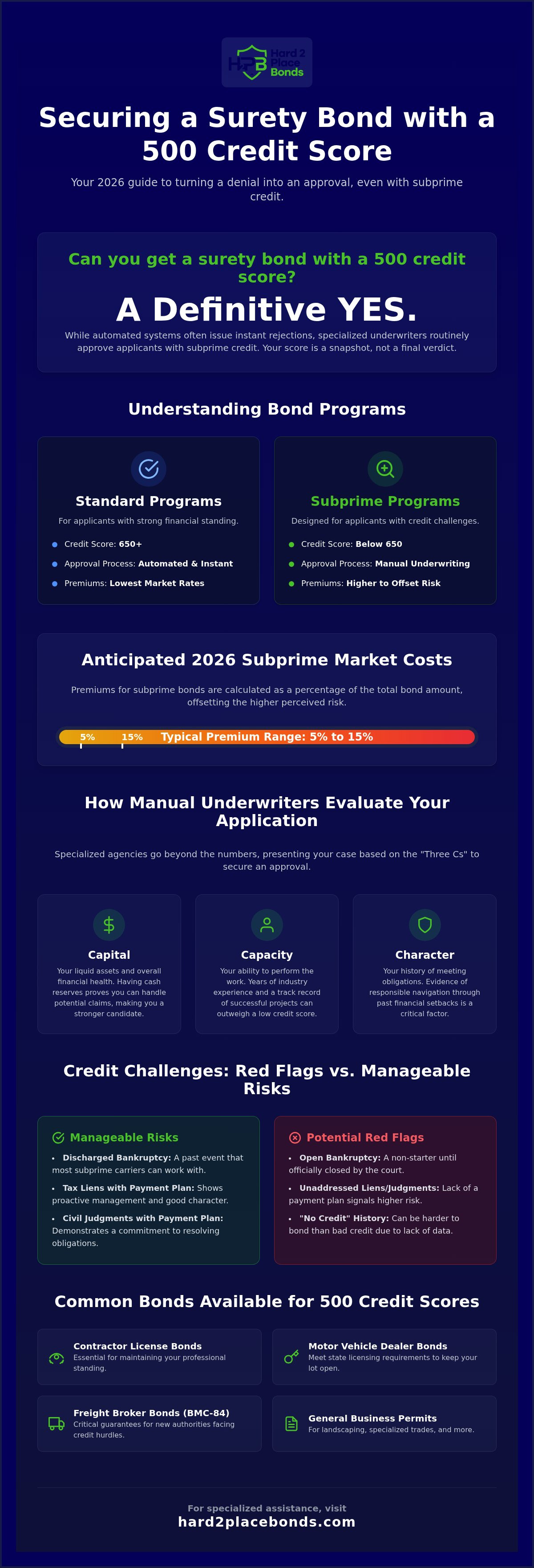
The short answer is a definitive yes. While many traditional insurance agencies rely on automated systems that trigger an instant rejection for subprime scores, the reality of the 2026 bonding market is much more nuanced. Securing a surety bond for 500 credit score applicants is not only possible; it's a routine part of what specialized underwriters do every day. Your credit score is a snapshot, not a final verdict on your professional integrity or your business's future.
The primary difference lies in the program type. Standard bond programs usually require a score of 650 or higher to qualify for the lowest rates. When you fall below that threshold, you move into "Bad Credit" or "Subprime" bond programs. These programs are specifically designed to accommodate higher risk profiles by adjusting the premium rather than flatly denying the application. For many generalist agencies, a 500 score represents a "floor" where they simply stop trying. For a specialist, it's where the real work of advocacy begins.
Why Credit Scores Matter to Surety Companies
Underwriters use credit reports as a proxy for financial responsibility and what they call "moral hazard." Unlike traditional insurance where you pay a premium to transfer risk, a surety bond is a financial guarantee that you will fulfill your obligations. The surety company expects a zero-loss outcome. If a claim is paid, you are legally required to reimburse the surety in full. A 500 credit score suggests to an underwriter that there may be a higher risk of financial instability, which could lead to a claim or an inability to pay the indemnity. By moving to a subprime program, the surety offsets this perceived risk with a higher premium, allowing you to get the bond you need to stay in business.
Common Bonds Available for 500 Credit Scores
Most commercial and license bonds are available to those with credit challenges. You don't have to put your business goals on hold just because of a past financial setback. Common bonds we successfully place for applicants with a 500 score include:
- Contractor License Bonds: Essential for maintaining your professional standing with state and local boards.
- Motor vehicle dealer bonds: We specialize in helping high-risk applicants meet state licensing requirements to keep their lots open.
- Freight broker bonds(BMC-84): New authorities often face credit hurdles, but we have the carrier relationships to secure these critical guarantees.
- General Business Permits: Many local municipalities require bonds for everything from landscaping to specialized trade work.
Securing a surety bond for 500 credit score requirements is about finding the right path forward, not accepting a "no" from a computer program that doesn't understand your specific situation.
How Underwriters Evaluate High-Risk Bond Applications
Most large insurance agencies rely on automated algorithms to process applications. If your data doesn't meet a specific numerical threshold, the system triggers an instant rejection. This "black and white" approach is why so many business owners struggle to find a surety bond for 500 credit score requirements. At Hard 2 Place Bonds, we move beyond the algorithm. We engage in manual underwriting, which allows a human expert to look at the story behind the numbers. In the 2026 market, subprime bonding programs are more robust than ever, but they require a specialist to present your case effectively to the right carrier.
The 'Three Cs' of Surety Underwriting
Professional underwriters don't just look at a FICO score; they evaluate three core pillars of your business profile. Understanding these can help you strengthen your application:
- Capital: This refers to your liquid assets and overall financial health. Even with a low credit score, showing that you have cash reserves to handle potential claims makes you a much more attractive candidate.
- Capacity: Underwriters want to know if you can actually do the job. Your years of industry experience and your track record of successful projects carry significant weight. If you've been a successful contractor for a decade, that experience often outweighs a subprime score.
- Character: This is the most subjective but critical pillar. It involves your history of meeting obligations. We look for evidence that you've navigated past financial setbacks responsibly and are committed to your professional duties.
Red Flags vs. Manageable Risks
Not all credit challenges are viewed equally. A discharged bankruptcy from three years ago is a historical event that most subprime carriers can work around. However, an open bankruptcy is often a non-starter until it is officially closed by the court. Similarly, tax liens or civil judgments don't have to result in a "no." If you can provide documentation of a formal payment plan, underwriters see that as a sign of good character and proactive management. Interestingly, "no credit" can sometimes be harder to bond than "bad credit" because there is no data to prove you've ever managed debt. Having a history, even a bumpy one, gives us a starting point to advocate for your approval.
Our role is to act as your tenacious advocate. We use our deep carrier relationships to explain the context of your credit history, turning a standard refusal into a consultative approval process. If you're ready to move past the automated rejections and work with a partner who understands your industry, you can begin your application here to let us start building your case.
The Cost of Bonding: Subprime Premium Expectations
Understanding the financial side of high-risk bonding is the first step toward regaining control of your business's future. It's natural to feel a bit of sticker shock when you first see subprime rates, but these costs reflect the "Risk Premium" that surety companies charge to offset the higher likelihood of a claim. For a surety bond for 500 credit score applicants, the premium typically ranges between 5% and 15% of the total bond amount. While these premiums are higher than standard rates, they are a temporary cost of doing business while you work to improve your credit and graduate to lower-risk programs.
The final price you pay depends heavily on the type of bond required. Commercial surety bonds, like those for motor vehicle dealers or freight brokers, often have more flexible pricing because they are mandated by the state for licensing. On the other hand, contract surety bonds for construction projects involve more complex risk assessments. Because contract bonds guarantee the completion of a specific project, underwriters may look closer at your cash flow and work history to determine where you fall within that 5% to 15% range.
Standard vs. High-Risk Premium Comparison
To put these numbers into perspective, it helps to see how the subprime market differs from the standard market. Applicants with a credit score of 700 or higher can usually expect to pay between 1% and 3% of the bond amount. When your score is in the 500 to 599 range, the rate increases to the 5% to 15% bracket. You can push your premium toward the lower end of this high-risk range by demonstrating strong industry experience or showing significant liquid assets. These factors prove to the underwriter that you have the "Capacity" and "Capital" to manage your obligations, even if your credit score hasn't caught up yet.
Financing Your Surety Bond Premium
Many business owners worry that a high premium will drain their operating capital. It's a common misconception that you have to pay the full face value of the bond; you only ever pay the premium. If the premium itself is still a hurdle, financing options are often available for high-cost bonds. Premium financing allows you to break the total cost into manageable monthly payments. This approach preserves your cash flow for daily operations while ensuring you remain in full legal compliance. We focus on finding solutions that make obtaining a surety bond a sustainable part of your business strategy rather than a financial roadblock.
Step-by-Step: How to Secure Approval with a 500 Score
Securing a surety bond for 500 credit score applicants isn't just about filling out a form; it's about building a case. Most business owners fail because they treat the process like a standard insurance application. When you're in the subprime market, you need a "Strength of File" packet that highlights your business's resilience. This proactive approach shows underwriters that you're a professional who understands your financial landscape, making it easier for them to say yes. Following a structured process ensures you don't leave your approval to chance.
Step 1: Gather Your Supplementary Documentation
Start by gathering documentation that provides context to your credit score. Underwriters want to see proof of your industry longevity and professional experience. A detailed resume or a list of completed projects can prove you have the capacity to perform the work. Additionally, prepare a Personal Financial Statement (PFS) to show your current liquidity. If your credit score was impacted by specific life events like medical bills or a divorce, write a brief, professional explanation. This transparency builds the character profile we discussed earlier and helps humanize your application.
Step 2: Apply Through a High-Risk Specialist
Once your documents are ready, you must choose the right partner. Applying with a generalist agency often results in an instant, automated denial that can lead to unnecessary hard inquiries on your credit report. A specialist who focuses on "Hard-to-Place" bonds knows exactly which carriers are subprime-friendly in 2026. This expertise is vital for obtaining a surety bond without wasting time or further damaging your score. We act as your advocate, presenting your supplementary packet directly to underwriters who value experience over algorithms.
Step 3: Review and Execute the Bond
After receiving a quote, you'll need to review the indemnity agreement. This is a standard legal document where you personally guarantee to reimburse the surety if a claim is paid. It's a high-stakes commitment, but it's the key to unlocking your bond. Once you execute the agreement and pay the premium, your bond is issued to the obligee. Use this first year to focus on credit improvement. By paying down debts or resolving old judgments, you can position yourself for a lower premium when renewal time comes around. We're here to help you navigate this transition and keep your business compliant.
Don't let a subprime score stall your progress. You can start your application today and let our team begin the process of advocating for your business approval.
Navigating Specialized Placement with Hard 2 Place Bonds
Finding a partner who understands the subprime market is the final piece of the puzzle. At Hard 2 Place Bonds, we've built our reputation on handling the files that other agencies find too complex or too risky. While standard providers focus on high-volume, low-risk clients, our focus is entirely on the "Hard-to-Place" segment. This specialization means we don't see a subprime score as a dead end. We see it as a starting point for a professional conversation. We've spent years cultivating deep relationships with subprime-friendly carriers who trust our ability to vet applicants based on more than just a credit report. Securing a surety bond for 500 credit score applicants is what we do every day.
Our commitment is to find a path forward when others simply say no. We understand the frustration of automated systems and the fear that a lack of bonding could lead to business closure. By positioning ourselves as your tenacious advocate, we bridge the gap between your current financial standing and the requirements of the bond obligee. Whether you need specialized coverage for a new venture or are trying to maintain existing licenses, we provide the expertise needed to navigate these high-stakes hurdles with confidence.
A Consultative Approach to High-Risk Risk
We don't just run an algorithm; we tell your business story to underwriters. This human element is especially critical for those seeking contractor license bonds while managing credit challenges. We know that your license is your livelihood. We work tenaciously to ensure you don't lose your ability to work because of past financial setbacks. Our expertise also extends to more complex instruments like bid bonds and performance bonds, where we advocate for contractors even with a 500 score. For a deeper look at specific contract requirements, check our guide on Payment Bond with Bad Credit.
Get Your Quote and Get Back to Business
Our streamlined process is designed specifically for high-risk applicants who need results quickly. We offer national coverage for all commercial and contract bond needs, ensuring you have access to the guarantees you need regardless of your industry. We know the stress that comes with a standard refusal. Our goal is to provide a sense of relief through calm competence and professional advocacy. You've done the hard work of building your business; let us do the hard work of securing your surety bond for 500 credit score requirements. You can Start your high-risk bond application today and move one step closer to fulfilling your professional mandates.
Secure Your Professional Future Today
A subprime score doesn't have to be the end of your business goals. We've explored how manual underwriting and specialized carrier relationships make it possible to secure a surety bond for 500 credit score applicants. By focusing on your character and industry experience, we move beyond the limitations of automated systems to find a path forward. While the subprime premium reflects a higher risk profile, it's a manageable, temporary investment that keeps your operations compliant and your contracts moving forward.
Our team acts as specialized high-risk underwriting experts with a national reach for all hard-to-place bonds. We provide empathetic, solution-oriented advocacy designed to build trust and deliver results when traditional channels fail. You don't have to navigate these complex financial requirements alone. Ready to clear this hurdle and get back to work? Apply for your high-risk surety bond today and let our experts handle the heavy lifting of the subprime market for you. Your business has a bright future, and we're here to ensure you have the professional support needed to thrive.
Frequently Asked Questions
Can I get a performance bond with a 500 credit score?
Yes, you can obtain a performance bond with a subprime score, though it's more complex than securing a simple license bond. Underwriters will look closely at your project history and current liquid assets to ensure you have the capacity to complete the work. This manual review process bypasses the automated rejections common in the standard market, focusing instead on your professional track record.
How much does a $50,000 surety bond cost with bad credit?
Premiums for high-risk applicants generally fall between 5% and 15% of the total bond amount. This means you'll pay a percentage of the 50,000 rather than the full face value. The exact rate depends on the specific risk factors found in your application and whether you're applying for a commercial or contract bond. Providing proof of industry experience can often help you secure a rate at the lower end of that range.
Will a surety bond company check my personal credit?
Yes, surety companies almost always check personal credit because it's a key indicator of financial responsibility. They use this data to evaluate the "Character" portion of the risk assessment process. Even if your business is an LLC or corporation, your personal financial history remains a primary factor in the approval process for most commercial bonds.
Can I get a freight broker bond if my credit is under 600?
You can definitely secure a freight broker bond (BMC-84) even if your score is well below 600. Many new brokers face credit challenges while launching their authority, and specialized programs exist to meet the 75,000 requirement. We use our relationships with subprime-friendly carriers to help you stay compliant without requiring a perfect credit history.
What happens if I have an open bankruptcy and need a bond?
An open bankruptcy is a significant hurdle and usually results in a denial until the case is officially discharged by the court. Most surety carriers require legal proof that the bankruptcy process is complete before they'll consider a new application. If you're currently in an open filing, it's best to wait for the discharge papers before applying for a surety bond for 500 credit score requirements.
How can I lower my surety bond premium for next year?
You can lower your premium by actively improving your credit profile and resolving any outstanding public records like tax liens or judgments. As your score moves toward the 600 or 700 range, you'll become eligible for standard market programs with much lower rates. Providing updated financial statements that show increased liquidity at renewal time can also help demonstrate your growing financial stability.
Does a 500 credit score mean I need to provide collateral?
Collateral isn't always required for a 500 credit score application. Many specialized carriers prefer to charge a higher premium rather than tying up your business assets in collateral. However, for extremely high-risk bonds or large contract amounts, an underwriter might request collateral to offset the risk. It's always best to discuss your specific situation with an advocate who can find the most flexible terms.
Is there a difference between a 500 and a 600 credit score for bonding?
There's a distinct difference in the premium rates offered at different subprime levels. A score of 600 often places you at the lower end of the high-risk premium scale, while a 500 score typically results in a rate at the higher end of the 5% to 15% range. Every point you gain helps demonstrate improved financial stability, making you a more attractive candidate to underwriters during the renewal process.