
You've spent weeks bidding on a critical contract, only to have a standard carrier decline your application because of a past credit hiccup or a niche industry classification. It's a frustrating setback that feels like a permanent roadblock to your company's growth. During these moments, most business owners start searching for answers to a specific question: what are hard to place surety bonds? These are specialized financial guarantees designed for applicants who don't fit the rigid, standard mold, whether that's due to credit scores below 600, a lack of deep financial history, or high-risk project types like solar decommissioning.
We understand that a rejection letter feels personal, but it's often just a sign that you're talking to the wrong person. This guide will show you how specialized underwriting turns those standard rejections into business approvals. You'll learn why certain bonds are labeled high-risk, what the current 2026 market rates look like for non-standard approvals, and how to find a broker who acts as a creative problem-solver for your specific challenge. There's a clear path forward, and it starts with looking beyond the limitations of traditional systems.
Key Takeaways
- Learn how specialized underwriting turns standard market rejections into business approvals by focusing on creative risk solutions.
- Understand what are hard to place surety bonds and how they address challenges like low credit scores, previous bankruptcies, or limited industry experience.
- Discover why a manual, asset-heavy underwriting approach provides a more realistic path to bonding than automated, credit-heavy systems.
- Identify the critical steps to preparing a transparent financial package that builds trust and demonstrates reliability to high-risk underwriters.
- Find out how partnering with a specialized advocate can help you navigate complex jurisdictional hurdles and secure the specific bonds your business needs to grow.
Defining Hard-to-Place Surety Bonds in 2026
If you've just been told "no" by a standard insurance carrier, you're likely feeling the weight of a stalled project or a frozen license application. It's a common experience for business owners who don't fit perfectly into a pre-set box. In these situations, understanding what are hard to place surety bonds becomes the first step toward getting back on track. Simply put, these are specialized bonding solutions for applicants who fall outside traditional underwriting guidelines. The term doesn't describe the bond itself; it describes the unique risk profile of the business owner or the complexity of the project involved.
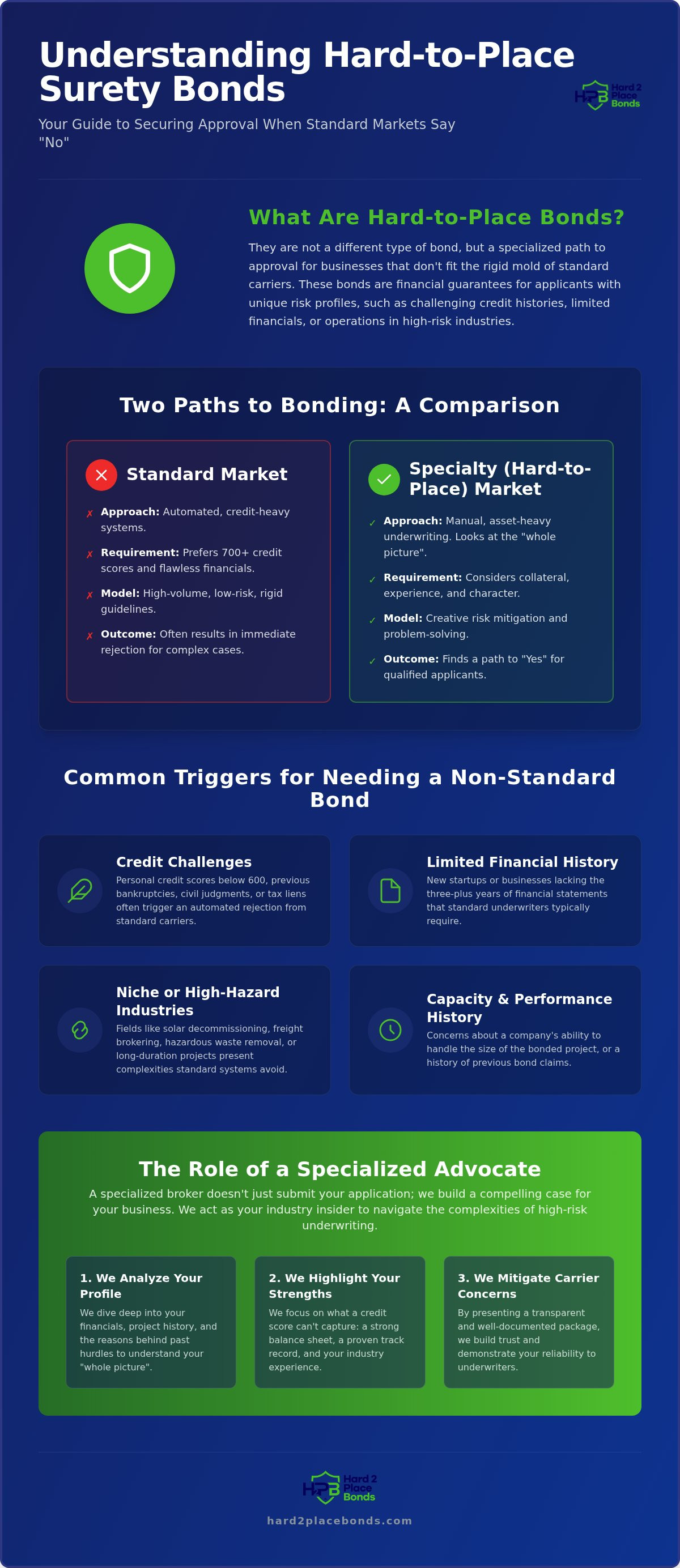
The standard market operates on a high-volume, low-risk model. They prefer applicants with 700+ credit scores and years of flawless financial statements. When you step into the non-standard market, the conversation changes. It's no longer just about a credit score. It's about finding a path to "yes" through creative risk mitigation. Understanding what a surety bond is helps clarify this relationship; it's a three-party agreement where the surety guarantees your performance to a third party. In the hard-to-place space, the surety takes a more hands-on approach to make that guarantee possible. This shift from automated rejection to manual review is often a massive source of emotional relief for owners who thought they were out of options. Instead of a door slamming shut, you find a partner willing to look at the collateral, experience, and character that a credit score simply cannot capture.
The Role of the Specialty Underwriter
Specialty underwriters don't just look at a computer-generated score. They look at the "whole picture" of your business. This manual process allows them to consider your assets, your project history, and the specific reasons behind past financial hurdles. As a specialized broker, Hard 2 Place Bonds acts as your industry insider. We don't just pass along an application; we advocate for your business. We help carriers understand the context of your situation, transforming a stack of paperwork into a compelling case for approval. When asking what are hard to place surety bonds , the answer often lies in the quality of the advocate standing between you and the carrier. We work to mitigate the carrier's concerns by highlighting your strengths, whether that's a strong balance sheet or a proven track record in a difficult niche.
Who Needs a Non-Standard Bond?
Several factors can trigger the need for a non-standard approach. New startups often lack the three years of financial history standard carriers demand. Businesses in niche industries, such as those requiring solar decommissioning bonds or specialized freight broker bonds, also frequently find themselves in this category. Whether you are dealing with contract risks in construction or need specific contractor license bonds, the non-standard market is designed to bridge the gap. For more information on the process, you can explore our guide on obtaining a surety bond to see how we navigate these hurdles together. We focus on the possibilities, identifying the candidates who have the capacity to perform even if their financial background has a few scars.
Why Bonds Become "Hard to Place": Risk Factors and Triggers
Why do standard carriers say no? It usually comes down to specific risk triggers that automated systems aren't programmed to handle. When you're asking what are hard to place surety bonds , you're really identifying the variables that push your application out of the "safe" zone. These variables range from personal financial history to the inherent volatility of your specific industry. Standard markets prefer predictable, low-risk profiles. When your business presents a more complex story, you need a different approach to underwriting.
Credit Challenges and Financial History
Credit scores are the primary gatekeeper in the bonding world. For most standard carriers, a personal credit score below 600 results in an immediate, automated rejection. These systems don't look at the story behind the number or the context of your business success. If you've dealt with previous bankruptcies, civil judgments, or tax liens, you're viewed as a higher risk for indemnity. However, these obstacles don't have to stop your operations. You can still secure payment bonds with bad credit by working with underwriters who specialize in manual reviews. These specialists look at your current liquidity and character rather than just a three-digit number. For small businesses struggling with these hurdles, the SBA's Surety Bond Guarantee Program can provide an essential safety net by backing the bond and reducing the carrier's risk.
Niche Industries and High-Hazard Risks
Sometimes the challenge isn't your history; it's the nature of your work. High-hazard risks include fields like hazardous waste removal or massive infrastructure projects with long durations. Underwriters often shy away from these because the potential for a claim is perceived as higher. In 2026, renewable energy projects face unique scrutiny. Securing solar decommissioning bonds requires a broker who understands the evolving state-level regulations and the long-term nature of these obligations. Similarly, freight brokers seeking BMC-84 authority often face hurdles if they have limited history in the logistics space. The Federal Motor Carrier Safety Administration (FMCSA) updated regulations in January 2026, requiring these bonds to be held in liquid form. This change has made it even more difficult for new brokers to find standard approvals without a specialized advocate.
Financial statement weaknesses, such as low liquidity or high debt-to-equity ratios, also trigger the "hard to place" label. Standard underwriters want to see that you have enough cash on hand to handle unexpected project costs. If your balance sheet looks tight, they assume you won't be able to honor the indemnity agreement if a claim arises. We focus on finding the strengths in your business that a standard computer program ignores. If you're ready to move past the rejections and find a path to approval, you can start your application today to see which non-standard solutions fit your current needs.
Standard vs. Non-Standard Underwriting: How Approvals Happen
Standard underwriting is a binary system. It's built for speed and high volume, relying almost entirely on algorithms. If you don't hit a specific credit mark, the system simply spits out a denial. When you explore what are hard to place surety bonds , you're entering a world where human judgment replaces these rigid algorithms. Instead of a simple pass or fail, a non-standard underwriter asks, "Under what conditions can we approve this?" This shift in perspective is the foundation of the non-standard market. It allows for a more nuanced look at your business, focusing on your future potential rather than just a historical snapshot.
To reach an approval, underwriters weigh the "Three Cs" of surety: Character, Capacity, and Capital. Character evaluates your integrity and history of fulfilling obligations. Capacity looks at your experience and physical ability to complete the specific work. Capital measures your financial resources and liquidity. In the non-standard space, if one "C" is weak, like Capital due to a credit hiccup, the underwriter looks for extra strength in the others to balance the risk. They use higher premiums to offset this increased exposure, ensuring that even businesses with specialized challenges can still secure the guarantees they need to operate.
The "Manual" Underwriting Advantage
A manual underwriter acts as a detective. They want to hear the story behind a business setback, such as a one-time legal dispute or a temporary market downturn that affected your cash flow. By providing supplemental information, such as detailed project histories or proof of resolved tax issues, you help mitigate their perceived risks. This is a consultative process. Obtaining a surety bond through a specialist means you aren't just a file in a stack; you're a business owner with a narrative that deserves to be heard. This advocacy is what turns a standard "no" into a non-standard "yes."
Key Differences in Bond Terms
Because the risk profile is different, the terms of your bond will reflect that reality. You'll likely see premium rates that are higher than standard market averages. These rates provide the carrier with the necessary cushion to take on more complex files. In some cases, an underwriter might require collateral or "funds control" to ensure project money is allocated correctly. They might also suggest personal indemnification or adding a cosigner to strengthen the application. For many small firms, the SBA Surety Bond Guarantee Program is a vital tool. It provides a government backstop that gives carriers the confidence to approve what are hard to place surety bonds for contractors who would otherwise be locked out of the market. These creative structures ensure your business stays compliant and competitive.
Solutions and Strategies to Secure a Non-Standard Bond
Securing an approval when your business doesn't meet standard criteria requires a shift in strategy. It's about proactively addressing the carrier's concerns before they have a chance to issue a denial. If you're still asking what are hard to place surety bonds in a practical sense, think of them as bonds that require a structured, multi-step approach to risk management. Success in this market isn't about finding a loophole; it's about building a case that proves your reliability despite past challenges or niche industry risks.
- Partner with a specialist: Standard brokers often lack the relationships with non-standard carriers. A specialized advocate knows which markets are currently hungry for specific risks.
- Build a transparent narrative: Don't just submit a credit report. Provide a written explanation for financial setbacks, such as a localized economic downturn or a resolved legal dispute. Showing a clear recovery path can sometimes prevent the need for more restrictive measures.
- Use risk-mitigation tools: Tools like funds administration show the surety you're serious about project compliance.
- Evaluate collateral: Be prepared to discuss Irrevocable Letters of Credit (ILOC) or cash equivalents if the risk profile remains high.
- Leverage government backing: The SBA Surety Bond Guarantee program remains a powerful tool for contractors who need an extra layer of security to qualify.
Utilizing Funds Control and Administration
Funds control is a common requirement for contract surety bonds in the high-risk space. This process involves a third-party administrator who ensures that project payments are first used to pay subcontractors and material suppliers. While it adds a layer of oversight, the benefits for you are significant. It drastically reduces the surety's risk, which often leads to increased bonding capacity for larger projects that would otherwise be out of reach. It's a professional way to demonstrate that your project's cash flow is managed with absolute integrity.
Collateral and Creative Credit Solutions
In the 2026 surety market, acceptable collateral typically includes cash, certificates of deposit, or ILOCs from approved financial institutions. This isn't a permanent loss of capital; it's a temporary security deposit. Once you've met all bond obligations and the carrier is released from liability, the "collateral return" process begins. For businesses with weak balance sheets, using personal assets as a bridge can sometimes secure an approval that would otherwise be impossible. This creative approach shows the underwriter you have "skin in the game," which builds the trust necessary for a non-standard approval. If you're tired of the rejections and want a professional to review your options, you can submit your details for a professional review today.
Navigating the High-Risk Surety Market with a Specialized Advocate
A standard rejection letter can feel like a final verdict on your business's future. However, in the specialty market, a "no" from a traditional carrier is often just the beginning of a deeper, more productive conversation. When you're dealing with the complexities of what are hard to place surety bonds , you need an advocate who doesn't just see a risk, but sees a viable solution. We provide national reach across the United States, ensuring that jurisdictional hurdles don't stop you from expanding your operations or bidding on work in new territories. By securing these non-standard approvals, you preserve your ability to compete for lucrative contracts and maintain the licenses necessary to stay in business. Our role is to act as your persistent ally, navigating the hurdles that standard systems simply aren't equipped to handle. We focus on your capacity and character, ensuring that your business isn't defined by its past setbacks but by its current potential.
Beyond Construction: Commercial Bond Expertise
While many business owners associate bonding challenges strictly with the construction industry, the commercial sector faces similar hurdles every day. We provide specialized advocacy for motor vehicle dealer bonds and freight broker bonds, where credit scores or limited history often trigger automatic denials in the standard market. If you're operating in a niche field, our deep expertise in solar decommissioning bonds saves you significant time in the permitting process by speaking the language of renewable energy underwriters. We also help professionals secure contractor license bonds even when they're facing significant credit hurdles or previous financial disputes. This specialized placement ensures that your business remains compliant and ready to grow, regardless of the industry's specific volatility or regulatory changes.
Starting Your Application with Confidence
We know that when you need a bond, you usually need it immediately to meet a deadline or secure a contract. Our intake process is designed to be quick and efficient, respecting both your time and the urgency of your business situation. You won't find a faceless corporate entity here. Instead, you'll find a team that offers empathetic reassurance combined with the professional authority needed to get results. We understand the stress of a high-stakes business environment and are here to guide you through every step of the process. Understanding what are hard to place surety bonds is the first step, but having a partner to secure them is the final one. If you're ready to stop feeling marginalized by traditional systems and want to see what's truly possible for your company, start your specialized bond application today. Let's turn your standard rejection into a definitive approval.
Moving Beyond Rejections to Business Approvals
A standard market rejection doesn't have to be the final word on your contract or license. As we've explored, the non-standard market operates on the belief that every business owner deserves a fair review of their whole story. Understanding what are hard to place surety bonds is the first step toward reclaiming your company's momentum. Whether you're navigating a credit score as low as 500 or managing complex requirements for solar decommissioning and freight broker bonds, there's always a path forward through creative risk solutions. Finding a partner who actually listens can turn a stressful setback into a definitive approval.
We're here to act as your tenacious advocate with a national reach that covers your operations across the United States. Our team focuses on possibilities, using manual underwriting to bridge the gap between where you are and where you need to be. You don't have to navigate these hurdles alone or feel marginalized by automated systems that don't see your potential. Take the next step toward securing your business's future and bid with confidence. It's time to move past the limitations of the standard market and find the support your business deserves.
Get Your Hard-to-Place Bond Quote Now
Frequently Asked Questions
Can I get a surety bond with a 500 credit score?
Yes, you can secure bonding even with a 500 credit score. Specialized underwriters perform manual reviews that prioritize your current financial liquidity and professional character over a single three-digit number. While standard markets use automated systems to reject lower scores, the non-standard market looks for ways to mitigate risk through creative solutions. This allows you to maintain compliance and continue bidding on projects despite past credit challenges.
Why do some surety bonds require collateral?
Collateral serves as a security deposit that offsets the increased risk an underwriter takes when approving a non-standard application. It provides the surety company with a financial cushion in case of a claim. This is common for businesses with low credit scores or those operating in volatile industries like solar decommissioning. Once you meet all bond obligations and the carrier is released from liability, the collateral return process begins.
What is the difference between a standard and a hard-to-place bond?
The primary difference lies in the applicant's risk profile rather than the bond itself. Standard bonds are for low-risk principals with high credit scores and long financial histories. If you're wondering what are hard to place surety bonds , they are specialized solutions for those who fall outside these rigid guidelines. They require manual underwriting and often involve higher premiums or collateral to account for the increased risk of the principal.
How long does it take to get approved for a high-risk surety bond?
Approval times vary depending on the complexity of your situation, but you can typically expect an initial quote within 24 to 48 hours. Because these bonds require a manual review of your whole picture rather than a quick computer scan, the process is slightly more involved. Providing a transparent financial package and explaining previous setbacks upfront can significantly speed up the intake process and lead to a faster definitive approval.
Will my bond premium decrease if my credit score improves later?
Yes, your premium can decrease during the renewal process if your financial standing improves. Surety bonds are typically renewed annually; this gives you a chance to demonstrate better credit scores or increased liquidity. If you've successfully managed your projects and improved your credit over the year, your broker can advocate for a lower rate or move you into a more standard market tier with better terms.
Can a new business without project history get a performance bond?
Yes, new businesses can secure performance bonds, though it often requires specialized solutions like funds administration or the SBA Surety Bond Guarantee Program. Since you lack a long track record, underwriters look for other signs of capacity, such as the owner's personal experience in the industry. These creative credit solutions bridge the gap; they allow startups to bid on larger contracts and build the history they need for future standard approvals.
What happens if I am denied a bond by a standard insurance agent?
A denial from a standard agent is often just a sign that your profile doesn't fit their automated criteria. It's not a final verdict on your business. When this happens, you should partner with a specialized advocate who has access to high-risk markets. We focus on finding the path to "yes" by highlighting your strengths and character, turning a standard rejection into a solution-oriented partnership that keeps your business moving forward.
Are hard-to-place bonds available for all types of industries?
Yes, these specialized approvals are available across a wide range of industries, from construction to logistics. Whether you need a contractor license bond or you're a freight broker seeking BMC-84 authority, there are non-standard options available. Understanding what are hard to place surety bonds means recognizing that these solutions exist for almost any business that faces credit hurdles or operates in a niche, high-hazard sector that standard carriers ignore.