Most underwriters see your new venture as a high-risk liability before they even read your business plan. It's a harsh reality, but in 2026, being "unproven" is often the quickest path to a standard rejection. You've likely felt the frustration of needing a license to operate while being told you don't have enough history to qualify for a surety bond for startups. It's a cycle that feels designed to keep you from ever getting off the ground, especially if your personal credit isn't perfect.
We believe that every entrepreneur deserves a path forward. This guide shows you exactly how to bridge the trust gap with underwriters and secure the bonding you need. You'll learn how to utilize specialized resources like the SBA Surety Bond Guarantee program, which recently increased contract limits to 9 million dollars for non-federal projects. We'll walk through the approval process step-by-step, helping you move past the anxiety of rejection and toward the professional license that lets you start operating. Your business has potential, and we're here to help you prove it.
Key Takeaways
- Learn how a surety bond serves as a financial guarantee that verifies your professional legitimacy to state and local regulators.
- Understand the "Three Cs" of underwriting and how founders can use personal financial history to overcome a lack of business age.
- Identify the specific license and permit requirements for your industry to ensure you apply for the correct bond type the first time.
- Navigate the approval process for a surety bond for startups by focusing on specialized underwriting paths designed for new businesses.
- Gain a competitive edge by leveraging your bonding status as a mark of reliability when marketing to your very first clients.
What is a Surety Bond for Startups and Why is it Necessary?
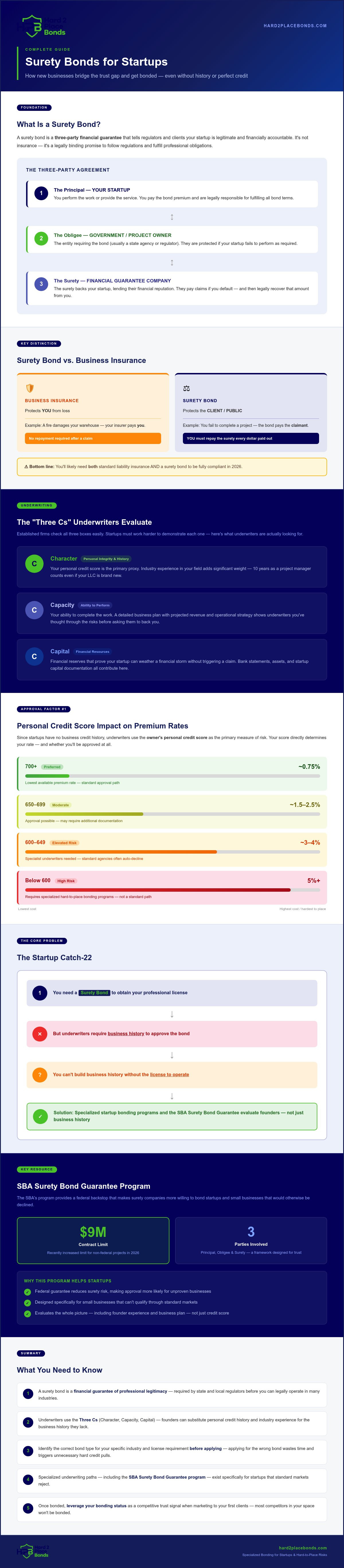
Launching a new business involves proving you are reliable before you've had a single day of operation. For many industries, a surety bond for startups is the primary tool used to bridge this credibility gap. Unlike a simple insurance policy, this bond acts as a financial guarantee that you will follow state regulations and fulfill your professional obligations. It's essentially a "letter of credit" issued by a third party that tells regulators and clients that you are legitimate and financially backed. A startup surety bond is a risk-mitigation tool required for legal compliance or contract bidding that ensures your new company meets its promises to the public or government.
To understand What is a Surety Bond on a foundational level, you have to look at it as a three-way relationship rather than a two-party transaction. While you might feel like you're just buying a piece of paper, you're actually entering a legal contract that binds your startup to a set of standards. This requirement exists because the state or your clients need a way to ensure that if your startup fails to meet its duties, there is a pool of money available to compensate them. It's about protecting the consumer from the inherent risks of working with an unproven entity.
The Three-Party Agreement Structure
Every bond involves three distinct roles that work together to create a safety net for the marketplace. Understanding these roles helps you see why the underwriting process is so thorough for new firms.
- The Principal: This is your startup. You are the party performing the work or providing the service. You're responsible for fulfilling the terms of the bond and paying the premium.
- The Obligee: This is the entity requiring the bond, usually a government agency or a project owner. They are the ones protected by the bond if you fail to perform.
- The Surety: This is the financial company that backs your startup. They provide the guarantee to the obligee that you'll perform as promised.
Surety Bonds vs. Traditional Business Insurance
Confusion between insurance and bonding is common, but they serve opposite purposes. Insurance protects you from loss; a surety bond protects the consumer and the public. If a fire damages your warehouse, your insurance pays you. If your startup violates a license requirement or fails to complete a project, the surety bond pays the claimant. You'll likely need both standard liability insurance and a bond to be fully compliant in 2026.
The role of indemnity is the biggest difference you'll encounter. While an insurance company doesn't expect you to pay back a claim, a surety company does. You are legally obligated to reimburse the surety for every dollar they pay out on your behalf. This is why obtaining a surety bond feels more like a credit application than a simple purchase. The surety is effectively lending you their financial reputation, and they want to be sure you're a safe bet.
Why Startups Often Face Challenges with Surety Bond Approval
Most traditional underwriters operate on a rigid set of criteria known as the "Three Cs": Character, Capacity, and Capital. For an established firm, these are easy to verify through years of tax returns and project history. For a new business, however, the lack of a track record often leads to an immediate "no." When you apply for a surety bond for startups, the underwriter isn't just looking at your business plan; they are looking for evidence that you won't trigger a claim they have to pay out. Without historical data, they view your venture as an unproven risk that lacks the necessary capacity and capital to weather a financial storm.
This creates a frustrating catch-22 for many entrepreneurs. You need a bond to get your professional license, but you can't build the business history required for the bond without that license. In many cases, standard agencies rely on automated systems that issue instant denials the moment they see "zero years in business." We believe this approach is short-sighted. Understanding the nuances of obtaining a surety bond requires a consultative look at your specific situation rather than a generic algorithm's judgment.
The "Unproven Risk" Factor for New Businesses
Standard surety markets are built on predictability. When a company has no financial history, underwriters shift their focus to the individual founders. They examine your industry experience to determine if you have the "Capacity" to succeed. If you're starting a construction firm but have ten years of experience as a project manager, that carries weight. However, without a detailed business plan that outlines your projected revenue and operational strategy, most carriers will still hesitate. They want to see that you've thought through the risks before they put their financial reputation on the line for you.
Personal Credit Score Barriers
Since a startup has no credit profile of its own, underwriters use the personal credit scores of the owners as a proxy for business reliability. In 2026, this remains the most significant factor in determining your approval odds and your premium. If your score is above 700, you might see rates as low as 0.75%. However, if you've faced financial challenges and your score is below 600, you move into the high-risk category. In this bracket, premium rates often jump to 5% or even 15% of the bond amount.
Many founders feel marginalized by this system, especially if a past personal setback is now blocking their professional progress. Standard brokers often walk away from these "hard-to-place" cases because they require more manual work. This is where specialized commercial surety bonds and expert advocacy become essential. You don't have to let a credit score define your business's future. If you're ready to move past the automated denials, you can submit your application details to see what options are actually available for your unique profile.
Step-by-Step Guide: How to Get a Surety Bond for Your Startup
Securing a surety bond for startups shouldn't feel like a mystery. While the process is rigorous, it follows a logical sequence that you can navigate with the right preparation. Your first step is to identify the exact bond requirement. This information usually comes from the state licensing board or the specific government entity you're working with. Once you know if you need a license bond or a specialized contract guarantee, you can begin the work of proving your reliability to an underwriter. This is where your preparation pays off, moving you from an "unproven risk" to a bonded professional.
After identifying the bond type, you'll need to gather your documentation and apply through a broker who understands the startup landscape. Don't settle for the first agency you find. You want a partner who looks at your application as a consultative conversation rather than a data entry task. Once an underwriter reviews your file, they will issue a quote and an indemnity agreement. This agreement is a legal contract where you promise to reimburse the surety for any claims paid out. After you sign the paperwork and pay the premium, the bond is issued, and you can file the original document with the obligee to finalize your legal compliance.
Preparing Your Startup Financial Documentation
Underwriters are essentially looking for stability. Since your business is new, they will lean heavily on your personal and professional history. Having these items organized before you start application procedures will significantly speed up the approval time. We recommend building a "bonding file" that includes:
- Personal tax returns for all owners from the last two years.
- Recent personal bank statements to demonstrate your current liquidity.
- A professional resume that highlights your specific industry experience.
- Business organizational documents, such as your LLC agreement or Articles of Incorporation.
Presentation matters. If you have a decade of experience in your field, lead with that. It demonstrates the "Capacity" that underwriters crave. A clean, well-organized package signals that you are a professional who manages their affairs with care, which can often sway an underwriter who is on the fence about a new venture.
Choosing the Right Surety Broker
The biggest mistake a founder can make is treating a surety bond like a standard insurance purchase. Most general insurance agents focus on home, auto, or general liability. They rarely have the deep relationships with non-standard markets required to secure a surety bond for startups with no history. If a broker only works with "standard" carriers, they'll likely give you an instant denial the moment they see a low credit score or a new business date.
Ask potential brokers if they specialize in "hard-to-place" risks. You want an advocate who can access niche markets and programs like the SBA Surety Bond Guarantee. National reach is also a major advantage. If your startup plans to grow, you'll eventually need contractor license bonds or other guarantees in multiple states. A specialized broker can manage that growth with you, ensuring your bonding capacity keeps pace with your ambition.
Common Types of Surety Bonds Startups Need in 2026
Every industry has its own "admission ticket" to the marketplace. For most service-based startups, this is a license and permit bond. It ensures you follow local ordinances and building codes while protecting the public from financial loss. If you're entering more specialized fields, the requirements become more technical. A surety bond for startups acts as a seal of approval from a financial institution, telling your customers that you have the backing to stand behind your work. With the surety market projected to grow to over 22 billion dollars by the end of 2026, the variety of bond types has expanded to match new industrial demands.
Financial guarantee bonds are also becoming more common in high-stakes sectors like telecommunications and energy. These bonds ensure that your startup will meet its financial obligations, such as paying utility bills or taxes. Because these bonds carry a higher risk of payout, they are often the most difficult for new businesses to secure. However, finding the right path to approval is essential because, without these guarantees, you simply cannot legally operate in many jurisdictions. Identifying your specific bond type early allows you to build the cost into your initial capital requirements.
Bonds for Construction and Development
Winning that first big contract is the ultimate goal for a new construction firm. But you can't even get your foot in the door without a bid bond. This guarantee tells the project owner that if you win the contract, you'll actually accept the job and provide the necessary follow-up bonding. It prevents startups from bidding on projects they aren't equipped to handle. Once you secure the job, payment and performance bonds become the standard. These ensure the project is finished according to the contract and that all your suppliers and subcontractors get paid. If you are a developer starting a new housing project, you'll also need site improvement and subdivision bonds to guarantee that public infrastructure like sidewalks and sewers are completed to city standards.
Niche Industry Bonds (Freight, Auto, Solar)
Logistics and green energy are seeing massive growth in 2026, creating new opportunities for entrepreneurs. If you're launching a freight brokerage, the FMCSA requires a 75,000 dollar freight broker bond. This can be a major hurdle for new firms with limited cash flow. Similarly, new car lots need motor vehicle dealer bonds to protect consumers from title fraud and unethical sales practices. We're also seeing a surge in environmental requirements. Many local governments now demand solar decommissioning bonds to ensure that solar farms are properly dismantled at the end of their lifecycle. These niche requirements often catch founders off guard, but they are essential for legal operation. If you're unsure which bond fits your specific industry, you can submit your business details here for a professional review of your requirements.
Securing Success: Strategies for High-Risk Startup Bonding
Receiving a rejection letter from a standard surety carrier can feel like a door slamming shut on your business dreams. It's a common experience for entrepreneurs who discover that a "standard" agency simply isn't equipped to handle the complexities of a new venture. However, a "no" from a generic automated system is often just the beginning of a more consultative process. Securing a surety bond for startups requires a strategy that looks beyond a simple credit score to highlight your professional potential and industry expertise. By working with a tenacious advocate, you can find alternative paths to approval that standard brokers ignore.
Beyond legal compliance, a bond serves as a powerful marketing tool. When you tell a prospective client that you are fully bonded, you're providing third-party verification of your business's stability. In a competitive 2026 marketplace, this distinction can be the deciding factor for a customer choosing between you and another unproven firm. As you plan your launch, understanding how much is a surety bond is a critical step for your initial budget. While high-risk premiums can range from 5% to 15% of the bond amount, this cost is a necessary investment in your startup's long-term credibility.
The Advantage of Specialized Broker Advocacy
A specialized broker doesn't just submit a form; they build a case for your business. We act as creative problem-solvers who know how to present your startup's potential to underwriters in a way that minimizes perceived risk. If your personal credit is a barrier, we explore solutions such as the SBA Surety Bond Guarantee program, which currently offers a 0.6% guarantee fee for final performance bonds. Other strategies might include:
- Utilizing a qualified co-signer to strengthen the financial profile of the application.
- Providing collateral to secure the bond in high-stakes industries.
- Highlighting specific past project successes to demonstrate your operational capacity.
Building Business Credibility Over Time
Your first surety bond for startups is just the starting line. As you complete projects and fulfill your obligations without claims, you build a "bonding history" that is just as valuable as a traditional credit score. This history allows you to eventually move out of high-risk programs and into standard market rates. Over time, you'll be able to transition to larger contract surety bonds, allowing you to bid on more significant projects and scale your operations across the country. We are here to guide you through every stage of this growth, from your very first license to your largest federal contract. Don't let an initial setback stop your progress. Get your startup bonded today and take the first step toward a fully licensed and operational business.
Launch Your Vision with Confidence
Standard markets might see a new business as an unproven gamble, but we see an opportunity for growth. Securing a surety bond for startups is about more than just checking a box for a regulator; it's about finding a partner who understands the unique demands of niche industries like solar or freight. We specialize in high-risk and bad credit approvals because we believe that a personal financial setback shouldn't block your professional progress. With our national reach across all 50 states, we have the expertise to navigate the most complex commercial and contract requirements.
You've already done the hard work of building a vision for your company. Now, it's time to bridge the gap between "unproven" and "operational." By focusing on specialized underwriting and creative solutions, we help you secure the bonding you need to compete and win. Don't let an automated denial from a generic agency stop your momentum. Our team is ready to act as your advocate, turning a difficult approval process into a clear path forward for your venture.
Secure your startup’s future—start your bond application now . Your business has potential, and we're here to help you prove it to the world.
Frequently Asked Questions
Can I get a surety bond for a startup with no business history?
Yes, you can secure a bond even without a prior track record. Underwriters will evaluate the individual founders' professional backgrounds and personal financial stability when a company lacks history. This consultative approach allows us to secure a surety bond for startups that standard agencies might reject because they only look at business age.
How much does a startup surety bond typically cost?
Premium rates are a percentage of the total bond amount, typically ranging from 0.75% to 15% depending on your credit profile. For those with scores above 700, rates are generally on the lower end of that spectrum. High-risk applicants with scores below 600 will see higher premiums because the perceived risk to the surety is greater.
Will my personal credit score affect my startup's bond approval?
Yes, your personal credit score is the most significant factor in the underwriting process for a new venture. Since the business has no track record, underwriters use your personal financial history as a proxy for how you'll handle business obligations. A lower score doesn't mean an automatic denial, but it does mean you'll likely need a specialized high-risk program.
What happens if my startup's surety bond application is denied?
A denial from a standard carrier isn't the end of the road. It simply means you need to work with a specialized broker who has access to non-standard and high-risk markets. We focus on finding alternative paths and advocating for your specific situation rather than relying on the automated systems that most general agencies use.
Do I need to provide collateral for a startup surety bond?
Collateral isn't always required, though it can be a tool used to secure approval for high-risk or very large bonds. Many founders utilize the SBA Surety Bond Guarantee program to avoid heavy collateral requirements on contract-based work. We always look for the least restrictive path to approval to keep your capital free for operations.
How long does it take to get a bond issued for a new business?
Most license and permit bonds can be issued within 24 to 48 hours once all documentation is received. Larger contract bonds, such as bid or performance bonds, may take several days. This extra time is necessary because they require a deeper review of your business plan, resumes, and personal financials to ensure a successful outcome.
Is a surety bond the same as business liability insurance?
No, they serve completely different purposes. Insurance protects your business from losses like property damage or accidents, while a surety bond for startups protects your customers and the public by guaranteeing your professional performance. You'll likely need both to stay fully compliant with state and local regulations in 2026.
Can I get a bid bond for my startup's first government contract?
Yes, you can qualify for a bid bond even on your very first project. Programs like the SBA guarantee help new firms access contracts up to 9 million dollars for non-federal work. This provides the financial backing you need to compete with established companies and start building your business history through successful project completion.