
A credit score under 600 isn't a death sentence for your construction business, even if every big agency's automated system says otherwise. You've worked hard to build your reputation on the job site, so it feels like a punch in the gut when a past financial setback threatens your ability to pull permits or keep your license active. It's frustrating to be reduced to a three-digit number by a computer that doesn't understand the construction industry.
The good news is that securing a contractor license bond with bad credit is entirely possible when you work with the right partners. You don't have to close your doors because of a low score or a few missed payments in your past. This guide will show you the exact steps to navigate high-risk underwriting, find a broker who actually listens to your story, and secure the bond you need to stay compliant. We'll also explain how to position your business for lower rates as your financial health improves, ensuring your business stays on solid ground for years to come.
Key Takeaways
- Realize that a low credit score is a common hurdle rather than a permanent barrier to your licensing goals.
- Discover how specialized underwriting makes securing a contractor license bond with bad credit possible by using manual reviews instead of automated denials.
- Learn how the "risk premium" affects your costs and what to expect regarding premium ranges for high-risk bonds.
- Master a five-step roadmap that prepares you to move quickly from a standard rejection to a successful bond issuance.
- Understand the importance of working with a broker who advocates for your business and helps you navigate complex construction requirements.
The Reality of Getting a Contractor License Bond with Bad Credit
Facing a licensing deadline is stressful enough without the added weight of a low credit score. You might feel like you're stuck in a loop of automated rejections, watching your business goals slip away because of a three-digit number. It's a common frustration in the construction industry. Many talented contractors find themselves sidelined by standard agencies that rely on rigid algorithms. However, a low score is a hurdle, not a permanent wall. Securing a contractor license bond with bad credit is a challenge thousands of professionals overcome every year by shifting their focus from standard carriers to specialized underwriters.
A Surety bond is fundamentally a regulatory tool designed for consumer protection. It acts as a guarantee to the state licensing board that you'll follow local regulations and fulfill your professional obligations. Unlike insurance, which protects you from loss, this bond protects the public. Because the surety company is essentially co-signing for your business, they want to know you're a reliable partner. Standard carriers often see a low credit score and walk away, but specialized brokers see an opportunity to advocate for your business's future.
Why Your Credit Score Matters to Surety Companies
From a surety's perspective, your credit score serves as a proxy for financial responsibility. They use this data to assess the risk of a claim being filed and, more importantly, the likelihood that you'll reimburse them if they have to pay out. It's a financial guarantee. If your history shows late payments or high debt, standard underwriters assume there's a higher risk of default. They don't always take the time to look at the context of your situation. It's also vital to understand that tax liens or civil judgments often carry more weight than a few missed credit card payments. These items suggest a direct legal obligation that hasn't been met, which can make standard companies even more hesitant to offer a contractor license bond.
Common Financial Hurdles for High-Risk Contractors
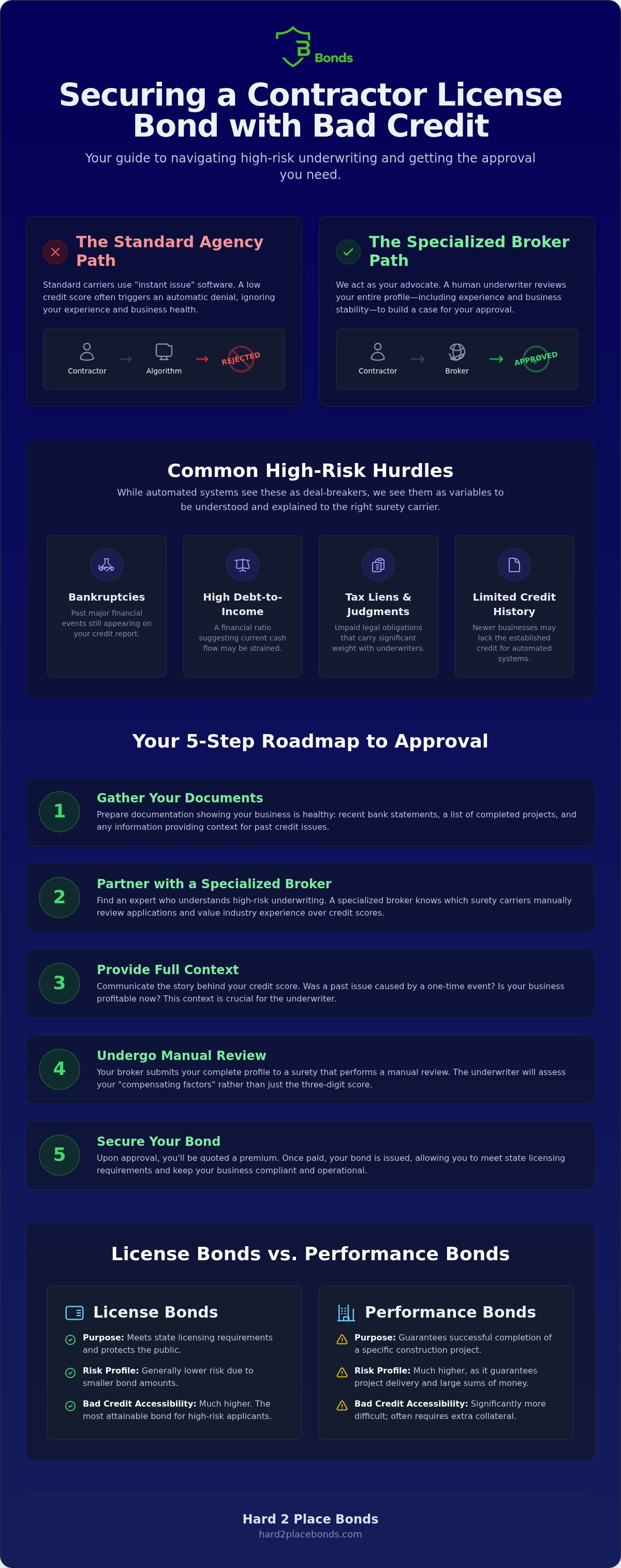
Several factors can push a contractor into the "high-risk" category. These often trigger immediate, automated denials in traditional systems:
- Past bankruptcies or foreclosures that are still appearing on your report.
- High debt-to-income ratios that suggest financial strain.
- Unpaid tax liens or active civil judgments.
- A lack of established credit history for newer business owners.
Don't let these hurdles discourage you. While standard agencies might see these as deal-breakers, they're simply variables that require a more nuanced approach. Navigating a contractor license bond with bad credit requires a partner who understands that your past doesn't have to define your professional future. By moving away from automated systems and toward manual, expert-led underwriting, you can find a path to approval that keeps your business moving forward.
How Specialized Underwriting Secures Your Approval
Standard insurance agencies often rely on "instant issue" software. These programs are designed for speed, not for problem-solving. If your credit score doesn't meet a specific threshold, the system triggers an automatic denial. For a professional seeking a contractor license bond with bad credit , this feels like hitting a brick wall. Specialized underwriting takes a different path. It's a manual, expert-led process where a human underwriter reviews your entire profile rather than just a three-digit score.
Specialized brokers act as your advocate. We don't just pass along a form; we build a case for your approval. We highlight your industry experience, your professional reputation, and the steps you've taken to resolve past financial issues. This level of advocacy is what turns a "no" into a "yes" at the carrier level. Carriers that specialize in hard-to-place risks value your ability to run a successful job site more than a perfect credit history.
Manual Review vs. Automated Denials
The "Hard 2 Place" approach focuses on the person behind the paperwork. We look for compensating factors that automated systems ignore. Perhaps a past bankruptcy was caused by a one-time medical crisis, but your current business operations are profitable and stable. Specialized surety bond placement acts as the bridge for high-risk applicants, connecting you with carriers that value character and industry longevity. This manual review process allows us to find solutions where others only see risk. It's about looking at where your business is going, not just where it's been.
License Bonds vs. Performance Bonds for Contractors
It's important to understand that not all bonds are created equal. License bonds are typically a baseline requirement to meet state licensing board requirements. Because these bonds usually involve smaller amounts and focus on general compliance, they're often easier to secure even with credit challenges. Performance bonds are different. They guarantee the completion of a specific project, which carries a higher risk profile for the surety. If you need a contractor license bond with bad credit , focusing on this regulatory requirement first is a smart move to keep your business legal. Learn more about contract surety bonds to understand how project-specific guarantees differ from your standard license bond.
If you've been frustrated by automated denials, it's time to speak with someone who understands your trade. You can start your application today and let our team advocate for your business.
Calculating the Cost of a Bad Credit Contractor Bond
Understanding the price of a contractor license bond with bad credit starts with the concept of a "risk premium." When a surety company agrees to bond a contractor with financial setbacks, they are taking on a higher level of perceived risk. To compensate for this, the annual premium is higher than what a contractor with an 800 credit score might pay. Typically, premiums for high-risk applicants range from 5% to 15% of the bond's total face value. While this is more expensive than standard rates, it's a necessary investment to keep your business active and compliant with state laws.
The total amount of the bond required by your state significantly impacts your annual cost. For example, a contractor in California must secure a $25,000 bond, while a general contractor in Washington now faces a $30,000 requirement as of July 2024. Because the premium is a percentage of these totals, a higher state requirement naturally leads to a higher out-of-pocket cost for the bond. If you're struggling to manage the full payment upfront, premium financing is often an option. This allows you to spread the cost over several months, easing the burden on your business cash flow. For some small businesses, exploring the SBA's Surety Bond Guarantee program can also provide additional support and pathways to bonding that might otherwise feel out of reach.
Factors That Influence Your Premium Rate
Your credit score isn't the only thing underwriters look at when determining your rate. They also consider the specific nature of your financial history. For instance, an open bankruptcy is viewed much differently than one that was discharged years ago. Underwriters also look at your years of experience in the construction trade. A seasoned veteran with twenty years in the field and a few recent credit hiccups often receives more favorable terms than a newcomer with the same score. State-specific regulations also play a role, as some jurisdictions have more stringent oversight, which can influence how surety carriers price their products.
How to Lower Your Bond Costs Over Time
Securing a contractor license bond with bad credit today doesn't mean you're locked into high rates forever. Bonds are typically renewed on an annual basis, which gives you a fresh opportunity to negotiate your premium every twelve months. As you resolve old debts, satisfy tax liens, or simply build a longer history of on-time bond payments, your risk profile improves. We encourage our clients to actively work on their credit health so they can transition into standard, lower-cost bonding programs in the future. Success in the high-risk market is often the first step toward qualifying for the most competitive rates available. You can learn more about the specific steps involved by understanding how to obtain a surety bond through our specialized process.
5 Steps to Get Approved for a Contractor Bond with Bad Credit
Moving from a rejection to an approval requires a shift in strategy. You need a clear plan that addresses the concerns of underwriters head-on. Transparency and preparation are your greatest assets when seeking a contractor license bond with bad credit . By gathering the right information upfront, you demonstrate professional responsibility that outweighs a simple credit score. This proactive approach shows the surety company that you're a serious professional who manages their obligations, even when things get tough.
Preparation and Application
Step 1: Identify your exact state licensing bond requirement. Requirements vary significantly by jurisdiction. For instance, California requires a $25,000 bond, while Washington recently increased its general contractor bond amount to $30,000 as of July 1, 2024. Knowing the exact obligation ensures you're applying for the correct product from the start.
Step 2: Gather documentation regarding past financial issues. If you have a discharged bankruptcy, keep those papers ready. If you're currently in a payment plan for back taxes, have that agreement on hand. Providing context for your financial marks shows underwriters that you're managing your obligations actively. Don't try to hide past mistakes; instead, show how you've resolved them.
Step 3: Partner with a high-risk specialist like Hard 2 Place Bonds. Standard agencies often lack the carrier relationships needed for difficult cases. We act as your ally, presenting your experience and professional character to carriers that specialize in non-standard risks. We understand the construction industry and know how to highlight your strengths to get you the coverage you need.
Approval and Issuance
Step 4: Review your quote and explore financing options. Once we've advocated for your case, you'll receive a quote based on the risk premium. If the upfront cost is a concern, we can often find financing plans to help you maintain compliance without draining your working capital. This helps you keep your cash flow steady while meeting your legal requirements.
Step 5: Sign the indemnity agreement and receive your bond for filing. The indemnity agreement is a critical legal document that serves as your promise to repay the surety company for any claims they pay out. Once signed and paid, your bond is issued, and you're ready to file it with your state licensing board. This final step secures your license and allows you to get back to work on the job site.
Don't let a past credit issue stop your business from growing. You can submit your application here and let our team find the right solution for your business.
Why High-Risk Contractors Choose Hard 2 Place Bonds
A rejection from a traditional bank or a standard insurance agency can feel like a dead end for your business. When you're told that your credit score makes you "unbondable," it's easy to feel marginalized by a system that doesn't see your potential. At Hard 2 Place Bonds, we operate on a different philosophy. We believe that a financial setback shouldn't prevent a skilled professional from working. Securing a contractor license bond with bad credit requires a partner who looks for possibilities rather than limitations. We specialize in turning those automated "no" responses into manual approvals through persistent advocacy and deep market knowledge. You deserve a broker who understands that your business is more than a credit report.
Expertise in Hard-to-Place Surety Solutions
Our team understands the nuances of niche construction markets. We know that your needs often go beyond a simple regulatory requirement. While many agencies struggle with a contractor license bond with bad credit , we have the infrastructure to handle even more complex requests. This includes helping you secure bid bonds for upcoming projects and payment and performance bonds to protect your contracts. If you're still unclear on how these different instruments interact, our Surety Bond Meaning: A Comprehensive Guide provides a deep dive into the mechanics of the industry. We use this expertise to navigate the hurdles that standard agencies simply avoid, ensuring you have the right financial guarantees for every stage of your business growth.
A National Advocate for Your Construction Business
We provide national coverage across the United States. This means we can help you stay compliant regardless of where your next job takes you. Our approach is defined by calm competence and a refusal to give up on difficult cases. We act as an industry insider who knows which carriers are willing to listen to your story. We don't just find you a bond; we find you a path forward. Our goal is to reduce the friction in your licensing process so you can focus on what you do best: building. We take pride in being the partner that sticks with you when others walk away. When you're ready to partner with a broker who values your tenacity and delivers results, you can start your high-risk bond application today and experience the relief of a solution-oriented partnership.
Get Back to the Job Site with Confidence
A low credit score shouldn't be a permanent barrier to your professional growth. You now understand that securing a contractor license bond with bad credit is a manageable process when you move away from automated systems and toward specialized, manual underwriting. By focusing on transparency and partnering with an advocate who understands the construction industry, you can meet state requirements and keep your business active. Remember that these bonds are renewed annually, giving you a recurring chance to lower your costs as your financial health improves.
Hard 2 Place Bonds stands as a national specialist in hard-to-place surety underwriting. We offer empathetic advocacy and a solution-oriented approach to ensure you aren't left behind by standard carriers. Our team is ready to help you navigate these hurdles with calm competence and reliable service across all 50 states. We look beyond the numbers to find the coverage that keeps your company moving forward.
Start your high-risk contractor bond application with Hard 2 Place Bonds and secure your license today. You've worked too hard to let a three-digit number stop your momentum. We're here to help you build a stronger future.
Frequently Asked Questions
Can I get a contractor license bond with a 500 credit score?
Yes, you can secure a contractor license bond with a 500 credit score by working with a specialist who utilizes manual underwriting. While standard agencies might decline you automatically based on a computer algorithm, high-risk programs look at your total professional history. We focus on your years in the trade and your current business stability to find a path to approval that keeps your license compliant.
How much more does a contractor bond cost if I have bad credit?
You'll pay a higher premium, often referred to as a risk premium, compared to contractors with excellent credit. While those with high scores might pay 1% to 3% of the bond amount, a contractor license bond with bad credit typically carries a rate between 5% and 15%. This increased cost allows the surety company to guarantee your obligations despite past financial challenges or credit setbacks.
Will a past bankruptcy prevent me from getting a contractor license bond?
A past bankruptcy won't necessarily stop you from getting bonded, especially if it has been discharged. Underwriters are more concerned with your current financial trajectory than mistakes from years ago. Providing discharge papers and showing a clean record since the filing helps demonstrate that you've regained your financial footing. This transparency makes you a more reliable risk in the eyes of the surety company.
Do I need to provide collateral for a high-risk surety bond?
Most contractor license bonds don't require collateral, even for high-risk applicants. Collateral is more common for large performance bonds or very high-limit guarantees. For standard state license requirements, the surety typically relies on your signed indemnity agreement as the legal promise to repay any claims. This means you don't have to tie up your business assets or cash to stay compliant.
How long does it take to get approved for a bad credit bond?
You can typically expect an approval within 24 to 48 hours when working with a specialized broker. Because bad credit cases require a manual review by a human underwriter, it takes slightly longer than an "instant issue" bond. However, having your financial documentation and state license information ready can speed up the process. This helps you meet tight licensing deadlines without unnecessary delays.
What happens if a claim is filed against my contractor license bond?
If a valid claim is filed, the surety company pays the claimant up to the bond amount and then seeks full reimbursement from you. It's vital to remember that a bond is not insurance for your business. The indemnity agreement you sign makes you legally responsible for every dollar the surety pays out. This includes any legal fees incurred during the claim investigation process.
Can I improve my bond rate if my credit score goes up next year?
Yes, you can qualify for a lower rate if your credit score improves before your next annual renewal. Bonds are not permanent contracts; they're reviewed every year. As you rebuild your credit and demonstrate a history of on-time bond payments, we can move your contractor license bond with bad credit into standard programs. This transition can lead to significantly lower premiums as your risk profile improves.
Are there financing options for high-risk surety bond premiums?
Financing options are frequently available to help you spread the cost of high-risk premiums over several months. This prevents a large upfront payment from straining your business cash flow. We understand that high-risk bonds represent a larger investment for your company. We work to find payment plans that make maintaining your license compliance affordable while you continue to grow your operations and build your reputation.