What if your credit score wasn't the final word on whether you can grow your construction business in 2026? Securing a payment bond with bad credit often feels impossible when standard brokers rely on automated systems that issue instant rejections. You've likely felt the sting of losing a lucrative contract just as it was within reach. It's frustrating to be sidelined by a financial history that doesn't reflect your current technical skills or your commitment to the project.
We believe that every professional deserves a path forward. This guide reveals how you can move past traditional hurdles to get the bonding you need. You'll learn how specialized underwriting looks at the bigger picture, what the total costs really look like, and how to find a partner who advocates for your approval. We'll help you understand the requirements clearly so you can stop worrying about the "no" and start focusing on the work ahead. By focusing on project-specific strengths rather than just a credit score, you can secure the necessary guarantees to keep your business moving.
Key Takeaways
- Master the "Three Cs" of underwriting to show carriers you have the character and capacity to finish the job regardless of your score.
- Learn why securing a payment bond with bad credit is a negotiation of risk mitigation rather than a binary credit check.
- Identify the specific differences between payment and performance bonds to ensure your project and your subcontractors are fully protected.
- Explore how tools like funds control provide the transparency needed to turn a standard rejection into a project approval.
- Discover how a specialized broker acts as your advocate by connecting you with niche markets that value your professional expertise.
What is a Payment Bond and Why Does Bad Credit Matter?
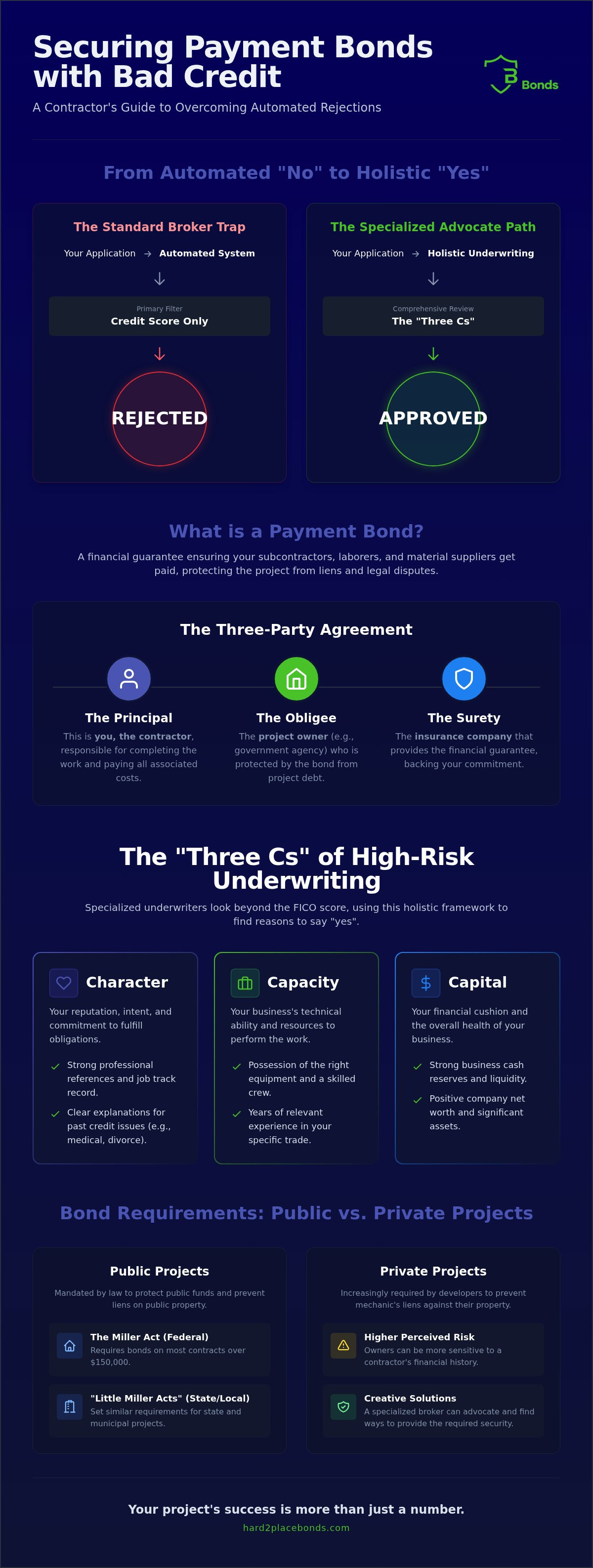
A payment bond is a financial guarantee that protects project stakeholders from the contractor’s insolvency. It acts as a safety net for the people who make your project possible. While you focus on the build, this bond ensures that your subcontractors, laborers, and material suppliers receive their agreed-upon payments. Without it, a project owner could face significant legal and financial headaches if you run into cash flow trouble. If you are seeking a payment bond with bad credit , you've likely realized that traditional sureties are hesitant to back you. They view a low credit score as a warning sign of potential liquidity issues. To an underwriter, a history of late payments or collections suggests a higher risk that you might not pay your crew or suppliers on time.
The requirement for these bonds isn't just a preference; it's often the law. The federal Miller Act requires payment bonds on most public work contracts that exceed $150,000. On the local level, "Little Miller Acts" in various states set similar requirements for state and municipal projects. These laws exist to prevent the government from being liable for unpaid bills on public land. Because subcontractors cannot file a mechanic's lien against public property, the payment bond serves as their primary protection. We understand that a past financial setback shouldn't permanently bar you from these essential contracts. Our goal is to help you present a case that looks beyond the credit report.
The Three-Party Agreement in High-Risk Bonding
Every payment and performance bond involves a specific legal structure. Understanding these roles helps you see why the surety is so careful about your financial history:
- The Principal: This is you, the contractor. You are the party with credit challenges who is responsible for fulfilling the contract and paying all associated costs.
- The Obligee: This is the project owner, often a government entity. They are the ones protected by the bond, ensuring the project stays free of debt claims.
- The Surety: This is the company that provides the financial guarantee. They stand behind you, promising the Obligee that everyone will be paid if you fail to do so.
Federal vs. Private Payment Bond Requirements
Federal projects follow the strict thresholds of the Miller Act, but private developers are increasingly requiring bonds too. In the private sector, developers use payment bonds to prevent mechanic's liens from being filed against their property. If a subcontractor isn't paid, they can't claim a piece of the building if a bond is in place. Interestingly, securing a payment bond with bad credit can sometimes be more difficult for private projects than public ones. Private owners often have less standardized risk mitigation strategies, making them more sensitive to a contractor's financial history. However, with the right advocate, you can still find creative ways to provide the security these developers demand.
How Surety Underwriters Evaluate High-Risk Payment Bond Applications
Standard carriers often use automated algorithms to issue an immediate "no" based solely on a FICO score. Specialized underwriters operate differently. They use a holistic approach known as the "Three Cs" to look for reasons to say "yes" even when you are applying for a payment bond with bad credit . This framework helps them understand the context behind the numbers and assess the actual risk of a claim.
- Character: This is about your reputation and intent. Underwriters want to know if you are a person who fulfills their obligations. If your credit score is low because of a specific life event, like a divorce or a past medical emergency, that tells a very different story than a pattern of financial neglect. They look at your professional references and your track record of completing previous jobs.
- Capacity: Can your business actually perform the work? If you have the right equipment, a skilled crew, and years of experience in your specific trade, your capacity to finish the project is high. This technical expertise can often outweigh a poor credit score in the eyes of a creative underwriter.
- Capital: This refers to your financial cushion. Your business liquidity and net worth can often offset personal credit challenges. If your company has strong cash reserves or significant assets, the surety feels more confident that your subcontractors and suppliers will be paid on time.
The Role of Personal vs. Business Credit
Personal credit scores often trigger high-risk underwriting, but they aren't the only metric that matters. Underwriters also examine business financials and Dun & Bradstreet reports to see how the company operates independently of the owner. If your business is healthy but your personal credit suffered, we can often bridge that gap. However, active tax liens, recent bankruptcies, or civil judgments require a clear explanation and a resolution plan. If you're ready to show the strength of your business beyond the score, you can begin your application today to see what options are available.
Project-Specific Risk Factors
The project itself influences the risk level when you apply for a payment bond with bad credit . Larger, multi-year projects are inherently riskier because the potential for economic shifts or project delays increases over time. Underwriters also watch for "onerous" contract clauses, such as extreme liquidated damages, that could squeeze your cash flow. Additionally, if you are using a high percentage of subcontractors, the need for a payment bond is even more critical. Each sub represents a potential claim; therefore, underwriters will look closely at how you manage your payment cycles and whether you are willing to use tools like funds control to mitigate those risks.
Payment vs. Performance Bonds: Comparing Requirements with Bad Credit
In the construction industry, you rarely see one without the other. These two guarantees are typically issued together as a single payment and performance bonds package. While they share the same bond number and premium, they protect different people. Performance bonds protect the "top down." They ensure the project owner gets the finished building they paid for. Payment bonds protect the "bottom up." They guarantee that subcontractors, laborers, and material suppliers aren't left with unpaid invoices.
Underwriters often view the payment side as the higher-risk component of the two. This is because claims for non-payment occur much more frequently than total project abandonment. When you're applying for a payment bond with bad credit , the surety is looking closely at your cash flow management. They want to ensure that the project funds will actually reach the people doing the work rather than being used to cover old debts or personal expenses. We help you demonstrate that your current project has the liquidity needed to keep everyone paid.
Risk Profiles for High-Risk Contractors
A surety might approve a performance bond because they trust your technical skills, yet they may hesitate on the payment side. This is a common hurdle for contractors with a credit score in the 500s. The cumulative risk of the P&P package is high; if you can't pay your plumber, they walk off the job. That walk-off then triggers a performance failure. It's a chain reaction that underwriters try to avoid through careful vetting and risk mitigation tools.
| Feature | Payment Bond | Performance Bond |
|---|---|---|
| Beneficiary | Subcontractors & Suppliers | Project Owner (Obligee) |
| Claim Trigger | Failure to pay for labor or materials | Failure to complete the contract |
| Bad Credit Difficulty | High (due to claim frequency) | Moderate (based on work history) |
Cost Differences in the High-Risk Market
Premiums for high-risk applicants are naturally higher than standard market rates. While a "clean" credit score might get a rate of 1% or 2%, bad credit contract bonds usually range from 3% to 10% of the total contract price. This cost covers the extra scrutiny and risk the surety takes on. Securing the payment bond portion is a mandatory step after winning a contract via government bid bonds. It's better to understand these costs upfront so you can bake them into your project bids. We focus on finding the most competitive rates available in niche markets so you don't overpay for the coverage you need to start work.
5 Strategies to Secure a Payment Bond with a Low Credit Score
Securing a payment bond with bad credit isn't about luck. It's about strategy. While traditional brokers might stop at your credit score, we look for ways to make your application undeniable to a surety. You need to present a plan that addresses the underwriter's fears head-on. By implementing these five strategies, you can transform a "no" into a path forward for your business.
- Partner with a specialized high-risk surety broker: Don't waste time with generalists. You need an advocate who understands niche markets and has deep relationships with creative underwriters.
- Utilize Funds Control to reassure the surety: This acts as a powerful risk mitigation tool. It proves you're committed to ensuring every subcontractor and supplier is paid.
- Provide robust CPA-prepared financial statements: Professionalism counts. A clear, transparent financial package shows that you have a firm grip on your business operations.
- Offer collateral or a strong co-signer: Sometimes a financial "backstop" is the final piece of the puzzle needed to secure an approval.
- Start small to build a "bonding line" of credit: Success on a smaller job builds a track record. This history makes it much easier to qualify for larger projects later.
If you're ready to put these strategies into action, you can start your application today and let our team advocate for your approval.
The Power of Funds Control and Escrow
Funds control is one of the most effective ways to overcome a poor credit score. In this arrangement, a neutral third-party manager oversees the project bank account. They ensure that project payments are used specifically for that project, paying subcontractors and material suppliers first. This setup provides a massive psychological win with underwriters. It removes the fear that project funds might be diverted to cover old debts or personal expenses. Because the risk of non-payment is significantly reduced, using funds control can often lead to lower premiums for contractors with challenging credit histories. It's a proactive step that demonstrates your integrity and commitment to the project's success.
Leveraging Collateral and Co-Signers
When credit challenges are severe, offering collateral can bridge the gap. Sureties typically look for an Irrevocable Letter of Credit (ILOC) or a cash deposit. While this ties up capital, it's often a temporary measure to get your foot in the door. Alternatively, you might use a co-signer. If a business partner or even a spouse has a stronger credit profile, their personal guarantee can "backstop" the bond. This provides the surety with an extra layer of security. The long-term goal is always to move away from these requirements. As you complete bonded projects and your credit improves, we'll work with you to transition toward standard bonding terms without the need for extra collateral.
Why Hard 2 Place Bonds is Your Advocate for Payment Bond Approval
Standard brokers often stop the moment they see a low FICO score. At Hard 2 Place Bonds, we specialize in the "no" that others give. We focus on finding the "how." We understand that your credit history is just one part of your story, not the final chapter. Our deep relationships with niche carriers allow us to access creative underwriting solutions that aren't available through standard channels. Whether you need contract surety bonds for a federal project or a local municipal job, our national reach ensures we can support your business in any state across the US. We recognize the urgency of construction deadlines. Our team prioritizes fast turnarounds because we know that a delay in bonding means a delay in starting your project.
We bring a unique set of advantages to your side of the table:
- Tenacious Advocacy: We don't give up when a standard carrier issues a refusal.
- Expert Underwriting: We know how to present complex financial histories in the best possible light.
- Creative Solutions: We utilize specialized tools to get tough bonds approved where others fail.
- National Presence: We provide expert, localized service across all 50 states.
Our Consultative Underwriting Process
We don't just run a credit check; we take the time to tell your business story. By understanding the context of past financial challenges, we can package your application to minimize perceived risk. If you've faced bankruptcies or have outstanding tax liens, we don't just walk away. We work with you to document resolutions and highlight your current operational strengths. This consultative approach is why many contractors choose us when they need a payment bond with bad credit . We act as your advocate, presenting your case to underwriters who value experience and capacity as much as capital. We believe in possibilities rather than limitations, creating a sense of relief for our clients.
Get Your Project Started Today
Our intake process is simple and designed for busy contractors. Beyond contract work, we offer expertise across commercial surety bonds and various specialized industrial fields. We possess deep knowledge of niche markets and know how to navigate complex hurdles that would stall a standard broker. If you're struggling to secure a payment bond with bad credit , don't let a standard refusal stop your growth. You can start your high-risk payment bond application here to get the professional support you need to move forward. Let us handle the complexities of the bonding market so you can focus on building your business.
Secure Your Next Contract and Move Forward
A low credit score shouldn't be the reason your business stops growing. You've seen that securing a payment bond with bad credit is a matter of presenting the right risk mitigation plan. By focusing on your technical capacity and utilizing tools like funds control, you can provide the security project owners demand. The standard "no" from automated systems is just a starting point for us. We look for the creative path that allows you to break ground on your next project.
As specialists in hard-to-place bonds, we provide solution-oriented high-risk underwriting and national coverage for all contract types. We act as your tenacious advocate, connecting you with niche carriers that value your expertise over a single financial metric. Don't let past setbacks define your future success in the construction industry. You have the skills to do the work; let us handle the hurdles of the bonding process.
Get a Payment Bond Quote Despite Your Credit Score and take the first step toward your next major approval. Your goals are within reach, and we're ready to help you cross the finish line.
Frequently Asked Questions
Can I get a payment bond with a credit score under 500?
Yes, you can still secure bonding even with a score in the 400s by working with specialized high-risk underwriters. While standard markets typically reject anything below 650, niche carriers focus on your project's profitability and your technical ability to finish the job. We look for ways to mitigate the risk through your professional experience rather than just relying on a credit report.
How much more does a payment bond cost with bad credit?
You can expect to pay a higher premium, which usually falls between 3% and 10% of the total contract amount. Standard market rates often hover around 1% to 3%, so the increase covers the extra risk the surety assumes. This is a one-time fee paid at the start of the project, and it's a necessary investment to unlock lucrative government and private contracts.
Will I always have to provide collateral if my credit is poor?
No, collateral isn't a universal requirement for high-risk applicants. While some carriers might ask for a letter of credit or cash, many programs prioritize project-based security instead. By using tools like funds control, you can often bypass the need for collateral. This allows you to keep your working capital available for payroll and materials while still providing the necessary guarantees to the project owner.
How long does it take to get approved for a high-risk payment bond?
Approval for a payment bond with bad credit typically takes 48 to 72 hours after we receive your completed application package. Because high-risk underwriting requires a manual review of your business story, it takes slightly longer than the instant approvals found in standard markets. We prioritize speed to ensure you meet your bid deadlines and can start work on the project as scheduled.
What is the difference between a payment bond and a letter of credit?
A payment bond is a three-party guarantee that doesn't freeze your existing cash or credit lines, whereas a letter of credit is a bank instrument that often ties up your liquid assets. Bonds are an extension of credit based on your character and capacity. This means you can satisfy project requirements without depleting the cash reserves you need to run your daily operations and pay your crew.
Does getting a surety bond help improve my business credit score?
Yes, successfully completing a bonded project builds a positive track record that strengthens your overall "bonding capacity." While it doesn't directly change your personal FICO score, it establishes trust with surety companies and reporting agencies. Over time, this history of performance allows you to qualify for larger projects and lower premium rates, effectively building a new form of professional credit for your company.
What happens if a subcontractor files a claim against my payment bond?
The surety will investigate the claim to verify if the work was performed and if payment is actually due. If the claim is valid, the surety pays the subcontractor to keep the project moving, but you're legally obligated to reimburse the surety for that amount. It's important to remember that a payment bond with bad credit is a form of credit, not insurance, so you remain responsible for the final costs.
Are there specific states where it is harder to get a bad credit bond?
No, the difficulty is generally tied to the project’s specific risks and your financial history rather than the state where the work happens. Since we offer national coverage across all 50 states, we understand the local regulations and "Little Miller Act" requirements in every jurisdiction. Our goal is to find a path to approval regardless of where your project is located, from New York to California.