
Why does a 580 credit score automatically kill your chance at a lucrative contract when you have the equipment and the experience to deliver results? It feels like the traditional insurance market is designed to reward perfect paperwork rather than actual grit. If you've been met with automated rejections while trying to secure a performance bond with bad credit, you're likely feeling the pressure as project deadlines loom. It’s frustrating to watch a massive opportunity slip away because a computer program flagged your financial history without looking at your business's true potential.
The good news is that securing approval in 2026 is about strategy, not just luck. We understand that your credit score is just one data point, not the final word on your future. This article will show you how to move past the "no" by finding surety partners who look at the whole picture of your operation. You'll discover the specialized programs and de-risking methods that allow you to secure your bond in time to start work. We will break down the cost-benefit of high-risk bonding and provide a clear path to getting your project moving without the stress of a standard refusal.
Key Takeaways
- Understand why performance bonds are treated as a higher risk than license bonds and how to overcome the "unsecured credit" label.
- Shift the underwriter's focus from your personal credit score to the specific profitability and low risk of your upcoming project.
- Access specialized programs designed to secure a performance bond with bad credit, helping you bridge the gap to better financial standing.
- Implement five immediate tactical steps to build professional credibility and meet urgent contract deadlines despite past financial challenges.
- Partner with a creative broker who knows which niche surety markets are currently looking to support high-risk contractors in 2026.
Understanding the Performance Bond Barrier for High-Risk Contractors
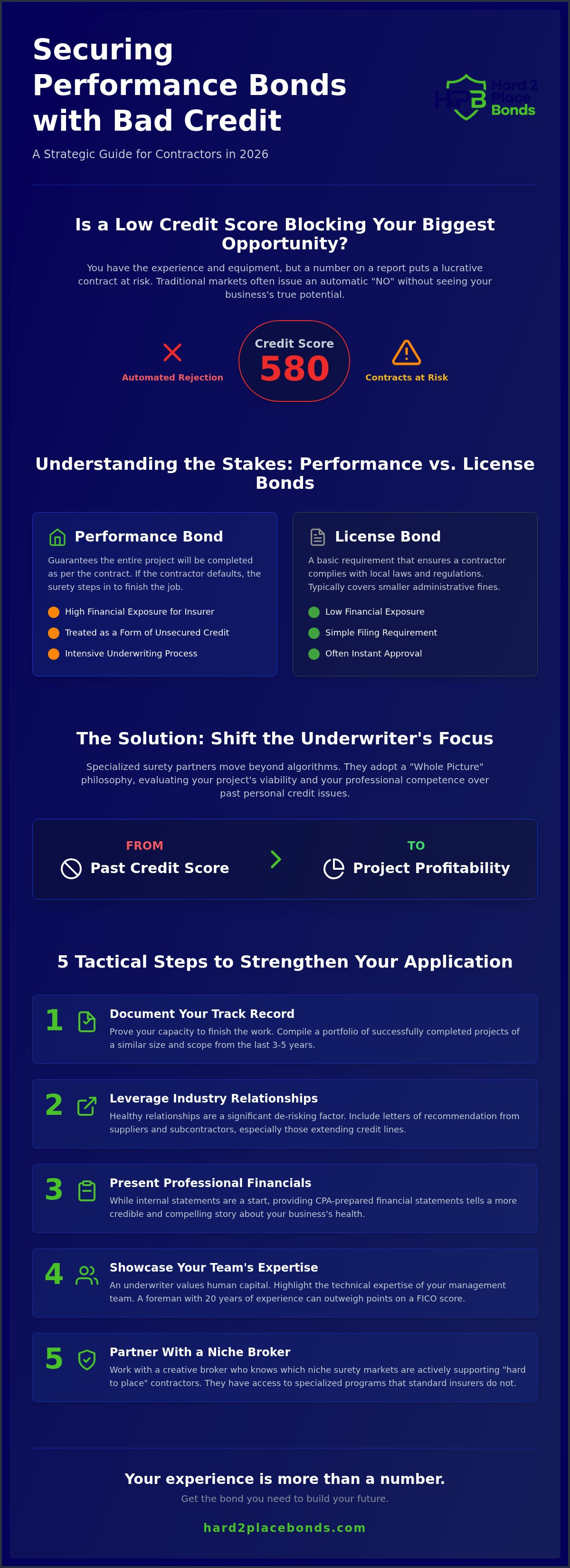
If you've been turned down for a performance bond with bad credit, you know the sinking feeling of watching a high-value contract slip through your fingers. Most standard carriers see a low credit score and immediately issue an automated "no." This happens because they view what a performance bond is as a form of unsecured credit. Unlike a license bond that might only cover a few thousand dollars in administrative fines, a performance bond guarantees you will finish the entire project. If you walk away, the surety pays to complete the work. They are essentially co-signing for your business's ability to perform, which represents a massive financial exposure for the insurer.
Why Performance Bonds Carry More Weight Than Other Surety Types
While a contractor license bond is often a simple filing requirement, payment and performance bonds involve significantly higher stakes. Underwriters focus on the "three Cs": Character, Capacity, and Capital. In the eyes of a traditional insurer, your credit score is the primary proxy for "Character." They assume that if you've struggled with personal finances, you might lack the discipline to manage a complex job site. This is a flawed assumption that ignores your actual field experience, but it's the reality of standard market underwriting. Because the surety's risk is tied directly to your project completion, they are far more selective than they would be for a basic license guarantee.
Common Credit Roadblocks: Bankruptcy, Judgments, and Low Scores
As we move through 2026, many contractors are still dealing with the financial fallout of fluctuating material costs and previous labor shortages. These economic pressures often result in "thin" credit files or damaged scores that don't reflect a contractor's true skill or reliability. Specific red flags like open tax liens, recent bankruptcies, or civil judgments can trigger instant rejections from big box insurers. However, being "hard to place" doesn't mean you are unbondable. It just means you need a partner who looks beyond the score to see the strength of your current project and your concrete plan for completion. We understand that a 580 score shouldn't be the end of your growth, and specialized programs exist to bridge that gap.
How Surety Underwriters Evaluate Performance Risk Beyond the Score
Securing a performance bond with bad credit requires moving the conversation away from the credit bureau and toward the job site. While standard insurers use algorithms to filter out anyone with a score below a certain threshold, specialized underwriters adopt a "Whole Picture" philosophy. They recognize that a credit score reflects past personal financial stress, not necessarily your current professional competence. By evaluating the specific risks of the project itself, these experts find reasons to say "yes" when others have already said "no." This approach focuses on the project's viability and your specific plan to manage the work from groundbreaking to final inspection.
This is particularly relevant when navigating Federal Acquisition Regulation (FAR) requirements for public works. These regulations mandate bonding to protect taxpayers, but they don't strictly forbid bonding for those with past credit issues. An underwriter who understands the nuances of the construction industry will prioritize your project's profitability and your operational history over a computer-generated number. They look for the Principal's personal commitment to the project, often evidenced by their "skin in the game" and hands-on management style. If you can demonstrate that the project is well-funded and within your expertise, the credit score becomes a secondary concern.
The Role of Capacity and Experience
Your best defense against a low credit score is a rock-solid resume. You need to prove you have the capacity to finish the work without a hitch. Document every project of a similar size and scope that you've successfully completed over the last three to five years. If your suppliers and subcontractors are willing to offer letters of recommendation or extend credit lines, include those in your package. Underwriters view these healthy industry relationships as a significant de-risking factor. They want to see that your management team has the technical expertise to handle the day-to-day hurdles of the contract. A foreman with twenty years of experience can often outweigh a few points on a FICO score.
Financial Statements: The Story Behind the Numbers
Numbers tell a story, but you need to be the narrator. While internally prepared statements are a good start, providing CPA-prepared financial statements significantly increases your credibility. These documents give the underwriter confidence in your working capital and net worth, which are the true indicators of your bonding capacity. A specialist underwriter will often overlook a one-time financial setback, such as a localized economic dip or a personal medical emergency, if the rest of your balance sheet shows resilience and current liquidity. They understand that a temporary cash flow crunch in 2024 doesn't mean you're a high-risk bet in 2026. If you are ready to present your case to a team that listens, you can submit your project details today to begin the review process.
Strategic Solutions: Programs for Performance Bonding with Poor Credit
Securing a performance bond with bad credit often means looking beyond the local insurance agent who only works with standard carriers. The non-standard surety market exists specifically for contractors who have the technical skill but lack the perfect credit profile. These programs usually carry higher premiums than standard lines, but they serve as a critical bridge. They allow you to perform on current contracts while you work to rebuild your corporate credit. When you finally receive the official government form (SF25), it represents a significant milestone in moving your business forward.
Transparency is your most valuable asset when applying for these high-risk programs. If you are upfront about past judgments or collections, an underwriter can often find a way to structure the deal. If they discover these issues during a background check instead, it breaks the trust necessary for a high-stakes guarantee. We focus on finding the "yes" by presenting your full story to carriers who are hungry for risk and understand the construction cycle. This proactive approach turns a standard refusal into a manageable path toward growth.
The SBA Surety Bond Guarantee Program
The SBA Surety Bond Guarantee Program is a powerful resource for emerging contractors. In 2026, the SBA continues to act as a co-signer by guaranteeing a significant portion of the bond to the surety company. This government backing drastically reduces the risk for the insurer, making them much more likely to approve a performance bond with bad credit . To qualify, your business must meet specific size standards and demonstrate that the bond is a requirement for the contract. The primary benefit is access to bonding capacity that would otherwise be out of reach, often at rates more favorable than the open high-risk market.
Funds Control and Escrow Agreements
Funds control is a specialized tool that provides underwriters with peace of mind. A neutral third-party company manages the project disbursements, ensuring that all subcontractors and suppliers are paid before any profit is released to your firm. Underwriters favor this arrangement because it virtually eliminates the risk of a payment bond claim. While there is a small fee for this administrative service, it often makes the difference between an approval and a rejection. It provides a level of project security that allows you to secure larger payment and performance bonds, proving your reliability to project owners regardless of your personal credit history.
5 Steps to Strengthen Your Performance Bond Application Today
When you are facing a tight contract deadline, you don't have months to wait for a credit score to tick upward. You need a performance bond with bad credit right now to secure your project. Most contractors fail because they submit the same thin application that triggered a previous rejection. To get a different result, you must provide a package that proves your technical competence and financial resilience. A professional, high-impact presentation can often override the red flags that automated systems use to disqualify you.
The goal is to provide the underwriter with enough "compensating factors" to justify an approval. This means moving beyond the numbers and showing the human expertise behind the business. By following these five tactical steps, you can build a case that even the most conservative surety might consider. If you are ready to put these steps into action, you should start an application with your documentation organized and ready for review.
Gathering Your 'Proof of Performance' Portfolio
Your first step is to document every win your company has achieved. Create a comprehensive job history list that includes contract amounts, project durations, and the contact information for project owners. This isn't just a list; it is a resume of your reliability. Next, secure letters of recommendation from previous general contractors or owners. These third-party validations carry significant weight in a high-risk underwriting environment. Finally, write a brief, honest narrative explaining the circumstances of your credit issues. Whether it was a one-time medical expense or a localized economic shift, explaining the "why" helps the underwriter see you as a person rather than a risk category.
Optimizing Your Business Financials
While you can't change your net worth overnight, you can change how it is presented. Focus on showing "liquid" assets, such as cash on hand or marketable securities, which can be used as collateral if the surety requires it. Ensure your accounts receivable aging report is current and accurate. Underwriters want to see that you are proactive about collecting what you are owed. A common mistake is submitting "stale" financials that don't reflect your current cash position. Finally, consult with a specialist broker to "pre-flight" your application. We can identify potential hurdles before they reach the underwriter's desk, ensuring your performance bond with bad credit has the highest possible chance of success. This proactive approach shows the surety that you are a serious professional who respects the bonding process.
Partnering with Hard 2 Place Bonds for High-Risk Approvals
Receiving a rejection from your local insurance agent doesn't have to be the end of your project. Most standard agencies are tied to a few large carriers that rely on automated "pass/fail" systems based strictly on credit scores. If you don't meet their rigid criteria, you are out of luck. Hard 2 Place Bonds operates as the creative alternative to these standard market failures. As a specialist division of Hako Risk & Insurance, we possess the industry depth and national reach required to find a path forward when others have given up. We don't just see a credit score; we see a business owner with the technical skill to deliver on a contract.
Our approach is fundamentally solution-oriented. We understand the stress and frustration that comes with a potential contract loss, and we respond with calm competence. By focusing on possibilities rather than limitations, we help you secure a performance bond with bad credit so you can get your crew on-site and start earning. We act as your tenacious advocate, ensuring that your story is heard by the right people at the right time.
Why a Specialist Broker is Your Best Advocate
The primary difference between a captive agent and an independent specialist is the breadth of the market. A captive agent is often limited to a single company's appetite for risk. If that company says no, the agent's job is done. As independent specialists, we have built deep relationships with niche surety markets that are "hungry" for risk and understand the construction cycle. We know which underwriters are willing to look at your resume and project profitability rather than just your FICO score. When we present your case, we don't just submit a form. We package your application to highlight your operational strengths, mitigating any financial weaknesses through the strategic programs we've discussed, such as funds control or SBA guarantees. This specialized advocacy is what turns a high-risk file into an approved bond.
Getting Your Performance Bond: The Next Step
Our intake process is designed to be quick, professional, and completely confidential. We know that in the construction world, timing is everything. You can expect clear communication and a logical sequence of steps that respect your deadline. Once you provide your documentation, we perform a "pre-flight" review to identify any hurdles. We then move quickly to match your project with the carrier best suited for your specific situation. You won't be left wondering where your application stands; we provide regular updates as we move toward a final approval. If you are ready to stop fighting automated systems and start working with a partner who values your expertise, you can contact Hard 2 Place Bonds for a specialized quote today. Let's move your project across the finish line together.
Secure Your Contract and Move Your Business Forward
A low credit score doesn't have to be the ceiling for your business growth. You've learned that securing a performance bond with bad credit is a matter of shifting the focus from past financial hurdles to your current operational strengths. By leveraging specialized programs like SBA guarantees or funds control and presenting a professional proof of performance portfolio, you can satisfy even the most cautious underwriters. The standard "no" from a captive agent is often just the beginning of a more creative path toward approval.
As national surety bond specialists, we provide expertise in bad credit and hard-to-place bonds through solution-oriented underwriting for complex risks. We don't stop at the first credit check; we advocate for the whole picture of your business. It's time to move past the frustration of automated rejections and partner with an industry insider who knows how to navigate these hurdles. Secure your performance bond with a specialist who understands your situation. Start your application today.
Your next big contract is within reach. We are here to help you secure the bonding you need to start work and build the future you've earned.
Frequently Asked Questions
Can I get a performance bond with a credit score below 550?
Yes, you can secure a performance bond with bad credit even if your score is below 550. While traditional insurers use automated systems that trigger instant rejections for low scores, specialist underwriters look at your technical capacity and job history. They prioritize your ability to finish the work over your personal credit score. We focus on presenting your project’s profitability to carriers who specialize in high-risk scenarios.
How much more does a performance bond cost with bad credit in 2026?
You should expect to pay a higher premium for a performance bond when your credit is challenged. Because the surety is taking on a greater risk by backing a contractor with a lower score, they adjust the cost to reflect that exposure. These non-standard rates serve as a bridge, allowing you to take on lucrative contracts while you work toward improving your financial standing for future projects.
Do I need to provide collateral to get a bond with poor credit?
Collateral is one tool used to secure approval, but it isn't always required. Many high-risk programs use alternative de-risking methods like funds control or the SBA Surety Bond Guarantee program to move forward without a cash deposit. An underwriter will evaluate your business's liquid assets and project-specific risks before determining if additional security is necessary for your specific contract. We explore every path to avoid tying up your cash.
Will a past bankruptcy prevent me from getting a performance bond?
A past bankruptcy is not an automatic "no" in the niche surety market. Underwriters are primarily concerned with the age of the bankruptcy and whether it has been fully discharged. If you can show that your business is currently stable and that the bankruptcy resulted from a specific, non-recurring event, we can often build a strong case for your approval. Transparency about the discharge is key to building trust.
How long does it take to get approved for a high-risk performance bond?
The approval process for a high-risk performance bond typically takes longer than a standard license bond. Because these bonds require a manual review of your financial statements, job history, and project details, you should plan for several business days of underwriting. Having your documentation ready, including a current aging report and project references, helps speed up the timeline significantly. We move as fast as the documentation allows.
What is the SBA Surety Bond Guarantee program, and do I qualify?
The SBA Surety Bond Guarantee program is a federal initiative that helps small contractors obtain bonding by guaranteeing a portion of the loss to the surety. You may qualify if your business meets SBA size standards and you've been denied a bond by a standard carrier. This program is specifically designed to help contractors with limited financial resources or credit challenges compete for larger public and private projects.
Can I include the cost of the bond premium in my project bid?
Yes, it's standard practice to include the cost of the bond premium as a line item in your project bid. Most project owners expect to see this expense and are willing to pay for the security it provides. By accounting for the higher cost of a performance bond with bad credit in your initial estimate, you ensure that the bond premium doesn't eat into your project's net profit.
What happens if my credit improves during the project term?
Improving your credit during a project won't change the premium for the current bond, but it significantly helps your next application. Once a performance bond is issued, the rate is set for that specific contract. However, as your score rises, you'll gain access to more competitive markets and lower rates on future jobs. We track your progress to help you transition into standard programs as soon as possible.