
What if a "no" from a standard surety carrier isn't a final judgment on your business, but simply a sign that you're talking to the wrong person? You've likely felt the sting of a major contract hanging in the balance, only to have an automated system trigger a denial based on a credit score or a "high-risk" industry label. It's incredibly frustrating to see your hard work stalled by rigid underwriting requirements that don't account for your specific situation. We understand that a rejection feels like a wall, but in reality, it's often just a mismatch of appetites.
The path to overcoming surety bond rejection starts with understanding exactly why the denial happened and how to present your case to specialized underwriters who look beyond the surface. As regulatory changes introduce new requirements, such as increased dealer bond amounts or expanded notary bond mandates, the "standard" market is tightening its grip. This article provides a proven framework to fix your application and secure approval. You'll discover the technical reasons for denials and get a clear roadmap to transform a "No" into the "Yes" that keeps your business moving forward.
Key Takeaways
- Decode the "Three Cs" of underwriting-Character, Capacity, and Capital-to pinpoint exactly why a standard carrier flagged your application.
- Learn why a single denial isn't a permanent mark on your record and how you can start overcoming surety bond rejection by pivoting to specialized markets.
- Follow a clear, five-step framework to audit your credit report and request formal decline letters that identify specific application triggers.
- Understand the difference between automated "yes/no" systems and the creative underwriting solutions available for credit scores as low as 500.
- Discover how specialized advocates navigate niche requirements for freight brokers, motor vehicle dealers, and solar decommissioning projects.
Understanding the Root Causes of Surety Bond Rejection
Receiving a denial letter can feel like a dead end for your business. It's often helpful to step back and look at what a surety bond is: a three-party guarantee of performance between you, the obligee, and the surety company. When a carrier says no, they aren't necessarily saying your business is a failure. They're saying your specific risk profile doesn't fit their current appetite. Most standard carriers rely on automated systems that trigger a hard stop the moment a credit score dips below a certain threshold or a specific industry keyword appears in your file.
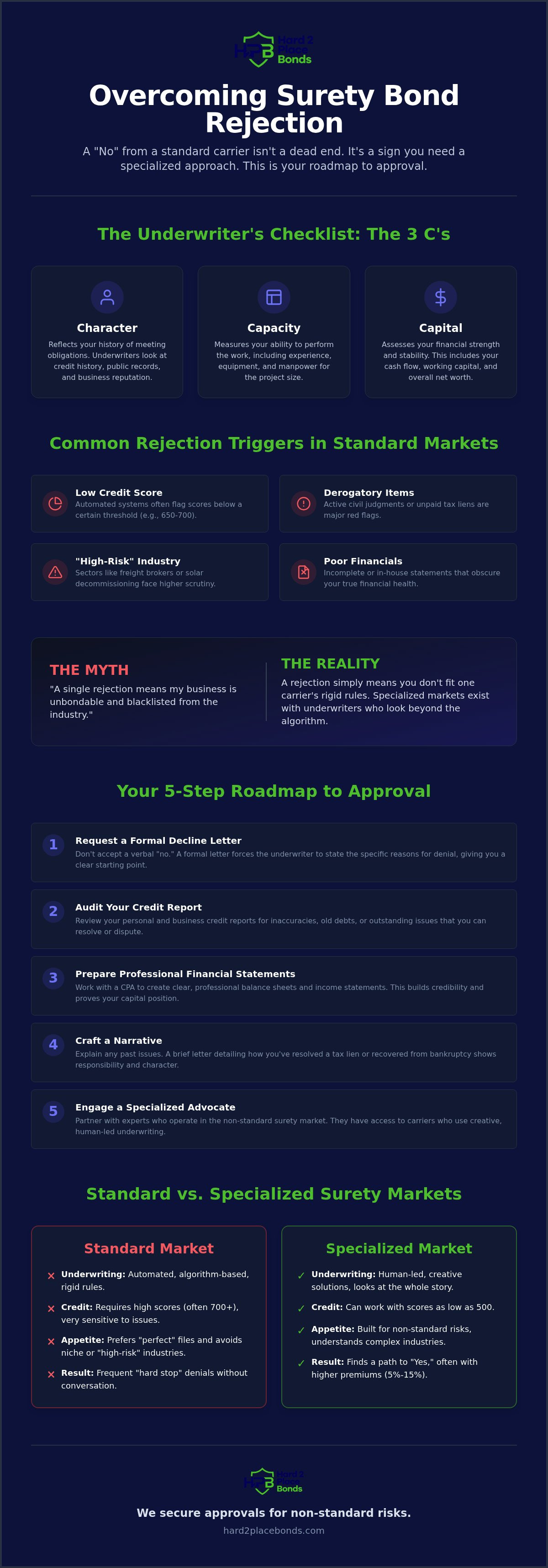
Underwriters analyze your application through the lens of the "Three Cs": Character, Capacity, and Capital. Character reflects your history of meeting obligations. Capacity measures your ability to physically perform the work. Capital assesses your financial cushion. If any of these pillars looks weak to a traditional underwriter, they'll likely issue a rejection without further conversation. This is where overcoming surety bond rejection requires moving away from automated algorithms and toward human-led, creative underwriting.
Certain sectors face higher hurdles by default. For example, the FMCSA requirement for freight brokers to maintain a $75,000 bond often leads to denials if the broker lacks significant liquid assets to replenish the bond after a claim. Similarly, solar decommissioning bonds are viewed as high-risk because they involve long-term obligations that many standard carriers don't want to carry on their books for decades. These industry-specific triggers can lead to a rejection even if your credit is perfect.
Credit-Based Denials: Beyond the Score
A low FICO score is rarely the only reason for a denial. Underwriters are far more concerned with derogatory items like active civil judgments or unpaid tax liens. These represent legal claims on your assets that could interfere with your ability to pay a surety back if a claim occurs. While no credit might be manageable for some license bonds, a history of bankruptcy typically triggers an immediate decline in the standard market. These carriers aren't equipped to assess the nuances of a post-bankruptcy recovery; they simply see a red flag and move on.
Capacity and Experience Hurdles
Capacity is about more than just having the right tools. It's about the ratio between your current projects and your available working capital. If you're bidding on a performance bond for a project significantly larger than your previous work, underwriters may doubt your ability to scale. Additionally, submitting in-house or incomplete financial statements can kill a deal. Without a clear, professional view of your balance sheet, an underwriter can't verify that you have the liquidity to handle a potential claim. Overcoming surety bond rejection in these cases often involves providing better documentation to prove you have the experience and the cash flow to back up the job.
Myth-Busting: Does One Rejection Mean You Are Unbondable?
A single rejection letter doesn't mean you're blacklisted from the industry. Many business owners believe there's a permanent record that follows them from one carrier to the next, but that's a total myth. In reality, a denial from a standard carrier just means you didn't fit their specific, often rigid, underwriting box. While the Federal Acquisition Regulation outlines formal causes for bond rejection in government contracting, private surety companies make decisions based on their own changing risk appetites. If one company says no, another might see an opportunity.
Your local insurance agent is likely a generalist. They have access to standard carriers that want perfect credit and clean histories. If you have a credit score near 500 or work in a niche like solar decommissioning, your agent might simply lack the right "pen" to write your bond. This doesn't mean you're unbondable; it means you've reached the limit of that specific agent's reach. In 2026, the market for overcoming surety bond rejection is more robust than ever, offering paths forward that didn't exist a decade ago.
The Secondary Market Explained
Specialized brokers operate in the non-standard surety pool, where underwriters are trained to look at the whole story rather than just a computer-generated score. They understand that a tax lien from three years ago shouldn't stop you from bidding on a contract today. The trade-off in this secondary market is usually a higher premium, often ranging from 5% to 15% of the bond amount. However, this is a strategic investment that allows you to fulfill your contract and build the "capacity" needed to eventually move back into standard, lower-cost markets. These specialized underwriters are creative problem-solvers who find ways to say "yes" when others have already given up.
Reversing the "No" Mentality
Treat a rejection as a diagnostic tool rather than a failure. It highlights exactly where your business looks vulnerable to an outsider. Use that feedback to clean up your financial statements or resolve old judgments. Persistence is the most important factor in securing high-limit contract bonds. Most successful contractors have faced a "no" at some point in their journey. At Hard 2 Place Bonds, we act as your tenacious advocate, bridging the gap between a standard refusal and a successful approval. If you've been told your risk is too high, it's time to explore a specialized surety bond solution tailored to your unique situation.
The Underwriter’s Checklist: Character, Capacity, and Capital
How do you convince an underwriter that you're a safe bet when your credit report suggests otherwise? Human underwriters, unlike automated algorithms, use a specific checklist called the "Three Cs" to evaluate risk. While a computer might issue an immediate denial based on a single data point, a professional underwriter looks for a balance across all three areas. If you're struggling with one "C," you can often compensate by strengthening the others. This holistic view is the secret to overcoming surety bond rejection even when the odds seem stacked against you.
The three pillars of bonding include:
- Character: This is your professional reputation. It's a measure of your integrity and your history of fulfilling obligations to clients, suppliers, and employees.
- Capacity: This evaluates your physical and technical ability to do the work. Do you have the right equipment, the necessary labor force, and the specific skill set to finish the project on time?
- Capital: This is your financial engine. It measures the cash flow, liquidity, and net worth required to support the bond amount and handle unexpected project costs.
Character and the General Indemnity Agreement
Your willingness to sign a General Indemnity Agreement (GIA) is a powerful signal of character. It tells the surety that you're personally invested in the outcome and stand behind your work. If your credit is poor, you can "buff" your character profile by providing glowing professional references from past project owners or long-term suppliers. Transparency is your best friend here. If there's a past legal or financial issue in your file, explain it clearly and provide documentation showing it's been resolved. Underwriters appreciate honesty; they're far more likely to work with someone who owns their history than someone who tries to hide it.
Capital Requirements for High-Risk Bonds
For high-risk applicants, capital is often the most scrutinized "C." Underwriters look for liquidity, which means they want to see cash or assets that can be quickly converted to cash if a claim arises. If your balance sheet is lean, specialized brokers can help you use tools like collateral or funds control as a bridge to a "Yes." Funds control ensures that project payments are used specifically for project expenses, which reduces the surety's risk. We focus on presenting your financials to emphasize your strengths, such as significant equity in your equipment or a strong backlog of profitable, completed jobs. This consultative approach helps overcoming surety bond rejection by showing the underwriter that you have the financial staying power to see the job through.
5 Concrete Steps to Overcome a Bond Denial
You've received a rejection. Now what? Most business owners stop here, assuming the door is permanently closed. In reality, this is where the real work of overcoming surety bond rejection begins. A denial is simply a data point; it tells you exactly what a standard carrier finds risky about your current profile. By following a structured "Plan B," you can address these specific concerns and present a stronger case to underwriters who specialize in non-standard risks.
Follow these five steps to reverse a "No" and secure the bonding you need:
- Step 1: Request a specific decline letter. Don't settle for a vague "credit-based" excuse. Underwriters are often required to provide the specific reason for a denial. This identifies the exact trigger you need to fix.
- Step 2: Clean up your data. Review your credit report and financial statements for outdated judgments or clerical errors. Correcting a single misreported lien can change your bondability overnight.
- Step 3: Pivot to a specialist. If your current agent only works with standard markets, they can't help you. You need a broker with access to "hard-to-place" surety pools.
- Step 4: Explore alternative structures. Look into the SBA Surety Bond Guarantee Program, which can back contracts up to $9 million (and $14 million for certain federal projects). Alternatively, offer collateral to bridge the risk gap.
- Step 5: Build an underwriting narrative. Don't just send a form. Write a professional explanation of past challenges, what you've learned, and why your business is stable today.
Pivoting to Specialized Placement
A generalist agent often triggers a rejection because they don't have the right relationships. They might submit your application to a carrier that automatically declines niche risks like solar decommissioning or freight brokerage. When you work with a specialized broker, we prepare a "rebuttal" package. This isn't just a re-submission; it's a targeted response that addresses every reason for the initial decline. We emphasize your completed projects and current liquidity to show that you're more than just a credit score.
Leveraging Collateral and Funds Control
If your credit score is near 500, a standard "Yes" might require a temporary bridge. Using an Irrevocable Letter of Credit (ILOC) as collateral can secure a bond for a startup or an applicant with a recent bankruptcy. Another effective tool is funds control, where a third party manages project disbursements to ensure suppliers and laborers are paid first. While these options might involve a higher premium or more oversight, they're essential for building your "bonding resume." Over time, successfully completing jobs with these controls allows you to graduate back to standard, lower-cost terms. If you're ready to move past a rejection, get a hard-to-place bond quote today and let us build your path to approval.
How Hard 2 Place Bonds Secures Approvals for Non-Standard Risks
At Hard 2 Place Bonds, we believe that every business deserves a path to growth. We don't see a credit score as a final verdict; we see it as a starting point for a deeper conversation. While standard agents often walk away after the first automated denial, we lean in. Our philosophy is built on the idea that overcoming surety bond rejection requires a tenacious advocate who understands the nuances of niche markets and knows how to navigate the technical hurdles that trip up generalists.
We provide access to specialized underwriting pools that standard insurance agencies simply can't reach. Our expertise covers high-stakes niches where the risk is perceived as too complex for the standard market. Whether you're dealing with the liquid asset requirements for BMC-84 Freight Broker Bonds or the long-term obligations of Solar Decommissioning Bonds, we have the relationships to find a solution. We also specialize in Motor Vehicle Dealer Bonds, helping dealers meet increasing state mandates, such as the $75,000 requirement in Ohio, even when their credit isn't perfect.
National Reach, Specialized Expertise
We operate nationally, providing creative bonding solutions across all 50 states. Our team is particularly skilled at handling the complex paperwork and technical underwriting required for subdivision and site improvement bonds. These projects often involve high values and long timelines, making them difficult for standard carriers to approve. Because we focus specifically on the "hard-to-place" segment, our recovery rate for previously denied applicants is among the highest in the industry. We don't just submit applications; we build winning cases.
Get Started on Your Recovery Plan
Our intake process is designed to be efficient and purposeful, moving you from a setback to a solution as quickly as possible. To begin overcoming surety bond rejection , please have the following items ready for your first consultation:
- Recent business and personal financial statements
- A copy of any previous decline letters or specific rejection reasons
- Details on the specific bond amount and obligee requirements
We'll listen to your story, adapt our strategy to your specific needs, and act as your guide through the entire underwriting process. Don't let a standard refusal stop your momentum. Speak with a high-risk surety expert today and discover how we can help you secure the "Yes" your business needs.
Secure Your Business Future Today
A rejection letter might feel like a dead end, but it's actually an opportunity to refine your business profile and find a partner who understands your unique value. We've explored how overcoming surety bond rejection is possible by focusing on your character and capacity rather than just a computer-generated score. By identifying the specific triggers behind a denial and pivoting to the non-standard market, you can keep your projects moving forward without delay.
Hard 2 Place Bonds acts as your dedicated advocate in a rigid industry. We specialize in providing solutions for credit scores as low as 500 and offer national coverage for all commercial and contract bonds. Whether you need help with complex solar decommissioning requirements or freight broker BMC-84 bonds, our team has the expertise to navigate the hurdles standard agents can't clear. We focus on your business's potential, not just its past challenges.
Ready to transform that "No" into a "Yes"? Get a Quote for Your Hard-to-Place Bond and let us help you build a stronger, more bondable future. You've worked hard to build your business; don't let a rigid algorithm stand in your way. We're here to help you cross the finish line.
Frequently Asked Questions
Why was my surety bond denied even though I have the cash for the premium?
A surety bond isn't a simple purchase like standard insurance; it's a credit relationship. Paying the premium only covers the service fee for the guarantee. The underwriter is actually looking at whether you can repay the full bond amount if a claim occurs. Even if you have the cash for the premium, a denial happens if the carrier doesn't believe you have the financial strength to back the total obligation.
Can I get a performance bond with a 500 credit score?
Yes, securing a performance bond with a 500 credit score is possible through specialized underwriting. While standard carriers use automated systems that trigger a hard stop at low scores, non-standard markets look at your project history and industry experience. You might need to provide additional documentation or work with a broker who can present your "capacity" and "character" as offsets to the low credit score.
How long do I have to wait to reapply after a surety bond rejection?
There's no mandatory waiting period to start overcoming surety bond rejection . You don't have to wait months for your credit to improve if you change your strategy. You can reapply immediately by pivoting to a different carrier or working with a specialized broker. The key is to address the specific reason for the first denial before submitting your file to a new underwriter with a different risk appetite.
What is a high-risk surety bond underwriter?
High-risk underwriters are specialists who manually review applications that standard companies won't touch. They focus on non-standard risks, such as businesses with low credit scores or those in volatile industries like solar decommissioning. Instead of relying on algorithms, these underwriters look at the "whole story," including your professional references and current project backlog, to find a creative path toward an approval that standard agents can't provide.
Will a past bankruptcy prevent me from getting a freight broker bond?
A past bankruptcy is a hurdle, but it isn't a dealbreaker for a BMC-84 freight broker bond. Specialized carriers understand that financial setbacks happen and focus more on your current stability and liquid assets. While a standard carrier might issue an automatic decline, a high-risk underwriter will often approve the bond if you can demonstrate that the bankruptcy is discharged and your current operations are financially sound.
What can I do if my local insurance agent says I am unbondable?
Don't take "unbondable" as a final answer from a generalist agent. Most local agents only have access to standard, "A-rated" markets that require near-perfect credit. Overcoming surety bond rejection often means seeking a second opinion from a specialist broker. We have access to niche markets and secondary underwriting pools specifically designed for applicants that generalist agents aren't equipped to handle or place.
Does a bond rejection affect my business credit score?
The rejection itself isn't reported to credit bureaus and won't lower your score. However, the "hard pull" on your credit report during the application process might cause a small, temporary dip of a few points. This is a standard part of the underwriting process. Applying to multiple carriers through a single specialized broker is often better than individual applications, as it can limit the number of inquiries on your report.
Are premiums higher for bonds placed through a specialized broker?
Yes, premiums for non-standard bonds are typically higher to reflect the increased risk the surety is taking. While a standard applicant might pay 1% to 3% of the bond amount, high-risk premiums often range from 5% to 15%. This higher cost is a strategic tool that allows you to fulfill contracts and build a successful "bonding resume," eventually helping you qualify for standard rates as your business grows.