Your credit score is just a three-digit number, not a permanent ceiling on your company's growth. If you have been told that a low FICO score makes it impossible to bid on public work, you have been getting the wrong advice. Securing a surety bond for contractors with poor credit is a specialized process that requires looking past automated rejection letters and focusing on your actual capacity to do the job. In a 2026 market where data center construction and infrastructure projects are booming, you cannot afford to stay on the sidelines because of a sub-600 score.
We understand the frustration of receiving a generic denial when you know you have the equipment, the crew, and the experience to deliver. It feels like the system is rigged against anyone who has faced a financial setback. This guide will help you break through those barriers. You'll learn how to secure the contract bonds you need to grow your business, even with a low credit score or past financial hurdles. We will explore realistic 2026 premium expectations, current SBA guarantee programs for projects up to $14 million, and how to find a partner who values your professional reputation as much as your balance sheet.
Key Takeaways
- Learn how manual underwriting in 2026 prioritizes your project capacity and professional character over a simple credit score.
- Understand the realistic pricing tiers for high-risk bonds and how to navigate premium ranges effectively for your next bid.
- Discover the specific steps to secure a surety bond for contractors with poor credit by building a submission package that highlights your operational strengths.
- Identify which types of bonds, from license to performance bonds, are most accessible for businesses with past financial setbacks.
- Find out how a specialized advocate can bypass automated rejection letters to secure the hard-to-place bonds your growth requires.
What is a Surety Bond for Contractors with Poor Credit?
A surety bond acts as a professional seal of approval. It is a legally binding agreement where a third party guarantees you will finish a project or follow state regulations. For many in the industry, finding a surety bond for contractors with poor credit is the difference between bidding on a lucrative contract and staying stuck in small-scale residential work. If you've wondered, " What is a Surety Bond?" at its core, think of it as a specialized form of credit where the surety company backs your reputation with their financial strength.
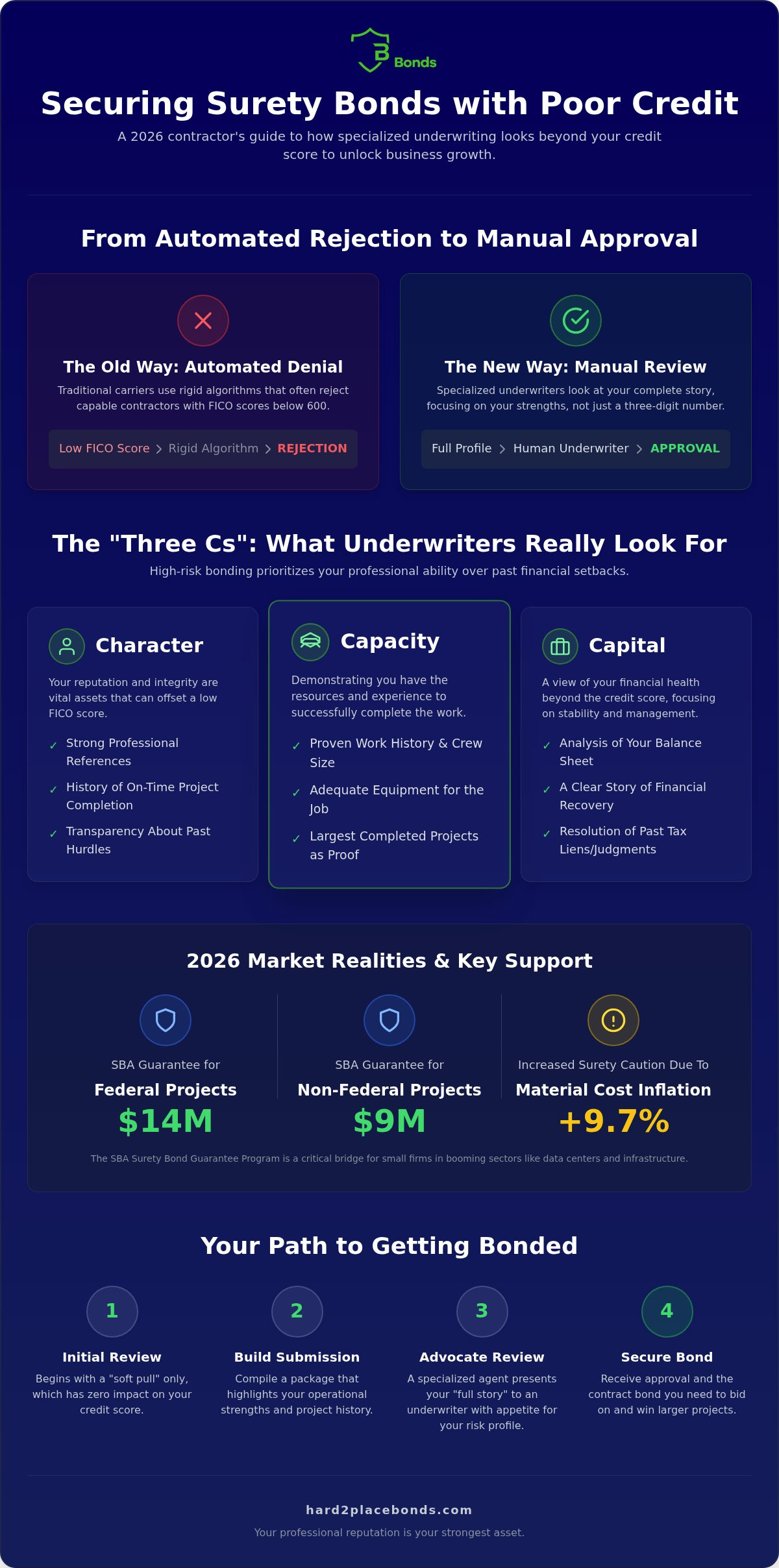
In the 2026 construction market, where material costs rose 9.7% year-over-year in May, sureties are more cautious than ever. They focus on "non-standard" risks, which include low FICO scores, past business failures, or recent financial recoveries. Unlike standard insurance, this is a credit product. If a claim occurs, the contractor is responsible for paying the surety back in full. This is why specialized underwriting is essential for small firms that don't fit the traditional mold.
The Role of Credit in Surety Underwriting
Surety companies use personal credit as a window into how you manage your business. They view a history of on-time payments as a predictor of project success. When your score sits between 500 and 600, traditional carriers often issue an automated rejection. However, specialized underwriting looks at the "Three Cs": Character, Capacity, and Capital. We focus on your ability to complete the work rather than just a number on a screen. Most initial reviews only require a "soft pull," which means your credit score won't drop just because you're looking for a quote.
Common Financial Hurdles for Contractors
Many successful business owners have faced setbacks. Civil judgments, past bankruptcies, or open tax liens don't have to end your career. While these issues make you a "hard-to-place" risk, they are hurdles you can clear with the right documentation. In 2026, underwriters are looking for a clear story of how you've resolved past issues. Whether you need contract surety bonds for a federal project or a simple license bond to stay legal, poor credit is a challenge to manage, not a reason to quit.
How High-Risk Surety Underwriting Works in 2026
Standard insurance companies often rely on rigid algorithms that trigger an automatic "no" the moment a credit score dips below a certain threshold. In 2026, this automated approach leaves thousands of capable firms without the support they need to compete. High-risk underwriting works differently. It replaces the algorithm with a manual review conducted by a professional who understands that a financial setback doesn't define your professional ability. When seeking a surety bond for contractors with poor credit, you need an underwriter who looks at the "Three Cs" of your business: Capital, Capacity, and Character.
Specialized agencies act as your advocate by finding "appetite" in niche markets. We present your business as a complete story rather than a single data point. This process often involves leveraging the SBA Surety Bond Guarantee Program. As of 2026, the SBA can guarantee bonds for contracts up to $9 million for non-federal projects and $14 million for federal projects. For many small firms, this government-backed support is the bridge to securing the contract bonds required for major infrastructure or data center projects.
Character vs. Credit Score
In high-risk bonding, your character is a vital asset. Underwriters define "Character" through your professional references, your reputation with suppliers, and your history of meeting obligations. If you have a clean track record of finishing projects on time and paying subcontractors, that history can often offset a low FICO score. Transparency is vital. Being honest about past business failures or tax liens allows an underwriter to build a credible case for your approval. They want to see that you've resolved past issues and have a clear plan for the future.
Capacity and Project Size
Capacity refers to your physical ability to do the work. Underwriters scrutinize your equipment, your crew size, and your largest completed projects to ensure you aren't overextending. For high-risk applicants, it's common to see initial bond limits that closely match your proven work history. You can build your "bondability" over time by successfully completing smaller bonded projects. This incremental growth proves your capacity and earns you the right to bid on larger, more lucrative contracts. If you're ready to see what's possible for your next project, you can begin your application online to get a manual review of your file.
Types of Contractor Bonds for Low-Credit Applicants
Every bond type presents a different challenge for the underwriter. Not all bonds carry the same level of risk, and understanding this hierarchy helps you plan your bidding strategy. While a license bond might be issued through a streamlined process, a performance bond demands a more rigorous review of your business operations. Obtaining a surety bond for contractors with poor credit is a manageable process, but the requirements shift significantly depending on the bond's purpose. Don't let the hierarchy discourage you; it's simply a roadmap for your growth.
Market data for 2026 shows that contractors with scores below 650 should expect premiums between 3% and 10% of the total bond value. While this cost is higher than standard rates, it provides the essential financial backing needed to compete for larger jobs. We maintain relationships with federally approved surety companies to provide you with legitimate, recognized coverage that meets all Miller Act and state requirements. This ensures your bond is accepted by any government or private project owner without delay.
License and Permit Bonds
States require contractor license bonds as a baseline for legal operation. These are often considered entry-level bonds because the financial risk to the surety is relatively low. Even with significant credit challenges, most contractors can secure these bonds with high approval rates. They serve as a vital starting point for rebuilding your professional reputation and proving your reliability to future underwriters. Because bond amounts are typically lower, often between $10,000 and $25,000, the approval process is usually fast and efficient.
Contract Bonds: Bid, Performance, and Payment
Securing payment and performance bonds represents the biggest hurdle for high-risk firms. These guarantees cover the full cost of the contract, meaning the surety takes on substantial risk if the project isn't completed. Because bid bonds act as a precursor to these larger obligations, they require a specialized placement strategy. Underwriters use a project-specific approach, looking at the contract terms and your specific experience with similar builds. After you finish the work, warranty bonds ensure the project remains free of defects for a set period, closing the loop on your contractual obligations.
Steps to Improve Your Approval Odds for a Contractor Bond
A low credit score isn't a permanent barrier; it's a hurdle that requires a better approach. Most contractors fail because they submit a thin application that forces the underwriter to rely solely on a FICO score. Preparation is the antidote to a low score. When you're seeking a surety bond for contractors with poor credit, your goal is to build a "submission package" that tells a story of professional success. You need to prove that while your personal credit has faced challenges, your business remains a reliable partner. The right documentation can turn a "no" into a "yes" by shifting the focus to your professional capacity.
Gathering Compensating Factors
Underwriters look for reasons to trust your capacity. If your credit score suggests a risk, your project history must prove your reliability. Experience talks louder than a three-digit number. Start by documenting your years of experience in your specific trade. If you've successfully completed projects of a similar size and scope, provide that list with contact names. Letters of recommendation from previous project owners or obligees act as a professional seal of approval. These items show the underwriter that you have the technical skill and professional character to finish what you start, regardless of your personal financial history.
Financial Transparency and Mitigation
Honesty is your best tool for building trust. Don't try to hide a past bankruptcy or a tax lien; the underwriter will find it. Instead, explain the "why" behind the setback. Whether it was a medical crisis, a divorce, or a bad business partnership, providing context helps the underwriter see you as a person rather than just a risk profile. You should also highlight current liquidity. If you have cash reserves or unencumbered equipment, you're showing a safety net that protects the surety. In 2026, where material prices remain volatile after the 9.7% increase seen in May, showing you have the working capital to manage a project is vital for approval.
Sometimes, mitigating risk means being open to alternative solutions. You might discuss the use of funds control or providing collateral to bridge the gap. The most important step is finding a broker who acts as an advocate rather than a middleman. A specialized partner knows which markets are open to your specific situation and how to present your case effectively. If you're tired of automated rejections and want a partner who looks at the whole picture, begin your application process here to speak with a specialist who understands your industry.
Why Hard 2 Place Bonds is the Right Partner for Contractors
Standard carriers often see a low FICO score as a dead end. We see it as a starting point for a conversation. As a specialized division of Hako Risk & Insurance, we focus on the risks that others call "un-bondable." Securing a surety bond for contractors with poor credit requires more than an automated portal; it requires a tenacious advocate who knows how to navigate the complexities of high-risk underwriting across all 50 states. We provide deep access to niche markets and specialty underwriters who prioritize your business experience over a computer-generated score.
Working with a national broker gives you a significant advantage in the 2026 construction market. We understand that your business is more than a balance sheet. Whether you are dealing with a past bankruptcy, open tax liens, or a recent financial recovery, we have the industry knowledge to position your firm as a reliable partner. Our goal isn't just to issue a one-time bond. We want to help you build a bondability track record that allows your company to bid on larger, more lucrative contracts year after year.
Our Solution-Oriented Process
We replace the frustration of automated rejection with a consultative approach. Our process is designed to capture your professional strengths, such as your years in the trade and your history of successful project completion. We advocate for your business during the underwriting phase, explaining the context of past financial hurdles to ensure a fair review. This manual intervention is what allows us to find approvals where others find obstacles. We are committed to helping you win the bid and build a lasting legacy for your firm.
Ready to Get Started?
The path to growing your business begins with a simple, transparent process. You can learn more about the specific requirements for obtaining a surety bond through our online resource center. When you are ready to move forward, our streamlined portal makes it easy to submit your information and receive a professional review of your file.
Once you start your application, you gain direct access to expert advisors who understand the unique pressures of the construction industry. We don't give up when faced with a standard refusal. Instead, we work with you to find a concrete path forward, ensuring you have the financial guarantees needed to keep your crew working and your business growing. Stop letting a credit score dictate your company's future and partner with an agency that values your experience.
Build Your Business Beyond Your Credit Score
The construction industry doesn't wait for a perfect credit score. With the right strategy, you can move past automated rejections and secure the surety bond for contractors with poor credit that your business deserves. Your professional capacity and project history carry significant weight when presented to the right underwriters. By focusing on financial transparency and choosing a partner who understands the manual underwriting process, you can bid on lucrative contracts that were previously out of reach.
Hard 2 Place Bonds specializes in high-risk contract surety placement across all 50 states. We pride ourselves on finding creative underwriting solutions for contractors facing complex challenges like past bankruptcies or open tax liens. Our team acts as your advocate, ensuring your business experience is the primary focus of every application. Don't let a low score stall your momentum when expert guidance is available to help you navigate these hurdles. It's time to stop worrying about your credit and start focusing on your next big project.
Get Your Contractor Bond Quote Today
We're ready to help you build your legacy, one project at a time.
Frequently Asked Questions
Can I get a performance bond with a 500 credit score?
Yes, you can secure a performance bond with a 500 credit score through specialized high-risk programs. Traditional carriers use automated systems that often reject scores below 620, but manual underwriters focus on your project experience and current liquidity instead. Programs like the SBA Surety Bond Guarantee Program are specifically designed to help contractors in this situation bid on projects worth up to $14 million.
How much more does a contractor bond cost with bad credit?
Contractors with credit scores below 650 typically pay premiums ranging from 3% to 10% of the bond amount. This is higher than the standard market rate because the surety is taking on more significant risk. While the cost is higher, it allows you to access lucrative contracts that would otherwise be unavailable, making the premium a necessary investment in your company's growth and professional reputation.
Will a past bankruptcy prevent me from getting a bid bond?
A past bankruptcy does not automatically disqualify you from obtaining a bid bond. Underwriters are most concerned with whether the bankruptcy has been discharged and if you have maintained a clean financial record since that time. Providing a clear explanation of the circumstances and showing a strong construction backlog can help a specialized broker build a winning case for your approval.
Do I need to provide collateral for a high-risk surety bond?
Collateral is not always required, but it is a common tool used to mitigate risk for high-risk bonds. If your credit score is significantly low or the project size is large, a surety might ask for cash collateral or a letter of credit. Alternatively, we often use funds control or project-specific escrow accounts to provide the surety with the security they need without tying up all your working capital.
How long does it take to get a contractor bond with poor credit?
Obtaining a surety bond for contractors with poor credit usually takes between three to five business days. Unlike "instant" license bonds, contract bonds for high-risk profiles require a manual review of your financial statements and project history. This extra time allows your advocate to present a complete picture of your business strengths to the underwriter, which often leads to higher approval rates.
Can I improve my bond rate over time as my credit score increases?
You can definitely lower your bond rates as your credit score and business reputation improve. Surety companies view your rate as a reflection of current risk, so as you resolve liens or increase your FICO score, you become eligible for better programs. Consistently finishing projects on time and building your professional character through references will eventually move you back into standard market pricing.
What is the difference between a license bond and a performance bond?
A license bond is a legal requirement to maintain your professional standing with the state, while a performance bond guarantees the completion of a specific contract. License bonds are generally easier to get because the bond amounts are smaller. Performance bonds carry much higher risk and require more detailed financial disclosure, especially when you are seeking a surety bond for contractors with poor credit.
What documents do I need to apply for a contract bond with bad credit?
To apply with bad credit, you need a comprehensive submission package beyond a simple application. You should prepare your most recent business and personal financial statements, a current work-in-progress report, and a resume of successfully completed projects. Including a written explanation of past financial setbacks and letters of recommendation from previous project owners will significantly improve your chances of securing a manual approval.