

What if a single line on your balance sheet is the only thing standing between you and your next major contract? It's incredibly frustrating to open an automated email and see that your surety bond denied due to financial statements, especially when you know your business is fully capable of performing the work. You've likely spent hours analyzing your debt-to-equity and liquidity ratios, wondering why a traditional carrier can't see the potential that you do. The fear of losing a lucrative project because of a rigid algorithm is a stress no business owner should have to face.
We understand that a rejection letter is not a verdict on your company's viability. It's often just a sign that you're knocking on the wrong door. This article will show you exactly why your financial statements triggered a denial and how to mitigate those risks for an underwriter. You'll learn how to address specific red flags and discover a specialized path to securing the bond you need. We're here to move past the automated refusal and find a concrete way forward that keeps your projects on track and your business growing.
Key Takeaways
- Identify the specific "red flags" like inadequate working capital and high debt-to-equity ratios that trigger automated rejection letters from standard carriers.
- Learn why your surety bond denied due to financial statements is often a result of rigid algorithms rather than a true reflection of your business's potential.
- Discover how to leverage the "Three Cs" of underwriting to prove your character and capacity to fulfill complex contract requirements.
- Follow a proactive five-step recovery plan to correct balance sheet errors and secure the vital bonds you need to win lucrative contracts.
- Understand the power of manual, story-based underwriting that looks past a simple credit score to find a path to approval for hard-to-place applicants.
Common Financial 'Red Flags' That Lead to Surety Bond Denial
Underwriters don't just look at your credit score; they look at the story your numbers tell. When your surety bond denied due to financial statements, it usually means the underwriter spotted a "red flag" that suggests your business might struggle to meet its obligations. To understand why this happens, it helps to first understand what a surety bond is: a three-party guarantee that you'll fulfill your contract. If your balance sheet looks shaky, that guarantee feels like an unacceptable risk to a traditional carrier.
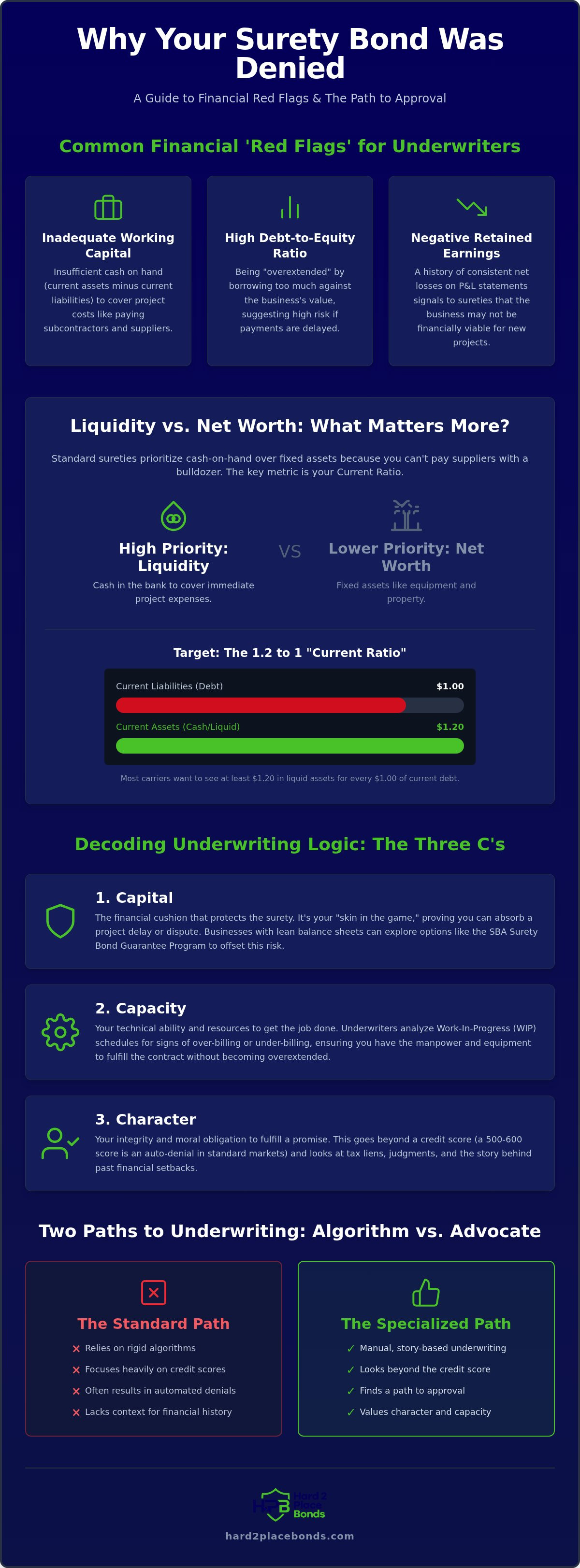
One of the most common triggers for rejection is inadequate working capital. This is the cash you have left after subtracting current liabilities from current assets. If this number is too low, underwriters fear you won't have the liquidity to pay subcontractors or suppliers during the project. Similarly, a high debt-to-equity ratio suggests you're overextended. If you've borrowed too much against your business's value, any minor delay in payment could cause a financial collapse. They also look for negative retained earnings or recent net losses on your P&L statement. If you're consistently losing money, a surety company isn't likely to back a new, large-scale commitment.
Liquidity vs. Net Worth: What Matters More?
You might have millions in equipment, but if you don't have cash in the bank, an underwriter will hesitate. Standard sureties prioritize cash-on-hand over fixed assets because you can't pay a supplier with a bulldozer. Most carriers look for a "Current Ratio" of at least 1.2 to 1. This means you have $1.20 in liquid assets for every $1.00 in debt. If your business financials are weak, a strong personal financial statement (PFS) can sometimes bridge the gap. However, for high-risk projects, liquidity remains the primary focus.
The Role of the Accountant in Your Denial
The level of professional oversight on your documents matters. Internally prepared statements are often acceptable for small license bonds, but for larger contract surety bonds, you'll need CPA involvement. There's a big difference between a compilation, a review, and a full audit. A "compilation" is just your data organized by a pro, while a "review" or "audit" provides much higher levels of assurance to the underwriter. If your financials contain misrepresentations, you don't just face a denial; you could face permanent debarment from government work. Professional preparation shows you take your financial health seriously.
It's frustrating to see your surety bond denied due to financial statements, but these red flags are often fixable. By identifying exactly which ratio or statement caused the "no," you can begin the process of correcting the record or finding a carrier that looks beyond the standard algorithm.
Decoding Underwriting Logic: The Three Cs of Your Financial Health
When a standard carrier informs you that your surety bond denied due to financial statements, they are essentially saying your business failed one of the "Three Cs." Underwriters use these three pillars-Character, Capacity, and Capital-to determine if you are a safe bet. Understanding this logic is the first step toward reversing a rejection and securing the bonding you need to grow.
Character: Beyond the Credit Score
In 2026, underwriters are increasingly sensitive to "Character" flaws that go beyond a simple number. While a personal credit score remains a primary factor for bonds under $100,000, carriers now look deeper into tax liens, civil judgments, and past bankruptcies. A credit score in the 500 to 600 range often triggers an automatic denial in standard markets, but it doesn't have to be the end of the road. Character is fundamentally about integrity and your moral obligation to fulfill a promise, not just a calculation performed by an algorithm. If you can explain the circumstances behind a past financial setback, you can often find a path to approval through high-risk markets that prioritize the human story over a computer-generated score.
Capacity and Capital: The Ability to Perform
Capacity is your technical ability to get the job done. If you are applying for a bid bond, the underwriter will analyze your Work-In-Progress (WIP) schedules. They look for signs of "over-billing," which suggests you're using cash from future work to pay for current expenses, or "under-billing," which might indicate a struggle to manage project accounting. Overextension is a fatal flaw for standard carriers; they want to see that you have the manpower and equipment to fulfill the contract without breaking.
Capital acts as the financial cushion that protects the surety if a claim occurs. It's the "skin in the game" that proves you can survive a project delay or a dispute with a subcontractor. If your balance sheet is lean, you may need to look toward the SBA Surety Bond Guarantee Program. This federal program provides a guarantee to the surety company, significantly reducing their risk and making it easier for small businesses with limited capital to qualify for large contracts. Even if your current financials don't meet traditional benchmarks, demonstrating a clear plan for capacity and capital can turn a "no" into a "yes."
If you're tired of automated rejections and want an advocate who understands the nuances of your financial history, you can start your application today to see which options are available for your specific situation.
Standard vs. Specialty Markets: Why One Denial Isn't the End
Most business owners don't realize that the surety industry is split into two very different worlds. If you've recently had a surety bond denied due to financial statements , it's likely because your application was processed by a standard market carrier. These companies rely on rigid, automated scoring systems that prioritize high credit scores and perfect balance sheets. In fact, roughly 90% of local insurance agents only have access to these standard carriers. When the computer says "no" based on their surety underwriting criteria, the agent often assumes the case is closed.
Specialty or high-risk markets operate with a completely different philosophy. Instead of a "one-size-fits-all" algorithm, they utilize manual underwriting. This means a human being actually reviews your file to understand the story behind the numbers. The trade-off for this specialized access is typically a higher premium. While standard rates often fall between 1% and 3% of the bond amount, applicants with financial challenges may see rates ranging from 3% to 10%, or even up to 15% in extreme cases. However, paying a higher premium is always better than losing a lucrative contract entirely.
Why Standard Carriers Say No to High Risk
Standard carriers aren't built to be creative. They often have strict corporate mandates that forbid them from bonding certain industries regardless of financial strength. For instance, many standard providers won't touch solar decommissioning bonds because the long-term nature of the obligation falls outside their comfort zone. They operate with a "checklist" mentality. If your debt-to-equity ratio is one point too high or your credit score is ten points too low, you're automatically rejected. They lack the specialized expertise required to navigate "hard-to-place" scenarios, leading them to decline anything that isn't a perfect fit.
The Advantage of a Specialized National Broker
A specialized national broker acts as your advocate, not just an order-taker. We have access to non-admitted carriers that specifically seek out credit challenges and complex financial histories. Because we have a national reach, we can find carriers with a specific appetite for your industry, whether you're in freight, construction, or vehicle sales. Most importantly, we know how to present "mitigating factors" directly to an underwriter. We can explain that a recent net loss was due to a one-time equipment purchase or that a low liquidity ratio is offset by a strong personal guarantee. This human-to-human connection is often the difference between a final rejection and a path to approval.
Denied for a Surety Bond? 5 Steps to Get Approved Now
Receiving a rejection letter doesn't mean your project is dead. It simply means the current carrier's algorithm couldn't find a way to "yes." If your surety bond denied due to financial statements , you need a technical recovery plan rather than a new standard application. Follow these five steps to pivot from a denial to an approval.
- Step 1: Get the denial in writing. Don't settle for a vague phone call. Ask the agent for the specific financial ratios or "red flags" that triggered the rejection. Knowing if you failed on liquidity versus debt-to-equity allows you to target the fix.
- Step 2: Clear the "low-hanging fruit." Sometimes a denial is triggered by a small tax lien you've already paid or outdated accounts receivable that look like bad debt. Provide proof of payment or updated aging reports to refresh your profile.
- Step 3: Draft a Letter of Explanation. Numbers lack context. If a one-time equipment purchase or a specific legal dispute skewed your year-end totals, explain it. Underwriters in specialty markets value transparency.
- Step 4: Pivot to specialized programs. Stop applying to standard carriers. Move your file toward a bad credit surety bond program designed for applicants with credit scores in the 500s or complex histories.
- Step 5: Utilize third-party supports. If the gap is still too wide, offer to use funds control or provide collateral. These tools reduce the surety's risk and can turn a hard "no" into a conditional "yes."
Strengthening Your Financial Package
Moving from a "compilation" to a "review" by a CPA can significantly increase an underwriter's confidence. While it costs more, a reviewed statement provides a higher level of verification that standard carriers often require for larger limits. Don't forget to look for "hidden assets." Equity in personal real estate or unbilled work-in-progress can sometimes be used to bolster a lean balance sheet. Your professional resume also serves as a mitigating factor; proving you have successfully completed similar projects shows you have the capacity to handle the current risk.
Alternative Solutions for Immediate Bonding
For small contractors, the SBA Surety Bond Guarantee Program remains a powerful tool to bridge the capital gap. If you operate in a non-construction niche, working with commercial surety bond specialists can help you navigate requirements for dealer or freight bonds that standard agents often misunderstand. In some cases, bringing on a co-signer or using personal indemnity can provide the additional "cushion" a carrier needs to issue the bond.
If you're ready to stop the cycle of automated denials and want a specialized roadmap to approval, start your application today and let us advocate for your business.
How Hard 2 Place Bonds Turns Rejections Into Results
At Hard 2 Place Bonds, we don't believe in the term "unbondable." While standard agencies might walk away when they see a 500 or 600 credit score, we see a business owner with a story that deserves to be heard. If your surety bond denied due to financial statements , we step in as your tenacious advocate. We specialize in navigating the complex financial histories that cause automated systems to fail. Our team understands that a temporary liquidity dip or a past bankruptcy doesn't define your company's future potential. We look at the person behind the paper to find a creative path forward.
Our expertise extends across all 50 states, providing a national reach that local agents simply can't match. We have built a network of non-standard carriers that have a specific appetite for risk. Whether you're a freight broker needing a trust fund alternative or a dealership looking for motor vehicle dealer bonds, we know which underwriters to call. We don't just submit your data; we present your case with the mitigating factors that standard carriers ignore.
Industry-Leading Placement for Complex Risks
We take pride in securing payment and performance bonds for contractors who have been rejected elsewhere. Our niche expertise covers high-stakes sectors like solar decommissioning, site improvement, and warranty bonds. We understand the technical requirements of these specific industries and how to align your financials with the right carrier's appetite. By focusing on manual underwriting, we can often secure approvals that seem impossible in the standard market. We bridge the gap between where your financials are now and where they need to be to win the contract.
Secure Your Bond Today
Time is usually your biggest enemy when a contract deadline is looming. Our simple intake process is designed to bypass the friction of automated rejections. We move quickly to analyze your situation and provide a definitive answer. You shouldn't have to put your growth on hold because of a rigid algorithm. We invite you to start an application today, even if you've already had a surety bond denied due to financial statements by another provider. Let us do the heavy lifting to find the solution you need to keep moving forward.
Turn Your Rejection Into a Business Win
A rejection letter from a standard carrier doesn't have to be the final word on your company's potential. We've explored how identifying specific red flags and understanding the three pillars of underwriting can help you pivot toward a solution. If your surety bond denied due to financial statements , it's time to stop relying on automated algorithms and start working with a partner who understands the person behind the paper. Specialty markets exist specifically for these challenges, offering a path forward when traditional doors close.
Hard 2 Place Bonds offers national reach across all 50 states and specializes in bad credit and hard-to-place surety bonds. Our team utilizes manual underwriting to advocate for high-risk applicants, ensuring your unique situation is heard by the right carriers. You don't have to navigate this high-stakes environment alone. We're here to help you secure the guarantees required to fulfill your contracts and keep your business moving toward its next milestone. Take the first step toward reversing your denial right now.
Get Your Denied Bond Approved Today
Frequently Asked Questions
Can I get a surety bond with a 500 credit score?
Yes, you can absolutely secure a bond with a 500 credit score. While standard carriers typically reject anyone below a 650, specialty markets use manual underwriting to approve applicants with significant credit challenges. These programs look past the score to understand your specific business history and current capacity to perform the work. We focus on finding a path to "yes" for individuals that traditional agents often label as unbondable.
What is the most common financial reason for a bond denial?
Inadequate working capital is the most frequent trigger for a surety bond denied due to financial statements. Working capital is calculated as your current assets minus your current liabilities. If this number is too low, underwriters fear you won't have the liquid cash necessary to pay subcontractors or suppliers if a project payment is delayed. Maintaining a healthy current ratio is the best way to avoid this automated red flag.
How long does it take to get approved after a rejection?
You can often receive a new approval within 24 to 48 hours when working with a specialized broker. The timeline depends on how quickly you can provide context for the previous denial, such as a letter of explanation or updated CPA-prepared statements. Because we bypass the automated systems used by standard carriers, our manual review process moves as fast as you can provide the necessary documentation.
Will a denial from one surety company affect my chances with others?
A denial from a standard carrier will not hurt your chances with specialty carriers. Standard companies often use identical automated scoring models, so applying to multiple traditional agents usually leads to the same result. However, high-risk underwriters expect to see applicants who have been turned away by standard markets. They are specifically equipped to evaluate the mitigating factors that the computer algorithms ignored.
What is a 'Hard-to-Place' bond specialist?
A 'Hard-to-Place' specialist is an advocate who maintains direct relationships with niche, non-admitted carriers that standard insurance agents cannot access. We focus on complex financial histories, including tax liens, bankruptcies, and low credit scores. Our goal is to present your business case to a human underwriter who can look at your project history and professional resume rather than just a balance sheet ratio.
Do I have to pay the full bond amount upfront if my financials are weak?
No, you are never required to pay the full face value of the bond. You only pay a premium, which is a small percentage of the bond's total amount. While standard rates often fall between 1% and 3%, applicants with financial challenges may see rates from 3% to 10%, or up to 15% in high-risk cases. This premium is the cost of the surety company's guarantee on your behalf.
Can a co-signer help me get a bond after a financial rejection?
Yes, adding a co-signer with strong financials is a highly effective way to mitigate a rejection. A co-signer provides additional indemnity, giving the surety company more confidence that they can be reimbursed if a claim occurs. This strategy is often used to bridge the gap when a business balance sheet lacks sufficient liquidity or when the primary owner has a personal credit score below 600.
What is the SBA Surety Bond Guarantee program?
The SBA program provides a federal guarantee to surety companies, covering up to 90% of their potential losses. This significantly reduces the risk for the surety, making it much easier for small businesses with limited capital to qualify. As of 2026, the SBA program covers contracts up to $9 million, and up to $14 million for specific federal projects, providing a vital lifeline for growing contractors.