
Most business owners assume a low credit score or a high-risk industry is an automatic "no" for their bonding needs. It's incredibly frustrating to be treated like a liability just because your financial history doesn't fit a standard mold. You might be staring at a contract requirement and wondering how much is a surety bond actually going to cost you out of pocket. Many people confuse the total bond amount with the premium, leading to unnecessary stress about high upfront costs.
We're here to clear up that confusion and show you that a path to approval always exists. This 2026 guide reveals exactly how premiums are calculated, typically ranging from 0.5 percent to 15 percent of the total bond value. You'll discover how to navigate credit challenges, leverage the SBA's updated guarantee limits, and use professional underwriting to lower your rate. By the end of this article, you'll have a clear strategy to secure the bond you need without the standard broker runaround.
Key Takeaways
- Understand the critical distinction between the total bond amount and your premium to avoid overestimating your actual out-of-pocket costs.
- Learn how your credit score dictates your rate, with standard premiums for 2026 often ranging from 0.75 percent to 5 percent.
- Discover exactly how much is a surety bond based on your specific industry, project size, and professional track record.
- Identify actionable strategies, such as providing strong financial statements, to lower your premium and improve your approval odds.
- Find a reliable path to approval even with challenging credit scores as low as 500 or a history of bankruptcy.
Understanding Surety Bond Costs: Premium vs. Bond Amount
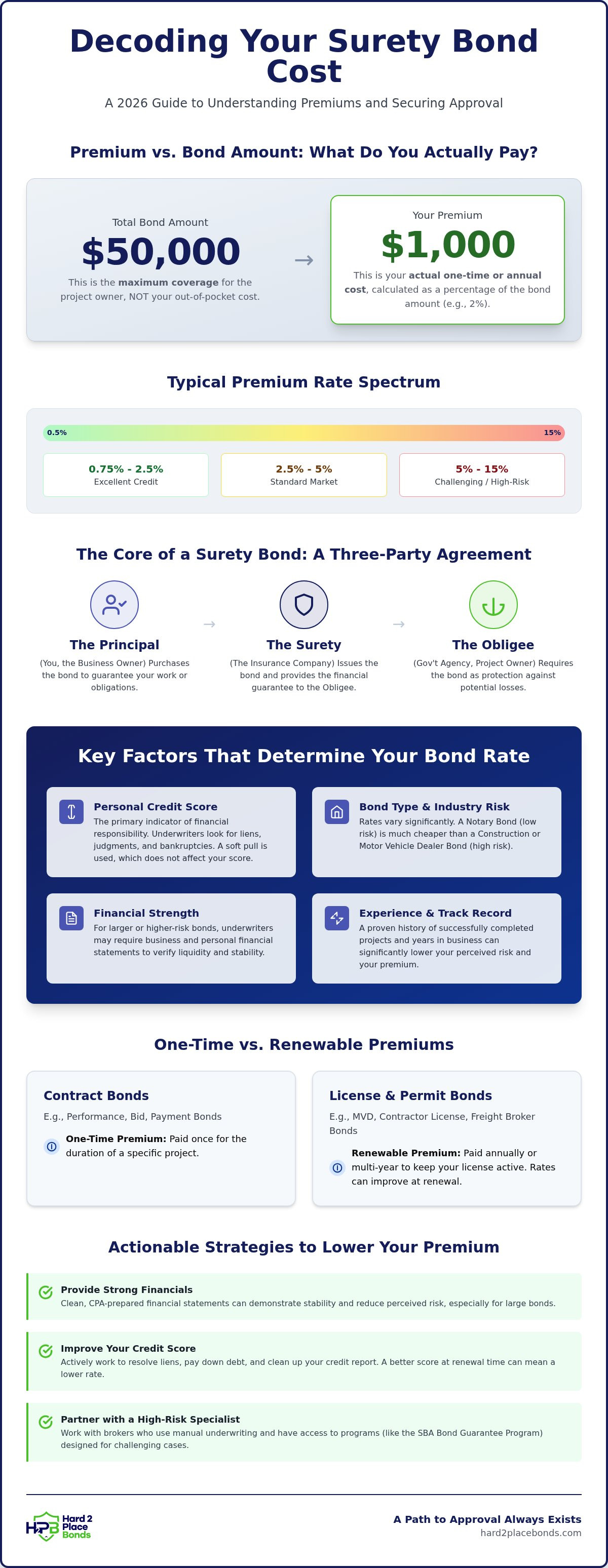
Seeing a high bond requirement on a contract or license application can be intimidating. If a project requires a $50,000 bond, many business owners worry they need to provide that full amount in cash. Fortunately, that isn't how the process works. The bond amount, also known as the penal sum, is the maximum limit of coverage available to the entity requiring the bond. It isn't the price you pay. When you ask how much is a surety bond , you're actually asking about the premium.
The premium is the actual out-of-pocket cost to secure the bond. In 2026, standard industry rates typically range from 1 percent to 15 percent of the total bond amount. For example, a $50,000 bond with a 2 percent premium would cost $1,000. These rates aren't fixed; they fluctuate based on your credit history, financial strength, and the specific risk associated with your industry. While standard brokers might turn you away if your risk profile is high, we focus on manual underwriting to find a path to approval.
The Three-Party Agreement and Your Cost
This legal structure, known as a Surety, involves three distinct parties: the principal, the obligee, and the surety company. As the business owner, you're the principal. The obligee is the government agency or project owner requiring the bond. The surety is the company that provides the financial guarantee. You pay a premium because the surety is putting its own corporate credit on the line to back your performance.
It's vital to understand that this premium is generally non-refundable. Once the bond is issued, the surety has provided the "service" of the guarantee to the obligee. Even if the project is canceled or you close your business a month later, the bond company has already assumed the risk for that period. This makes it even more important to work with a partner who can secure the most competitive rate from the start.
One-Time vs. Renewable Premiums
The timing of your payments depends on the type of bond you need. Contract bonds, like bid or performance bonds, usually involve a one-time premium based on the specific contract price. You pay for the duration of that specific project. Once the job is finished and the warranty period ends, the bond's life cycle is over.
License and permit bonds, such as those for motor vehicle dealers or freight brokers, work differently. These require annual or multi-year renewals to keep your business license active. The good news is that your premium isn't set in stone forever. If you work with us to improve your credit score or build a cleaner track record over the next year, your renewal rate can decrease significantly. We don't just issue a bond and disappear; we help you optimize your costs as your business grows.
Key Factors That Influence Your Surety Bond Rate in 2026
Underwriters don't pull rates out of thin air. When you're trying to figure out how much is a surety bond for your specific business, you have to look at the factors that signal "risk" to a bonding company. In 2026, the industry has moved toward more nuanced data analysis, but the core benchmarks remain the same. Your rate is essentially a reflection of the likelihood that the surety will have to pay out a claim on your behalf and how likely you are to reimburse them if that happens.
The Role of Personal Credit in Underwriting
For most commercial bonds, your personal credit history is the primary tool underwriters use to gauge financial responsibility. They aren't just looking at the three-digit score; they're searching for specific red flags like active tax liens, unpaid judgments, or recent bankruptcies. If your credit is less than perfect, you might feel like the system is rigged against you. We understand that a score doesn't tell your whole story. That's why we prioritize manual underwriting to look for context that automated systems miss. Most modern agencies perform a soft credit pull during the quote process. A soft credit pull is a background check that allows an underwriter to view your credit report without lowering your score or leaving a visible mark for other lenders to see.
Bond Type and Industry Risk Profiles
The specific type of bond you need significantly impacts the final price. Low-risk bonds, such as notary or janitorial bonds, are often issued at flat rates because the potential for a massive claim is minimal. On the other end of the spectrum, high-risk bonds like solar decommissioning, subdivision, or motor vehicle dealer bonds require much deeper scrutiny. These "hard-to-place" risks often involve long-term performance guarantees or complex environmental regulations. Because these bonds carry more weight, underwriters may ask for CPA-prepared financial statements or proof of significant liquidity before they'll even consider a quote.
Experience also plays a massive role in 2026. If you've been in business for ten years with a clean track record, an underwriter might overlook a lower credit score that would normally trigger a rejection. Conversely, a new business owner in a high-risk field like freight brokering will likely see higher premiums until they've proven their stability. Small businesses working on federal or municipal projects should also look into the SBA's Surety Bond Guarantee Program, which can help you secure contract bonds that might otherwise be out of reach due to strict private market requirements.
Finally, keep in mind that the "Obligee" (the entity requiring the bond) sets the rules. Some states, like California or Florida, have more stringent bond forms that increase the surety’s exposure, which can lead to higher premiums compared to states with more lenient requirements. If you're struggling to find a broker who understands these niche state regulations, you can explore our specialized hard-to-place bonds to find a solution that fits your unique situation.
Estimating Your Premium: A Cost Breakdown by Credit Score
Your credit score acts as the primary filter for most bonding companies. If you're trying to calculate how much is a surety bond for your next project or license renewal, looking at your current FICO score provides the most accurate baseline. In 2026, the surety market remains segmented into three primary tiers, each reflecting a different level of perceived risk and financial stability.
Applicants in the Standard Tier, typically those with a credit score of 700 or higher, are viewed as low risk. These business owners can expect premiums to range between 0.75 percent and 2.5 percent of the bond amount. For these individuals, the approval process is often automated and requires minimal documentation. If your score falls into the Mid-Market Tier (600 to 699), premiums generally shift into the 2.5 percent to 5 percent range. While still competitive, underwriters may look closer at your professional experience to ensure your business is on solid footing.
The most significant challenges arise for those in the Sub-Prime or Hard-to-Place category, where credit scores sit below 600. Many traditional brokers simply stop helping at this point. In this tier, premiums can range from 5 percent to 15 percent or more. We specialize in these difficult cases, securing approvals for scores as low as 500. Even if you've faced rejection elsewhere, we focus on manual underwriting to find a solution that works for your budget.
Cost Table: $50,000 Surety Bond Examples
To help you visualize these costs, here is how a $50,000 bond requirement translates to actual premiums across different credit profiles:
- Excellent Credit (720+): Expect a premium between $375 and $1,000.
- Fair Credit (620-680): Expect a premium between $1,250 and $2,500.
- Challenged Credit (500-600): Expect a premium between $3,500 and $7,500.
Why Rates Vary for the Same Credit Score
Two people with the exact same credit score can still receive different quotes. This happens because underwriters look at the quality of your financial data. A company that provides CPA-prepared financial statements demonstrates a higher level of transparency than one using in-house reports, often leading to lower rates. We also consider "character" issues; a score might be low due to medical debt, which is viewed differently than a history of previous bond claims or active bankruptcies. In some high-stakes scenarios, providing collateral can also help lower your premium rate by reducing the surety's total exposure.
Strategies to Lower Your Bond Premium and Improve Approval Odds
Receiving a high quote or a flat rejection can feel like a dead end for your business. However, your initial quote isn't always the final word on how much is a surety bond for your company. By taking proactive steps to reduce the perceived risk in your file, you can often unlock lower premiums and secure approvals that standard brokers might miss. Underwriters are looking for stability and professional competence; proving these qualities can save you thousands of dollars over the life of your bond.
One of the most effective ways to lower your rate is to demonstrate strong liquidity. If your business holds significant cash reserves or liquid assets, you prove to the surety that you have the means to reimburse them in the event of a claim. Along with financial strength, you should resolve any outstanding civil judgments or tax liens before you submit your application. Even if you've already started a payment plan, providing documentation of your good standing shows a level of financial responsibility that automated systems often overlook. If the upfront cost is still a hurdle, consider asking about premium financing. This allows you to spread the cost over several months, keeping your working capital available for daily operations.
Building a Stronger Underwriting File
A complete application is your best tool for advocacy. Don't leave gaps in your work history or financial records, as silence is often interpreted as risk. Include professional resumes for key personnel and a list of successfully completed projects to prove your competence in your field. For contractors, a letter of intent from your bank can provide the necessary assurance for a bid bond application by confirming you have the financial backing to support the project. These details move the conversation away from a simple credit score and toward your actual ability to perform the work.
Working with a Specialist Broker
Many business owners make the mistake of using a general insurance agent for their bonding needs. While these agents are great for auto or property insurance, they often lack access to the niche markets required for non-standard risks. A dedicated niche surety bond specialist understands how to navigate complex hurdles and has established relationships with carriers that specialize in "hard-to-place" bonds. We prioritize manual underwriting, ensuring a real person reviews the nuances of your business rather than relying on a computer's "no." This personalized advocacy is often the difference between a high-premium approval and a standard rejection.
Securing Hard-to-Place Bonds: The Hard 2 Place Advantage
Many business owners come to us after a standard broker has already closed the door. It's a common story: you have a contract in hand or a license deadline looming, but a past bankruptcy or a low credit score makes you a "non-standard" risk in the eyes of automated systems. We don't see a score; we see a business with potential. While other agencies are preoccupied with only the easiest cases, we've built our reputation as a tenacious advocate for those who feel marginalized by traditional financial systems. We believe that every business deserves a path to approval, and we have the tools to find it.
Understanding how much is a surety bond for a high-risk applicant requires looking beyond the standard 1 percent rate. Because we specialize in bad credit surety bonds and hard-to-place risks, we have access to a network of niche carriers that don't participate in standard markets. This national reach allows us to navigate the specific state-level requirements that often trip up general insurance agents. Our goal is to provide a sense of relief by turning a complex, stressful process into a clear, manageable step for your business growth.
Solutions for Bad Credit and Bankruptcy
We take a consultative approach to every file. If your credit score is as low as 500, we don't just send an automated rejection. Instead, we use manual underwriting to highlight your industry experience and current liquidity. Navigating the bond process after a corporate or personal bankruptcy is complex, but it isn't impossible. Our specialized carriers focus exclusively on sub-prime surety, allowing us to find a "yes" when others only see limitations. We advocate for you by presenting the full context of your financial journey to the underwriters who matter.
Niche Bonds: Solar, Freight, and Motor Vehicle Dealers
Different industries present unique challenges that standard underwriters often misunderstand. Solar decommissioning bonds, for instance, require a long-term mindset due to the multi-decade nature of the guarantee. For new freight brokers, securing a BMC-84 bond can be a major hurdle, especially if your credit is still in a rebuilding phase. We also help motor vehicle dealers get approved quickly to ensure they don't miss critical state licensing deadlines. Our expertise in these niche areas means we know which documents to prioritize to get your file approved on the first try, saving you time and frustration.
Next Steps: Get Your Custom Quote
Securing your bond doesn't have to be a source of stress. Our intake process is designed to be efficient and supportive, moving you quickly from a setback to a concrete resolution. During your consultation, we'll review your specific requirements and identify the best path forward, regardless of your past financial hurdles. Stop letting a standard refusal hold your business back. You can Request a specialized quote from Hard 2 Place Bonds today and see how our creative problem-solving can work for you.
Secure Your Business Success Today
Navigating the complexities of bond premiums shouldn't stand in the way of your next big contract or license renewal. You now have a clearer understanding of how much is a surety bond based on your credit tier and industry risk. While credit scores are a major factor, they aren't the only thing underwriters consider. By providing strong financial records and working with a specialist who understands niche requirements, you can optimize your costs even with a challenging financial history.
Hard 2 Place Bonds acts as your creative problem-solver when standard brokers say no. As a specialized division of Hako Risk & Insurance, we bring national reach and deep expertise to every application. We specialize in securing approvals for credit scores as low as 500 and handling complex niche bonds that others avoid. Don't let a standard rejection stall your progress. Take the next step toward your goals and get a specialized bond quote from Hard 2 Place Bonds. We're ready to find the path forward that works for you.
Frequently Asked Questions
Is the bond amount the same as the price I pay?
No, the bond amount is the total coverage required by the obligee, not the out-of-pocket cost. When calculating how much is a surety bond, you only pay a premium, which is a small percentage of that total amount. For a $25,000 bond, you might pay only a few hundred dollars depending on your credit and industry risk.
Can I get a surety bond with a 500 credit score?
Yes, you can secure a bond with a 500 credit score by working with a broker that uses manual underwriting. While standard brokers might decline your application based on a computer-generated score, we look at the full context of your business. We specialize in finding approvals for bad credit surety bonds by highlighting your professional experience and industry track record.
Why is my surety bond premium so high?
High premiums are usually the result of a low credit score, lack of business experience, or working in a high-risk industry. Underwriters set these rates based on the likelihood of a claim and the principal's ability to reimburse the surety. If you're wondering how much is a surety bond for your specific situation, improving your financial statements or resolving liens can help lower your future rates.
How long does it take to get a quote for a hard-to-place bond?
You can typically expect a quote for a hard-to-place bond within 24 to 48 hours. Unlike standard bonds that use automated systems, non-standard risks require a real person to review your financial history and business plan. Providing a complete application with resumes and project references helps our team advocate for your approval and secure a competitive rate quickly.
Are surety bond premiums refundable if I close my business?
Surety bond premiums are generally non-refundable once the bond is issued and filed with the obligee. The fee you pay compensates the surety for the risk they assume during the bond's term. Even if you stop operating your business or no longer need the license, the surety has already fulfilled its service by providing the guarantee for that period.
Do I have to pay my surety bond premium every year?
Renewal requirements depend on the type of bond you carry. License and permit bonds, such as those for auto dealers or freight brokers, typically require annual or multi-year premium payments to remain active. Contract bonds, like bid or performance bonds, are usually one-time fees tied to a specific project and do not require yearly payments once the job is finished.
What happens if I can't afford the full premium upfront?
Premium financing is often available to help you spread the cost of your bond over several months. This option is ideal for business owners who need to preserve their working capital for equipment or payroll. Instead of a large upfront payment, you can manage your expenses with a structured plan that fits your monthly budget while staying fully compliant.
Can I get a performance bond for a new construction company?
New construction companies can secure performance bonds by demonstrating their technical expertise and financial stability. While you may lack a long corporate history, underwriters will often consider your personal experience and past project management roles. We help startup contractors build a strong case for approval, ensuring they have the guarantees necessary to bid on and win larger projects.