A surety bond isn't just another insurance policy; it's a financial vote of confidence that can make or break your ability to do business in 2026. Understanding the true surety bond meaning is the first step toward securing that professional license or contract you've been eyeing. If you've felt anxious about bond requirements or feared a rejection due to your personal credit history, you're not alone. It's frustrating to deal with complex jargon when you're simply trying to grow your business, especially as global demand for surety reaches new heights this year.
We're here to act as your advocate and simplify the process. This guide will help you master the fundamentals of the three-party bond structure and identify exactly which bond type you need to stay compliant. You'll gain a clear understanding of how these guarantees work and find a reliable path to approval, even if you've faced financial hurdles in the past. We'll walk through everything from basic definitions to the specific steps required to get your bond issued and your business moving forward.
Key Takeaways
- Understand the surety bond meaning as a specialized three-party agreement that acts as a financial guarantee of your professional performance.
- Identify the specific roles of the principal, obligee, and surety to navigate your bonding requirements with confidence.
- Distinguish between contract and commercial bonds to ensure you're applying for the correct coverage for your project or license.
- Learn how premiums are calculated based on risk and credit, helping you anticipate the actual costs of securing your bond.
- Explore alternative paths to approval for hard-to-place bonds, proving that a low credit score doesn't have to be a barrier to your business growth.
Surety Bond Meaning: Defining the Financial Guarantee
Have you ever searched for a bond only to end up looking at home security systems? It's a common point of confusion because of brands with similar names, but let's clear that up right now. A surety bond has nothing to do with cameras, motion sensors, or alarms. Instead, it's a specialized legal tool that protects your clients and the public from financial loss. When we discuss the surety bond meaning , we're describing a professional endorsement that proves your business is capable of fulfilling its promises and following the law.
A surety bond is a financial guarantee of performance. It serves as a "vote of confidence" from a bonding company, signaling to project owners and government agencies that you've been thoroughly vetted. If you don't meet your obligations, the bond provides a fund that the affected party can claim against. This is why many professional licenses require a bond before you can even open your doors. A deep dive into the surety bond meaning reveals that it isn't just a piece of paper; it's the bridge between a business owner's ambition and a client's peace of mind.
The Legal Foundation of Surety
The law views these contracts through the lens of "joint and several liability." This sounds like complex legal jargon, but it's actually quite simple. It means that both you and the surety company are responsible for the full amount of any valid claim. Government agencies require these bonds because they want to ensure that public funds aren't wasted on contractors who can't finish the job. By understanding what a surety bond is, you can see why it's a mandatory step for many licenses. It acts as a safety net for the person hiring you, not for your own business assets.
Surety vs. Traditional Insurance
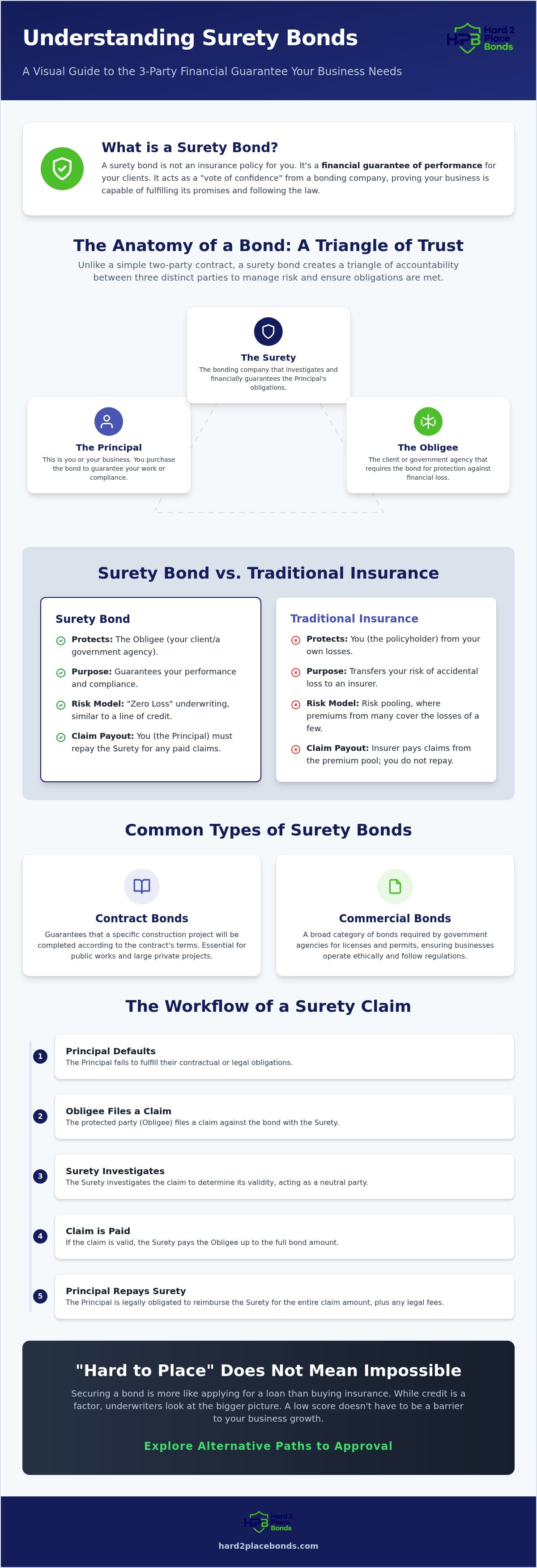
You might be used to buying insurance to protect yourself, but surety works differently. In a standard insurance policy, you pay a premium so the company will cover your losses if something goes wrong. In the world of surety, the premium you pay doesn't protect you at all; it protects the "obligee," which is the entity requiring the bond.
Standard insurance relies on risk pooling, where many people pay in to cover the few who will have accidents. Surety companies operate on a "zero loss" model. They only issue bonds to people they believe will never have a claim. This is why the underwriting process feels more like applying for a bank loan than buying a car insurance policy. They're looking for proof of your character, capacity, and capital before they'll put their name behind yours. If a claim is paid out, you're legally required to pay the surety back every cent.
The Anatomy of a Bond: How the Three-Party Agreement Works
To truly grasp the surety bond meaning , you have to look at it as a triangle of trust. Unlike a standard two-party contract between a buyer and a seller, a surety bond involves three distinct entities working together to manage risk. Each party has a specific role to play in ensuring that obligations are met and projects are completed. This structure creates a layer of security that a simple handshake or a standard insurance policy can't provide.
- The Principal: This is you or your business. You're the party that needs the bond to prove you can perform the work or follow the regulations of your license.
- The Obligee: This is the entity that requires the bond. It's usually a government agency, a project owner, or a licensing board. They're the ones being protected from financial loss.
- The Surety: This is the financial institution that provides the guarantee. They stand behind the Principal and pay the Obligee if the Principal fails to deliver on their promises.
The core of this relationship is the indemnity agreement. This is a separate legal document where you agree to hold the surety harmless. It's a critical part of the surety bond meaning because it establishes your personal legal obligation. If the surety pays a claim, you're legally bound to repay them every dollar, including legal fees and costs. This is why bonding companies vet your financial history so carefully; they're essentially extending you a line of credit based on your ability to fulfill your word.
The Workflow of a Surety Claim
What happens when a Principal fails to meet an obligation? First, the Obligee files a claim against the bond. The surety company then steps in to investigate the validity of that claim. They don't simply pay out immediately; they act as a neutral investigator to ensure you actually defaulted on your contract. If the claim is valid, the surety pays the Obligee to settle the debt or finish the project. Finally, the reimbursement process begins. Because of the indemnity agreement, the Principal is ultimately responsible for the loss. The surety will look to you to make them whole, which is a major incentive to resolve disputes before they escalate to a claim.
Why the Three-Party Structure Matters
This structure creates a neutral third party to verify business capability. It builds trust in high-stakes industries like construction and freight where the risk of non-performance is high. For example, the SBA guarantees surety bonds for many small businesses to help them compete for contracts they might otherwise miss. A broker plays a vital role here, acting as your advocate to help you find the right surety partner. If you're unsure which bond type your obligee requires, our team specializes in Hard-to-place Bonds and can help you decode the paperwork. This three-party system ensures that only qualified businesses get the green light, protecting the entire industry from bad actors.
Contract vs. Commercial Surety Bonds: Which Do You Need?
Identifying the specific bond your business requires is the next step in applying the surety bond meaning to your professional growth. Most bonds are categorized as either contract or commercial. Knowing the difference prevents costly application errors that can stall your progress. While contract bonds are project-specific, commercial bonds focus on your legal right to operate a business in a regulated industry.
Essential Construction & Contract Bonds
Contract surety bonds are the standard for construction and public works projects. They provide the financial backbone for infrastructure, ensuring that taxpayers and private owners aren't left with unfinished work. These are often required for federal projects exceeding $150,000 under the Miller Act.
- Bid Bonds: These allow you to compete for contracts by guaranteeing you'll accept the job and provide the final performance bond if you win the bid.
- Payment & Performance Bonds: These ensure the project is completed according to specifications and that all subcontractors and material suppliers are paid in full.
- Warranty Bonds: Also known as maintenance bonds, these stay in effect after the project is finished. They protect the owner against defects in materials or workmanship.
Commercial and Specialized Niche Bonds
Commercial bonds are typically a prerequisite for professional licensing. If you're a car dealer or a freight broker, you can't legally operate without one. These bonds protect the public and ensure your business follows state and federal regulations.
- Motor Vehicle Dealer Bonds: These are a standard requirement for auto sales licensing, protecting consumers from unethical business practices.
- Freight Broker Bonds (BMC-84): The logistics industry faces tighter scrutiny in 2026. Following the FMCSA rule change on January 16, 2026, brokers must meet stricter financial security requirements. A BMC-84 bond is the primary way to maintain compliance.
- Solar Decommissioning Bonds: This is a growing requirement for renewable energy developers. These bonds guarantee that solar equipment will be safely removed and the land restored once a project ends.
Finding the right category for your specific license can feel like a hurdle, especially in emerging industries. Whether you need a standard contractor license bond or a complex solar decommissioning guarantee, understanding the surety bond meaning for your niche is essential. We specialize in identifying the exact coverage your obligee requires and finding solutions for niche markets that other brokers often overlook.
Calculating Costs and Navigating Credit Requirements
Once you grasp the surety bond meaning in a legal sense, the next question is always about the bottom line. How much will this actually cost your business? Bond premiums aren't a flat fee. Instead, they're calculated as a percentage of the total bond amount. This means if you need a $50,000 bond, you'll pay a small fraction of that total to the surety company every year. Your specific rate is determined by an underwriter who assesses the risk of your business failing to meet its obligations.
Underwriters look at three main areas: character, capacity, and capital. They want to see that you have a history of paying your debts, the professional experience to finish the job, and the financial liquid assets to handle potential issues. If you're labeled as a "Hard to Place" risk, you might face higher premiums than a business with perfect credit. However, being high-risk doesn't mean you're out of the game. It simply means you need a broker who knows how to present your case to specialized markets that look beyond the surface numbers.
The Impact of Credit Scores on Bonding
Your personal credit score is often the first thing an underwriter checks. In the standard market, applicants with scores above 700 usually secure the lowest possible rates. If your score has taken a hit, you'll likely be moved into the non-standard or "bad credit" market. Underwriters in this space look for patterns rather than just a single number. They'll check for open bankruptcies, unpaid tax liens, or civil judgments. A 500 credit score does not automatically disqualify an applicant. We've helped many business owners secure bonding even with significant credit challenges by focusing on their current business stability and industry track record.
Ways to Lower Your Bond Premium
You have more control over your premium than you might think. Providing strong business financial documentation, such as CPA-prepared statements or clear tax returns, can reduce the perceived risk. If your credit is low, your professional experience can act as a powerful offset. Someone who has successfully operated in their industry for ten years is seen as a much safer bet than a newcomer with the same credit score.
Working with a specialized broker is your best strategy for finding competitive rates. We understand the nuances of non-standard underwriting and can help you package your application to highlight your strengths. If you've been turned down elsewhere, don't give up on your licensing goals. You can apply for Bad Credit Surety Bonds today and get a clear path forward for your business.
Securing Your Bond: Why "Hard to Place" Does Not Mean Impossible
Getting a rejection letter for a bond application can feel like a door slamming shut on your business dreams. Most standard insurance agents work with a limited set of underwriters who only want "clean" files. If your credit score is low or you operate in a high-risk industry, these traditional systems often fail you. But remember, the true surety bond meaning is about finding a way to guarantee performance, and that doesn't always require a perfect financial past. Rejection from a local agent usually just means you haven't found the right partner yet. We believe that every business deserves a path to compliance, and we work to find the specific surety bond meaning that applies to your unique situation.
We take a different approach. As a national brokerage, we specialize in Hard-to-place Bonds because we know that every business owner has a story. Whether you are in a niche market like solar energy or you are a contractor looking for Contractor License Bonds with a few credit bruises, there is almost always a solution. Our reach extends across the United States, providing a way forward regardless of your local market's limitations or the complexity of your risk profile.
The Advantage of a Specialized Broker
Standard insurance agents often lack the connections to niche surety markets. They might handle your auto or general liability insurance, but they don't have the deep-rooted relationships with high-risk underwriters that we maintain. We act as your tenacious advocate. Instead of just sending a spreadsheet, we tell the story behind your credit score. We highlight your industry experience and your business's growth potential. This advocacy is especially vital for complex Site Improvement / Subdivision Bonds or Solar Decommissioning Bonds , where the technical requirements often scare off generalist agents who don't understand the niche.
Moving from Denial to Approval
Denials usually stem from three factors: poor personal credit, a lack of established business history, or working in an industry that standard sureties consider too volatile. If you've been told "no," we look for the "how." This might involve utilizing specialized programs designed for Bad Credit Surety Bonds or exploring options that can secure the bond while you rebuild your financial standing. We move quickly from acknowledging the setback to offering a concrete path forward.
The goal is progress, not perfection. We focus on creative problem-solving to reduce the friction in your licensing process. You don't have to let a standard refusal stop your momentum. Our team is ready to provide the consultative support you need to navigate these hurdles and secure your professional future. Get started with a specialized quote from Hard 2 Place Bonds and let us help you turn that denial into an approval.
Take the Next Step Toward Your Professional Goals
Now that you've mastered the surety bond meaning and how it functions as a financial guarantee, you're ready to move forward with confidence. You understand that the three-party agreement is a tool for building trust, not just a regulatory hurdle. Whether you're navigating the complexities of contract bonds for a new project or securing a commercial license for your dealership, the right bond is the key to unlocking your business potential. You don't have to let past financial challenges or a low credit score stand in your way.
We specialize in turning denials into approvals through our expert underwriting for bad credit and high-risk commercial and contract bonds. With a national reach across all 50 states, we act as your tenacious advocate to find the solutions that standard agents often miss. Our team is dedicated to creative problem-solving, ensuring that every business owner has a fair shot at success. Don't let uncertainty stall your progress. Secure your bond today with Hard 2 Place Bonds and get the professional support you deserve. Your future is bright, and we're here to help you build it.
Frequently Asked Questions
What is the simple meaning of a surety bond?
A surety bond is a legally binding contract that ensures a project or obligation is completed according to specific terms. It's essentially a financial guarantee that you'll follow the rules of your license or contract. If you fail to meet these requirements, the bond provides a way for the harmed party to be compensated. Grasping the surety bond meaning is vital for any professional who needs to prove their reliability to a government agency or client.
How is a surety bond different from insurance?
Insurance protects you from your own losses, while a surety bond protects your client or a government agency from losses you might cause. In a traditional insurance policy, the risk is shared among many policyholders to cover accidents. In a surety agreement, the bond is based on your specific ability to perform a task without failure. The expectation in the surety industry is that no losses will occur because every applicant is thoroughly vetted.
Can I get a surety bond with a 500 credit score?
Yes, you can secure a bond with a 500 credit score through specialized high-risk markets. While standard carriers might decline your application, niche brokers have access to programs designed specifically for bad credit situations. Your premium might be higher than someone with perfect credit, but your score doesn't have to be a barrier to getting licensed. We focus on your industry experience and business stability to help you find a path to approval.
What happens if a claim is filed against my surety bond?
If a claim is filed, the surety company investigates to see if you actually defaulted on your obligation. They act as a neutral party to verify the facts before any money is paid out. If they determine the claim is valid, they'll pay the obligee up to the bond's limit to settle the debt. This isn't the end of the process, as you'll then be required to reimburse the surety for every dollar they paid out.
How much does a typical surety bond cost?
The cost of a bond is a small percentage of the total bond amount, often called the premium. In 2026, these rates typically range from 0.5% to 15% depending on your risk profile and credit history. This rate is determined by the underwriter based on your financial strength, industry experience, and the specific risk of the bond type. You don't pay the full bond amount upfront; you only pay the annual premium to keep the bond active.
Who are the three parties involved in a surety bond?
The three parties are the principal, the obligee, and the surety. The principal is the business owner who needs the bond, the obligee is the entity requiring the bond, and the surety is the company providing the guarantee. This triangle of trust ensures that all parties are protected and that obligations are met according to the law. Understanding this surety bond meaning helps you navigate the application process more effectively and builds trust with your clients.
What is a solar decommissioning bond?
A solar decommissioning bond is a financial guarantee that a renewable energy site will be properly cleared and restored once its useful life ends. It ensures that the cost of removing panels and equipment doesn't fall on the local government or property owner. These are becoming standard requirements for large-scale solar developments in 2026. This specialized bond type helps developers secure permits by proving they have a plan for responsible land restoration in the future.
Do I have to pay back the surety company if they pay a claim?
Yes, you are legally required to reimburse the surety company for any valid claims they pay on your behalf. This obligation is outlined in the indemnity agreement you sign during the application process. Unlike insurance, where the company absorbs the loss, a surety bond requires the principal to remain financially responsible for their own defaults. This structure is why bonding companies vet you so carefully; they're essentially extending you a line of credit based on your character.