
A credit score in the 500s shouldn't be a permanent roadblock to your dealership's success, even if automated bond websites tell you otherwise. It's exhausting to deal with instant "denied" notifications or premium quotes that feel more like a punishment than a business expense. You've worked hard to build your business plan, and seeing it stalled by a rigid algorithm is a frustration no entrepreneur should have to face.
We understand that a credit score is just a snapshot of the past, not a final verdict on your future. This 2026 guide will show you exactly how to secure a motor vehicle dealer bond bad credit notwithstanding, through specialized high-risk surety solutions that prioritize your potential. You'll learn how to satisfy state licensing requirements even as states like Ohio and Georgia raise their bond amounts to $75,000 and $50,000 respectively. We'll also break down the path to finding a broker who advocates for your case and helps you move toward lower premiums as your credit recovers. From understanding California's strict new filing policies to accessing non-standard markets, we have the roadmap you need to get your lot open and your inventory moving.
Key Takeaways
- Learn how manual underwriting evaluates your character and capital to bypass the "denied" messages from automated systems.
- Discover the specific steps to secure a motor vehicle dealer bond bad credit applicants need to satisfy 2026 state licensing requirements.
- Understand the difference between standard and high-risk premium rates so you can budget accurately for your dealership's overhead.
- Find out how to prepare a professional narrative that explains financial setbacks and builds trust with niche surety carriers.
- Learn why partnering with a national surety broker opens doors to non-standard markets that traditional insurance agencies can't access.
Understanding the Motor Vehicle Dealer Bond Requirement for High-Risk Applicants
A Surety bond isn't a traditional insurance policy for your dealership; it's a legal guarantee that you'll conduct business ethically and follow state regulations. Think of it as a financial backstop for the public. If a dealer fails to deliver a clean title or doesn't pay for a vehicle at auction, the bond ensures the harmed party receives compensation. Because this is a financial guarantee, the surety company assumes you'll fulfill your obligations. If they have to pay a claim on your behalf, you're legally required to reimburse them every cent.
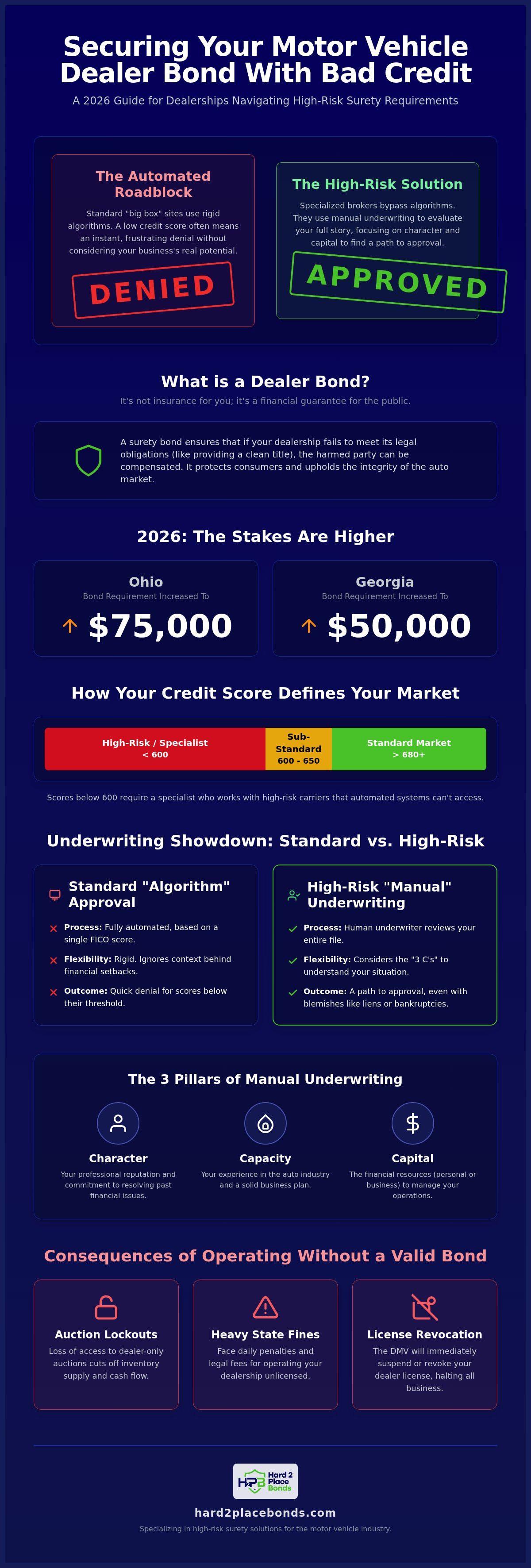
States require these bonds to maintain the integrity of the automotive market. They protect consumers from title fraud and ensure that bank drafts are honored. Since the surety is essentially co-signing for your business, they view auto dealers as high-risk. This is especially true for used car dealer bond bad credit scenarios in 2026. With Ohio increasing requirements to $75,000 and Georgia moving to a $50,000 limit, the financial stakes for surety companies have never been higher. This increased liability makes it harder for those with financial setbacks to find a motor vehicle dealer bond through traditional channels.
Why Credit Scores Dictate Bond Eligibility
Surety underwriters use credit scores as a barometer for risk. There's a proven correlation between personal financial management and the likelihood of a bond claim. In the "Standard Market," dealers with scores above 680 enjoy low rates and easy approvals. However, once a score drops below 650, you enter the "Sub-Standard Market." Most standard carriers stop offering approvals entirely when scores hit the 600 mark. This is where a motor vehicle dealer bond bad credit specialist becomes necessary. They look beyond the number to find a path to approval that automated systems simply can't see.
The Consequences of Operating Without a Valid Bond
Operating without an active bond isn't just a paperwork error; it's a threat to your business's existence. If your bond is cancelled or you can't secure a renewal, you'll face severe penalties:
- License Revocation: The DMV will immediately suspend or revoke your dealer license.
- State Fines: You can face heavy daily penalties and legal fees for unlicensed operation.
- Auction Lockouts: You'll lose access to dealer-only auctions and floor plan financing, cutting off your inventory supply and cash flow.
How High-Risk Surety Underwriting Differs from Standard Approvals
Standard "big box" insurance sites rely on rigid algorithms. If your FICO score doesn't hit their specific threshold, you're denied in seconds. This binary approach ignores the nuances of business ownership and the realities of financial recovery. High-risk underwriting for a motor vehicle dealer bond bad credit case takes a different path. Instead of a computer making the final call, a human underwriter reviews your specific file. They evaluate the three pillars of risk: Character, Capacity, and Capital. They want to see that you're committed to your business and have a plan to manage your obligations, regardless of past financial struggles.
A specialized broker acts as your advocate during this manual review. They don't just submit a score; they present a "risk narrative" to the carrier. This story explains the context behind the numbers. Perhaps a medical emergency or a difficult divorce impacted your credit, but your business operations remain sound. By obtaining a surety bond through experts who understand these nuances, you transform a flat rejection into a productive business conversation.
The Role of Specialized High-Risk Carriers
Standard markets often close their doors to anyone with a score below 600. Specialized high-risk carriers exist specifically to fill this gap, often working with applicants in the 500 to 580 range. These carriers require more detailed financial disclosures, such as bank statements or business plans, to offset the perceived risk. While you'll likely pay higher premiums, the trade-off is the ability to secure your license and start generating revenue. Programs like the SBA's Surety Bond Guarantee Program highlight how the government and private sector collaborate to support small businesses that face these hurdles.
Addressing Bankruptcies, Liens, and Civil Judgments
Financial red flags don't have to be deal-breakers. Underwriters view a discharged bankruptcy much more favorably than an active one. It represents a fresh start with cleared liabilities. If you have outstanding tax liens, showing a documented payment plan is essential. It proves you're taking responsibility for your debts. Similarly, civil judgments can be managed if you provide proof of resolution or an ongoing settlement. Being transparent about these issues helps build the trust necessary for approval. If you're ready to see what options are available for your specific situation, you can start your application today to get a professional review of your file.
Evaluating the Real Cost of a Bad Credit Auto Dealer Bond in 2026
Calculating the cost of a motor vehicle dealer bond bad credit profile requires a clear understanding of premiums versus bond amounts. The "bond amount" is the total coverage required by your state, but the premium is the actual price you pay. For applicants with strong credit, premiums usually fall between 1% and 3% of the bond's value. High-risk applicants, however, should budget for rates between 5% and 15%. This higher range reflects the increased risk a surety company assumes when backing a business with past financial challenges.
The total bond amount you must carry varies significantly by state and license type. Recent regulatory changes have pushed these requirements higher to provide better consumer protection. As of April 1, 2026, Ohio used car dealers are required to carry a $75,000 bond. Georgia followed a similar path on July 1, 2026, increasing its used dealer bond requirement to $50,000. These higher limits mean that even a 10% premium can result in a significant annual expense. This is why partnering with commercial surety bond specialists is so important. They have the access to shop your file through niche carriers to find the most competitive quote. You can also research the SBA Surety Bond Guarantee Program to understand how federal support helps small businesses navigate these bonding hurdles.
Factors That Influence Your Premium Quote
Underwriters look at more than just a single number. They analyze the specific details of your credit history to determine where you fall on the 5% to 15% scale. Recent collections or active tax liens will drive costs higher. Conversely, older medical debt or a discharged bankruptcy from several years ago are viewed more leniently. Your time in business also plays a role; a dealer with several years of clean operations is seen as more stable than a brand-new startup. Finally, the specific state penalty amount acts as the multiplier for your rate, making state-specific updates a major factor in your total licensing overhead.
Financing Your Surety Bond Premium
Paying a large premium in one lump sum can strain your dealership's operating capital. Premium financing is a common solution that allows you to spread the cost over several months. Most high-risk bonds require a down payment ranging from 25% to 40% of the total premium. The remaining balance is then paid in manageable monthly installments. This approach preserves your cash flow, allowing you to put more money toward inventory and marketing. Financing turns a large regulatory hurdle into a predictable monthly line item that keeps your business compliant and your lot open.
5 Steps to Secure Your Car Dealer Bond Despite Financial Setbacks
A low credit score is a hurdle, not a wall. Securing a motor vehicle dealer bond bad credit profile in hand requires a methodical approach that moves beyond simple automation. You need to build a professional case that proves your dealership is a responsible risk. By following these five steps, you can navigate the 2026 licensing landscape with confidence.
- Step 1: Obtain a current credit report. Don't guess your score. Get a full report from all three bureaus and identify any errors. Disputing a single inaccurate collection can sometimes provide the point boost needed for a better rate tier.
- Step 2: Prepare your narrative. Write a brief, professional explanation for major financial setbacks. If a 2024 medical emergency or a business partnership dissolution caused your score to dip, providing this context helps a manual underwriter see the person behind the numbers.
- Step 3: Organize your financial statements. Gather proof of liquidity and business assets. Showing that you have the "Capital" to handle small claims proves your business is stable despite a personal credit history.
- Step 4: Partner with a national surety bond broker. You need an advocate with access to non-standard markets. A specialized broker knows which carriers are currently aggressive in the high-risk auto dealer space.
- Step 5: Complete the application with full transparency. Use the start application portal to submit your documents. Provide all requested details upfront to avoid delays during the manual review process.
The Importance of Transparency in the Application
Hiding financial history is the fastest way to get an automatic rejection. Underwriters have access to deep background checks; if they find an undisclosed tax lien or a pending judgment, it signals a lack of character. Instead, lean into your turnaround story. Explain what happened, how it's being resolved, and why your business is now on solid ground. Honesty builds trust with the surety carrier. When an underwriter trusts your transparency, they are much more likely to find a creative way to approve your file.
Graduating to Better Rates: The Long-Term Strategy
Your high-risk premium isn't a life sentence. Think of your first year as a proving ground. By staying compliant and avoiding bond claims, you build a "surety track record" that carries weight. Use the next twelve months to settle old debts and improve your personal FICO score. When your renewal comes up in 2027, your broker can present your improved profile to the market to secure a lower rate. For more details on this transition, see our high-risk surety bond placement 2026 guide. If you're ready to take the first step toward your license, submit your details for review and let us find the right carrier for your situation.
Why a Specialized Broker is Essential for Your Dealership’s Licensing Success
Most dealers start their search at a local "Big Box" insurance agency. While these firms are excellent for standard business liability, they often hit a wall with specialized surety needs. They rely on standard carriers that use automated "pass or fail" systems. If you're seeking a motor vehicle dealer bond bad credit case in hand, these automated systems will likely trigger an instant rejection. A specialized broker doesn't rely on these rigid standard markets. We have spent years building relationships with non-standard carriers that aren't available to the general public. These niche markets are designed for the "hard to place" risk, and we know exactly how to package your application to get their attention.
We position ourselves as your tenacious advocate. When a standard carrier sees a 550 credit score, they see a liability. When we look at that same file, we see a business owner ready for a fresh start. By working with a motor vehicle dealer bonds specialist, you're hiring someone to tell your story to an underwriter who actually listens. This advocacy is what turns a "denied" message into a "licensed" dealership. We don't give up when a standard system says no; we find the alternative path that keeps your business moving forward.
Navigating National Requirements with a Single Partner
Many of our clients operate in multiple states or plan to expand their footprint. Each state has its own quirks, like the 2026 increases in Ohio and Georgia. Managing different brokers for different states is a logistical nightmare that leads to compliance gaps. A national partner provides a single point of contact, ensuring your bonding remains consistent regardless of where you do business. If you're still learning the ropes, our guide on surety bond meaning provides a solid foundation for understanding these three-party agreements and why they are vital for your authority to operate.
Beyond the Dealer Bond: Comprehensive Support
Your dealership's needs might evolve over time. You may eventually need sales tax bonds or even contractor license bonds if your business model expands into service or installation. Having a long-term relationship with a high-risk specialist means you don't have to restart the "explanation" process every time you need a new bond. We maintain your file and understand your history. This "Calm Competence" approach reduces the stress of licensing renewals and allows you to focus on selling cars. We aren't just a vendor; we're a partner invested in your long-term growth and your journey toward credit recovery.
Secure Your Dealer License and Move Toward Success
Securing a motor vehicle dealer bond bad credit profile in hand is a challenge you can overcome with the right strategy. We've discussed how manual underwriting and a professional risk narrative replace the instant rejections of automated platforms. By prioritizing transparency and organizing your financial story, you can satisfy state licensing requirements and get your inventory moving. Remember that your current premium isn't a permanent fixture; it's a bridge to a stronger credit future and lower rates as your business grows.
As a specialized division of Hako Risk & Insurance, we offer national coverage across all 50 states. Our high-risk underwriting experts are dedicated to finding solutions where others only see limitations. We understand the pressure of opening or renewing a dealership, and we're here to act as your tenacious advocate in the surety market. You've done the hard work of building your business plan; now let us handle the hurdles of the bonding process with calm competence.
Start your high-risk dealer bond application today to see how we can turn your licensing goals into a reality. We're ready to help you build a compliant and profitable dealership.
Frequently Asked Questions
Is it possible to get a motor vehicle dealer bond with a 500 credit score?
Yes, you can secure a motor vehicle dealer bond bad credit even with a score as low as 500. While standard markets usually reject applicants below 600, specialized high-risk carriers focus on your business's overall health and your professional narrative. You'll likely face higher premiums, but your score isn't an automatic disqualifier. Working with a national broker who understands niche underwriting is the best way to get these difficult files approved.
How much more does a bad credit auto dealer bond cost compared to standard rates?
High-risk applicants typically pay significantly more than those with standard credit. While a dealer with a 700 score might pay a premium of 1% to 3% of the bond amount, a bad credit profile can push that rate to 5% or 15%. For a $50,000 bond, this difference is substantial. These higher rates reflect the increased risk the surety takes when backing an individual with a history of financial setbacks.
Will I be required to provide collateral for a high-risk dealer bond?
Collateral is rarely required for motor vehicle dealer bonds, even in high-risk scenarios. Most specialized carriers prefer to charge a higher premium rather than tying up your dealership's liquid assets. In some extreme cases involving very large bond amounts or severe active legal issues, a surety might request a letter of credit. However, for the vast majority of used car dealers, the bond is issued based on the premium and indemnity agreement alone.
Can I get a bond if I have an open bankruptcy or unpaid tax liens?
You can often secure a bond with tax liens or a discharged bankruptcy, but an open bankruptcy is much more difficult. Most surety companies require a bankruptcy to be fully discharged before they'll consider an application. For tax liens, providing a documented payment plan shows the underwriter that you're resolving the debt. This transparency builds the trust necessary for a motor vehicle dealer bond bad credit approval despite past financial red flags.
How long does the approval process take for a high-risk applicant?
The approval process for a high-risk applicant usually takes 24 to 48 hours. Because these files require a manual review by an underwriter rather than an instant computer score, you should expect a slight delay. Providing all your documents, such as credit reports and your "turnaround story," upfront helps speed things along. Once the underwriter reviews your file and issues a quote, the bond can be filed immediately after you make the payment.
Do all states have the same motor vehicle dealer bond requirements?
No, every state sets its own bond amounts and licensing rules. For example, Ohio requires a $75,000 bond as of April 2026, while Georgia's requirement is $50,000. Some states also have different rules for new versus used car dealers. It's vital to check your specific state's DMV or regulatory agency to ensure you're applying for the correct bond amount. A national broker can help you navigate these state-specific variations efficiently and accurately.
Can I finance the premium for my bad credit surety bond?
Yes, premium financing is available for most high-risk dealer bonds. This allows you to pay a down payment, often between 25% and 40%, and spread the remaining balance over several monthly installments. Financing is a smart way to preserve your dealership's cash flow for inventory and marketing. It turns a large annual licensing expense into a predictable monthly cost, making it much easier for new or struggling businesses to stay compliant and operational.
What happens to my bond if my credit score improves during the year?
Improving your credit during the year won't change your current premium, but it will help at renewal. Surety bonds are typically non-refundable once issued, so you won't get a partial refund if your score jumps mid-term. However, a better score allows your broker to shop your file to standard markets for the following year. This is the primary way to "graduate" from high-risk rates to the much lower 1% to 3% standard premiums.