A credit score is a starting point for a conversation, not a final verdict on your professional capability. In the 2026 surety market, many entrepreneurs mistakenly believe that securing a license and permit bond bad credit is an impossible hurdle after receiving a standard rejection. It's incredibly frustrating to face automated "no" responses when you're trying to launch or grow, especially when you fear a licensing delay could lead to a permanent business closure. You've worked hard to build your business, and a past financial setback shouldn't stand in the way of your professional future.
We recognize these challenges and offer a path forward through specialized underwriting that focuses on solutions rather than limitations. This guide will show you exactly how to navigate the approval process and secure the essential licenses you need to stay compliant. We'll break down the current market landscape for high-risk applicants, explain how modern underwriters evaluate your file, and provide a clear roadmap to getting your bond issued by an advocate who understands your specific situation. You'll gain the clarity needed to move past the frustration and get back to work with the confidence of a fully licensed operation.
Key Takeaways
- Understand the three-party legal guarantee required by government agencies and how it functions to keep your business compliant.
- Learn how specialized non-standard underwriting protocols allow you to secure a license and permit bond bad credit even after a standard carrier says no.
- Identify the difference between instant-issue and underwritten bonds to determine the fastest path toward your specific business license.
- Discover why an automated rejection isn't the end of the road and how human-led advocacy can turn a "no" into a "yes."
- Gain insights into 2026 market rates for challenged credit to accurately budget for your bond costs without any surprises.
What Is a License and Permit Bond and Why Does Credit Matter?
Think of a license and permit bond as a professional promise backed by a financial guarantee. It's a legal tool that ensures your business follows specific government regulations and local ordinances. In 2026, license and permit bonds are the non-negotiable gatekeepers for legal business operation because they provide the state with a way to hold professionals accountable. Without this bond, you can't get your license, and without your license, you can't open your doors.
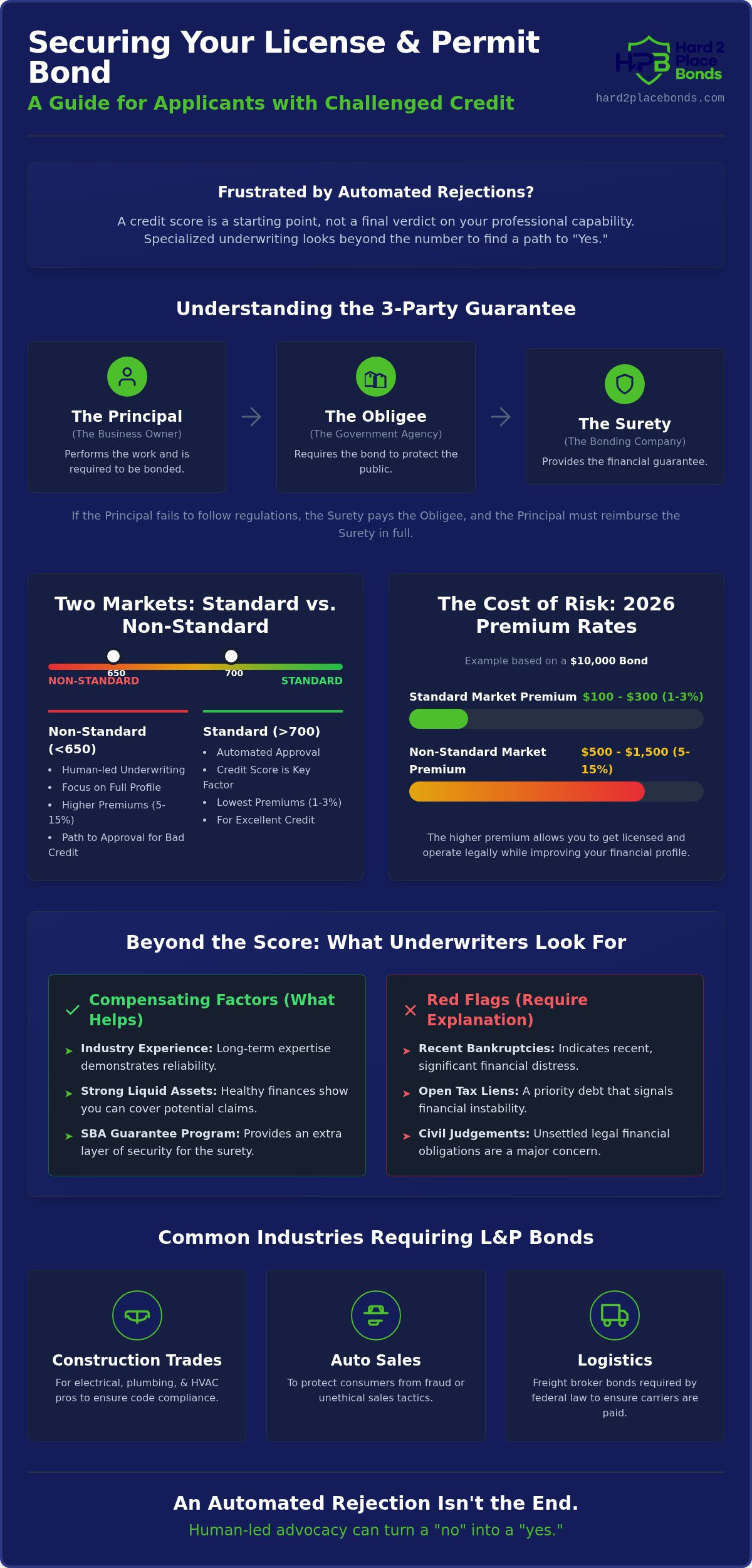
A Surety bond creates a unique three-party relationship. First, there's the Principal (that's you), who is the party performing the work. Second, the Obligee is the government entity that requires the bond to protect the public. Finally, the Surety is the bond company that provides the financial backing. If you fail to follow the rules, the Surety pays the Obligee, and you are then legally required to reimburse the Surety in full.
Why does your credit score play such a massive role in this process? It's because surety is a form of credit, not traditional insurance. Standard insurance companies expect a certain number of losses and build that into their pricing. In contrast, a surety company expects zero losses. They view the bond as a line of credit they're extending to you. This is why securing a license and permit bond bad credit feels so difficult; traditional carriers see a low score as a signal that you might not be able to repay them if a claim occurs.
The Legal Necessity of Being Bonded
Public protection is the core reason these bonds exist. While general liability insurance protects your business from accidents, a bond protects the consumer from your business's potential failure to follow the law or ethical standards. Operating without the required bond is a high-stakes gamble. It often leads to immediate license revocation, significant financial penalties, and a "blacklisted" status that makes it nearly impossible to get bonded in the future.
Common Industries Requiring L&P Bonds
Many sectors cannot function without these guarantees. Here are the most common industries where we see applicants needing specialized help:
- Construction Trades: Most states require contractor license bonds for electrical, plumbing, and HVAC professionals to ensure they follow local building codes.
- Auto Sales: To protect buyers from title fraud or unethical sales tactics, motor vehicle dealer bonds are mandatory for most dealerships.
- Logistics: Federal law requires freight broker bonds to ensure carriers get paid for their services.
Whether you're a contractor or a dealer, the bond is your ticket to the market. Even if your credit isn't perfect, understanding these mechanics is the first step toward getting approved.
How Credit Scores Impact Bond Approval and Pricing
The surety industry operates within two distinct ecosystems. The standard market caters to applicants with high credit scores, typically 700 or above, offering them the lowest possible rates. However, if your score falls below 650, your application enters the non-standard market. This transition triggers specialized underwriting protocols where agents look deeper than just a number. For those seeking a license and permit bond bad credit , this shift is actually a positive step. It moves your file from an automated refusal to a desk where a human underwriter can evaluate your full story.
Surety companies view lower credit as an increased risk of indemnity claims. Since you're legally required to repay every dollar the surety pays out on your behalf, they need to feel confident in your financial stability. In 2026, market rates for non-standard bonds generally range from 5% to 15% of the bond total value. While higher than standard rates, this premium allows you to legally operate while you work on improving your financial profile. The surety is essentially betting on your future success despite past setbacks.
Factors Beyond the Score: What Underwriters Look For
Underwriters aren't robots. They seek "compensating factors" that offset a lower score. Your length of time in the industry and specific business experience carry significant weight. If you've successfully managed trade projects for a decade, that expertise matters more than a missed credit card payment from years ago. They want to see that you know your craft and understand the regulations of your industry.
They also examine the specific nature of your credit history. Recent bankruptcies, open tax liens, or civil judgments are red flags that require a clear explanation. Conversely, showing strong liquid assets or a healthy personal financial statement can bridge the gap. Programs like the SBA's Surety Bond Guarantee Program provide additional support for small businesses, offering a layer of security that encourages underwriters to approve applications they might otherwise decline.
The Cost of Risk: Calculating Your Premium
Understanding the math helps you budget effectively for the year ahead. If you need a $10,000 bond and receive a 10% rate based on your profile, your annual premium is $1,000. While this is an upfront cost, many providers offer premium financing to spread that expense over several months. This strategy reduces the immediate burden on your cash flow and keeps your capital available for operations.
This bond is more than just a regulatory hurdle; it's a tool that enables you to generate revenue. By staying bonded and avoiding claims, you build a positive history with the surety. Over time, this professional track record can lead to lower rates and better terms. If you're ready to see which rates apply to your business, you can submit your details for a review today.
Key Types of License and Permit Bonds for Bad Credit Applicants
Securing a license and permit bond bad credit depends heavily on the specific type of bond your industry requires. Some bonds are "instant-issue," meaning they're approved based on basic business information without a rigorous credit check. These usually involve lower bond amounts and lower risk to the surety. However, most professional licenses require "underwritten" bonds. These require a closer look at your financial history because the potential for a claim is higher. Underwriters prioritize bonds where the risk is clearly defined and the applicant shows a commitment to compliance. Getting a license and permit bond bad credit often means moving from these automated systems to a more personalized review process.
State-mandated bonds vary in difficulty based on the financial risk they represent. For example, a notary bond is almost always approved instantly regardless of your credit score. In contrast, motor vehicle dealer bonds require more scrutiny because they involve high-value transactions and potential consumer fraud risks. Understanding where your bond falls on this spectrum helps you set realistic expectations for the approval timeline and the documentation you'll need to provide.
Contractor License Bonds for High-Risk Trades
General and specialty contractors face unique hurdles when their credit isn't perfect. States have specific requirements for trades like electrical, plumbing, and HVAC, often mandating contractor license bonds before a single job can be started. While a license bond is usually attainable even with a low score, it's important to realize that bad credit can impact your ability to secure the performance bonds needed to bid on larger municipal projects. If you're looking for a deep dive into specific trade requirements, our 2026 Contractor License Bond Guide: All Trades provides a comprehensive breakdown for every specialty.
Freight Broker (BMC-84) Bonds
The freight industry faces some of the strictest bonding requirements in the country. To maintain operating authority, the Federal Motor Carrier Safety Administration (FMCSA) requires a $75,000 BMC-84 bond. This high bond amount makes it historically difficult for applicants with credit challenges. Surety companies view these as high-risk because they guarantee payments to motor carriers. If a broker fails to pay, the surety is on the hook for a significant sum. Despite these challenges, we specialize in finding paths to approval for new authority. You can learn more about the specific application steps in our 2026 Guide: BMC-84 Freight Broker Bond for New Authority.
Steps to Secure a Bond After a Rejection
Receiving a "no" from a standard insurance carrier can feel like a dead end for your business plans. However, a rejection from an automated system is not a permanent ban; it's simply a sign that your profile doesn't fit a rigid, computerized mold. When you're applying for a license and permit bond bad credit , the most important rule is full disclosure. Underwriters hate surprises. If you have a past bankruptcy or an open judgment, be upfront about it. Providing a clear, honest explanation yourself is always better than letting an underwriter discover a red flag during a background check. Transparency builds the trust necessary for a human underwriter to override an automated refusal.
You can effectively use "compensating factors" to tilt the scales in your favor. These are strengths in your professional background that offset the perceived risk of a low credit score. A specialized broker acts as your personal advocate, translating your unique business story into a language that high-risk underwriters trust and accept.
Finding the Right High-Risk Surety Partner
A general insurance agent often lacks the specific connections needed for non-standard risks. They might only work with a handful of carriers that auto-decline anything below a 650 score. A specialized surety broker has direct access to "B-rated" and non-standard markets specifically designed for these situations. They understand the nuances of obtaining a surety bond when the standard path is blocked. This specialized access is often the only difference between a stalled license and a successful business launch.
Improving Your Application Profile
You can strengthen your case by highlighting your industry experience. If you can prove several years of successful operation in your trade, it demonstrates professional stability that offsets financial setbacks. Also, take a moment to check your credit report for small errors. Resolving a single misreported late payment can sometimes nudge your score just enough to qualify for more favorable terms. For extremely high-risk bonds with high face values, you might consider a co-signer with stronger credit or even offering additional collateral to secure the guarantee. These steps show the surety that you're a serious professional who is fully committed to your legal and financial obligations.
Don't let a standard rejection stop your progress. If you're ready to move past the automated "no" and speak with an expert who can find a solution, you can submit your application for review right now.
Hard 2 Place Bonds: Your Advocate in the Surety Market
Our philosophy is built on the belief that a credit score is just one piece of a much larger puzzle. While standard carriers rely on automated algorithms that see only numbers, we focus on the person and the business behind the application. We understand that financial setbacks happen and that they don't define your professional integrity or your ability to run a successful operation. This human-centric approach is why we excel at securing a license and permit bond bad credit for applicants who have been turned away elsewhere. We don't just process paperwork; we build a case for your approval by highlighting your strengths.
As a specialized division of Hako Risk & Insurance, we leverage deep expertise in complex risk management to find solutions where others see only obstacles. Our national reach allows us to secure L&P bonds across all 50 states. We possess the local knowledge required to handle specific state complexities, ensuring your business remains compliant no matter where you operate. If you're ready to get your business back on track, you can Start Your Application today and let us advocate for your future.
A Solution-Oriented Approach to Licensing
We pride ourselves on being industry insiders who know how to navigate the most challenging niche markets. Whether you're working in solar decommissioning or managing a freight brokerage, we understand the specific regulatory hurdles you face. Our team combines empathetic communication with professional authority to bridge the gap between high-risk applicants and non-standard surety markets. For a broader look at how we handle these complex scenarios, see our High-Risk Surety Bond Placement: 2026 Guide.
Getting Started Today
The intake process is designed to be efficient and purposeful. To speed up your quote delivery, have your basic business details, bond requirements, and a brief explanation of any credit challenges ready. We move quickly from acknowledging your situation to offering a concrete path forward. Most clients receive a response or a quote within 24 to 48 hours; our goal is to reduce friction and help you move toward your next professional step without unnecessary delays. We're here to listen, adapt, and help you succeed. Contact Hard 2 Place Bonds for a specialized quote and secure the professional backing your business deserves.
Take the Next Step Toward Your Professional Goals
Securing a license and permit bond bad credit is entirely possible when you move away from automated systems and toward human-led advocacy. You've learned that your credit score is simply a starting point for a conversation, not a final decision. By focusing on compensating factors and choosing a broker with national underwriting expertise, you can overcome the frustration of past rejections. We specialize in finding solutions for individuals with credit scores under 600 because we believe your business potential is worth more than a single number.
Our solution-oriented advocate team is ready to help you navigate the complexities of the 2026 market and get your doors open. Don't let a standard refusal stall your progress any longer. Secure your business license today with a specialized bond quote and start building the future you deserve. You have the skills and the drive; we have the tools to make it official. We're here to ensure your professional journey continues with confidence and clarity.
Frequently Asked Questions
Can I get a license and permit bond with a 500 credit score?
Yes, you can absolutely secure a bond with a 500 credit score. While standard carriers usually decline applications below 650, specialized non-standard surety markets exist specifically for this range. These underwriters look at compensating factors like your industry experience and business stability rather than just the number. We work with applicants across the entire credit spectrum to ensure they can legally operate their businesses without being held back by past financial challenges.
How much more does a bad credit license bond cost?
Applicants with challenged credit typically pay a higher premium than those with excellent scores. In the 2026 market, rates for a license and permit bond bad credit usually range from 5% to 15% of the total bond amount. For example, a $10,000 bond might cost between $500 and $1,500 annually. This is higher than the 1% to 3% rates offered to high-credit applicants but allows you to maintain compliance and generate revenue.
Will a past bankruptcy prevent me from getting a permit bond?
A past bankruptcy does not automatically disqualify you from obtaining a bond. Underwriters are generally more concerned with open bankruptcies or very recent filings. If your bankruptcy has been discharged and you've shown a period of financial stability since then, many non-standard sureties will consider your application. Providing a clear explanation of the circumstances and showing current liquid assets can significantly improve your chances of approval during the specialized underwriting process.
Do I need to pay for the bond every year?
Most license and permit bonds require annual premium payments to remain active and valid. The bond's term usually matches your state license period, which is often one year. Some states offer multi-year terms, but you'll still need to renew the bond to prevent your license from being revoked. It's vital to track your renewal dates closely, as operating with an expired bond can lead to immediate fines or the loss of your business authority.
What is the difference between a BMC-84 and a BMC-85 for freight brokers?
A BMC-84 is a surety bond, while a BMC-85 is a trust fund agreement. With a BMC-84, you pay an annual premium to a surety company that guarantees the $75,000 requirement. A BMC-85 requires you to place the full $75,000 into a trust, which ties up significant capital. For brokers with credit challenges, the BMC-84 is often the preferred choice because it preserves cash flow while meeting federal FMCSA requirements for your operating authority.
How long does it take to get approved for a high-risk bond?
Approval times for high-risk bonds typically range from 24 to 48 hours. Because these applications require a manual review by a human underwriter instead of an automated system, the process takes slightly longer than a standard bond. You can speed up the delivery by having your business financial statements and a brief explanation of any credit issues ready. We focus on moving quickly to ensure your licensing process stays on schedule and your doors open.
Can I improve my bond rate over time as my credit improves?
Yes, your bond premium can decrease as your credit score and business history improve. Every time your bond comes up for renewal, the surety re-evaluates your risk profile. If you've made timely payments and avoided claims on your bond, you'll be in a much stronger position to negotiate a lower rate. Building a long-term relationship with your surety broker helps you transition from non-standard rates toward standard market pricing as your profile strengthens.
Are there any license bonds that do not require a credit check?
Some smaller, low-risk bonds are "flat-rated" and do not require a credit check for approval. These are typically bonds with low face values, such as notary bonds or certain small municipality permits. However, for most professional licenses like contractor or auto dealer bonds, a credit check is a standard part of the risk assessment. Even in these cases, specialized underwriting ensures that a low score isn't a barrier to your professional success.