

A "no" from a traditional surety company doesn't mean your freight brokerage is finished. Many brokers feel the sting of rejection when applying for their BMC-84, especially when automated systems focus solely on a credit score. Understanding your freight broker bond cost shouldn't feel like a mystery or a roadblock to your FMCSA compliance. It's stressful to manage the constant pressure of regulatory changes while trying to keep your cash flow steady.
We know the frustration of being marginalized by systems that don't see the full picture of your business. That's why we've created this 2026 pricing guide. You'll discover how your premium is actually calculated as a percentage of the $75,000 requirement and learn how to secure a bond even with significant credit challenges. We'll also cover the critical January 16, 2026, FMCSA rule changes regarding bond replenishment and why the BMC-84 remains the most practical choice for most brokers. By the end of this guide, you'll have a clear path to maintaining your operating authority without overpaying or tying up all your working capital.
Key Takeaways
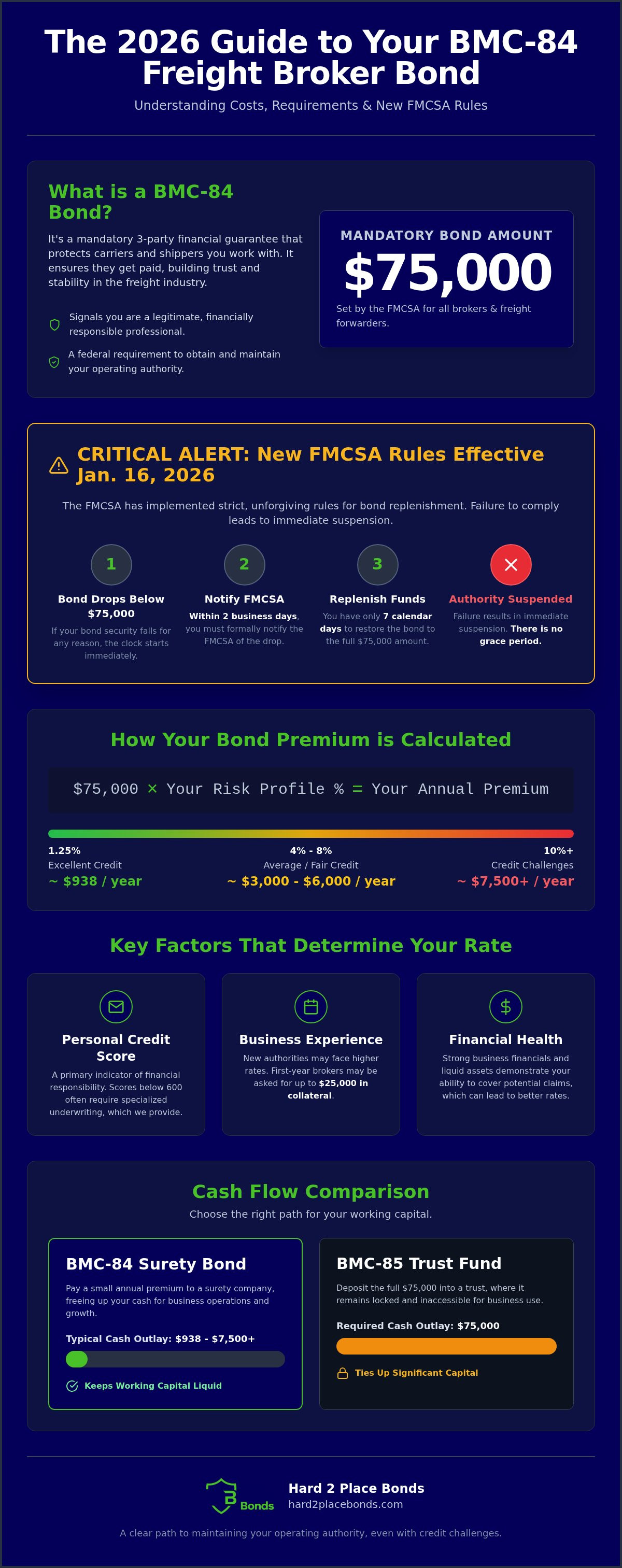
- Understand the mandatory $75,000 BMC-84 requirement and the strict 2026 FMCSA rules for replenishing bond security within seven days of a drop.
- Learn how your freight broker bond cost is calculated as a percentage of the total bond amount based on your credit profile and business experience.
- Compare the cash-flow advantages of a BMC-84 surety bond against the heavy capital requirements of a BMC-85 trust fund.
- Discover specialized underwriting strategies that provide a path to approval even if you've faced prior rejections due to credit challenges.
- Prepare for a successful application by organizing your business financials and understanding potential first-year collateral requirements for new brokers.
Understanding the $75,000 BMC-84 Freight Broker Bond Requirement
The BMC-84 bond is the backbone of your brokerage's legal operation. It acts as a three-party agreement between your business, the FMCSA, and a surety provider. Unlike traditional insurance that protects you from liability, freight broker surety bonds protect the carriers and shippers you work with every day. If a broker fails to pay a carrier for services rendered, the bond ensures those funds are available to satisfy that debt. This financial guarantee is mandatory for anyone seeking to obtain or maintain their brokerage authority.
The FMCSA sets the bond amount at a flat $75,000 for all brokers and freight forwarders. This isn't a suggestion; it's a federal requirement designed to stabilize the transportation industry. While the bond amount is fixed, your actual freight broker bond cost depends on how a surety company evaluates your risk profile. We specialize in helping brokers who might be struggling to find coverage elsewhere, ensuring you stay compliant even when traditional markets turn you away.
Purpose of the Freight Broker Bond
Why does this bond exist? It's about trust. Carriers need to know that if they haul a load, they'll get paid. The bond prevents unethical brokers from vanishing with carrier fees or mismanaging funds. By maintaining this coverage, you contribute to a healthy national freight ecosystem where businesses can trade with confidence. It signals to your partners that you are a legitimate, financially responsible professional who respects the integrity of the industry. Without this layer of protection, the risk of non-payment would cripple the flow of goods across the country.
2026 FMCSA Compliance Standards
Effective January 16, 2026, the FMCSA has tightened the screws on financial responsibility. The new rules are unforgiving. If your bond security drops below the $75,000 threshold for even a single day, you must notify the FMCSA within two business days. You then have only seven calendar days to replenish the amount. Failure to do so leads to the immediate suspension of your operating authority. There is no grace period for administrative errors or missed payments. Continuous coverage is the only way to stay on the road. This makes choosing a reliable partner even more critical because a single lapse can halt your revenue entirely. We focus on placing these bonds quickly so you don't face a single hour of downtime.
Factors That Determine Your Freight Broker Bond Premium
Your freight broker bond cost isn't a random figure pulled from thin air. Underwriters calculate your premium as a percentage of the $75,000 bond requirement. This percentage typically ranges from 1.25% for those with excellent credit to over 10% for higher-risk applicants. The surety company is essentially betting on your financial reliability. They want to know that if a claim arises, you have the means to resolve it or reimburse the surety for any payouts made on your behalf.
The Role of Personal Credit Scores
Underwriters view your credit history as a roadmap of your financial responsibility. They look beyond the three-digit score to see the context of your financial life. Standard tiers usually apply to scores above 700, while scores below 600 fall into the poor credit category. If you have a history of bankruptcy or civil judgments, you'll likely face rejections from standard providers. We specialize in these non-standard cases. We find ways to secure approval by looking at your current business health rather than just past setbacks. A single score doesn't tell your whole story, and it shouldn't stop your business from moving forward.
Business Experience and Industry History
Experience matters in the transportation world. New authorities often face a steeper climb. If you're in your first year of operation, you might even be asked for $25,000 in cash collateral in addition to your annual premium. This acts as a safety net while you prove your operational stability. A clean claims history is your best tool for lowering costs over time. Because the FMCSA can now suspend the operating authority for financial lapses, showing a history of timely payments to carriers is vital for your long-term success. Reliable record-keeping is a direct path to better rates.
Liquid assets and strong financial statements can sometimes tilt the scales in your favor. Showing you have cash on hand suggests you can resolve disputes before they turn into bond claims. If you feel stuck because of a low score or a lack of industry history, remember that your credit isn't the only factor we consider. You can start your application to see the creative options available for your specific situation. We focus on finding solutions where others only see risk.
BMC-84 Bond vs. BMC-85 Trust Fund: A Cost Comparison
Brokers face a major fork in the road: the BMC-84 surety bond or the BMC-85 trust fund. While both satisfy the FMCSA requirement, the actual freight broker bond cost and the long-term financial impact on your daily operations couldn't be more different. A BMC-85 trust fund requires you to deposit the full $75,000 into a trust. Conversely, a BMC-84 bond only requires an annual premium payment. For most businesses, keeping that capital accessible is the difference between growth and stagnation.
The 2026 regulatory updates have made the trust fund even more restrictive. New rules limit the types of assets held in a BMC-85 to cash, treasury bonds, or irrevocable letters of credit from federally insured banks. This means you can't use other business assets or property to satisfy the requirement. When you calculate your total freight broker bond cost , you have to look beyond the premium and consider the value of your liquidity. Tying up such a large sum of cash is a heavy burden for any brokerage.
Cash Flow and Working Capital
Choosing a BMC-84 bond allows you to keep $75,000 in your business bank account. Think about what that money can do. It covers payroll, pays for marketing, or acts as a buffer for slow-paying shippers. If you tie that money up in a trust fund, it's effectively dead capital. The opportunity cost is staggering; $75,000 invested back into your brokerage could generate significantly more revenue than the cost of a bond premium. Most brokers find that a surety bond is the only scalable way to manage their authority. You can find more details on our Freight Broker Trust Fund vs Bond Comparison page.
Claims Handling and Legal Protection
The two options also differ in how they handle disputes. When a carrier files a claim against a BMC-85 trust fund, the trustee often pays the claim out of your deposited funds with very little investigation. This can leave you vulnerable to fraudulent or inaccurate claims. A surety company acts as your advocate. Before any money is paid out on a BMC-84 bond, the surety performs a thorough investigation. They require the carrier to provide proof of the debt and give you a chance to defend your position. This layer of professional oversight protects your reputation and your finances. Brokers prefer this advocacy because it prevents unnecessary hits to their record and their bottom line. We work to ensure you have this protection, even if you've been rejected by other providers in the past.
How to Secure a Freight Broker Bond with Bad Credit
A low credit score shouldn't be a death sentence for your brokerage. We understand that life happens. Medical bills, divorce, or past business failures can drag down a score even if you're currently a reliable professional. Standard surety companies often use automated systems that don't account for your industry expertise or current revenue. If you've been told "no" elsewhere, it's time to shift your focus toward specialized underwriting that values your potential over your past.
While your initial freight broker bond cost will reflect the higher risk, securing a bond is the first step toward rebuilding your reputation. We act as your advocate, presenting your case to underwriters who look at the human being behind the numbers. We don't just see a low credit score; we see a business owner with years of transportation experience and a clean claims history. For those with credit scores below 600, premiums may range from 7% to 10% of the bond amount, but this is a bridge to keeping your authority active.
Navigating the High-Risk Underwriting Process
Specialized underwriters prioritize different factors than traditional banks. They look for industry longevity and evidence that you've resolved previous financial issues. Providing a narrative explanation for credit blemishes can often make the difference between a denial and an approval. For a deeper look at this process, see our High-Risk Surety Bond Placement Guide. This professional advocacy ensures your application isn't just another file in a stack; it's a conversation about your business's future and your commitment to FMCSA compliance.
Tips for Lowering Your High-Risk Premium
You can take active steps to reduce your freight broker bond cost even with poor credit. One of the most effective strategies is adding a co-signer with a strong credit profile. This provides the surety with an additional layer of security and can drop your premium percentage significantly. Additionally, providing up-to-date business financial statements that show strong liquid assets can offset personal credit concerns. If you can prove your brokerage is profitable and carries low debt, underwriters are much more likely to offer competitive rates despite a lower personal score.
Remember that your bond rate isn't permanent. As you build a history of clean operations and improve your personal credit score, your renewal costs will naturally decrease. If you're ready to see what's possible for your business, you can start your application today. We focus on finding the "yes" that keeps your authority active and your business growing.
Next Steps: Obtaining Your Freight Broker Bond
Don't wait for your renewal date to start looking for coverage. The 2026 FMCSA enforcement rules leave no room for error. A single day of lapsed coverage can trigger an immediate license suspension. We recommend starting your search at least 30 to 60 days before your current bond expires. This gives you enough time to explore every option and ensure your freight broker bond cost remains manageable. We advocate for your authority by finding the most favorable terms, even when standard markets have walked away from your application. Our goal is to move you from a state of uncertainty to a position of compliant strength.
Preparing Your Application
Accuracy is your best friend when submitting paperwork. Even minor typos in your MC number or legal business name can lead to a rejection by the FMCSA's automated filing system. Proactive preparation prevents these administrative headaches and keeps your authority active. You should have the following items ready for your specialist:
- Full legal name and ownership structure of the brokerage.
- Active MC number or your pending application number.
- Personal financial data for all owners with a 10% or greater stake.
- Recent business financial statements to prove operational stability.
Reviewing the steps on How to Obtain a Surety Bond can help you organize these documents effectively. Being prepared reduces the back-and-forth and gets your filing processed faster. It also signals to underwriters that you're a serious professional who values precision.
Partnering with a Specialized Underwriter
Automated portals often kick out high-risk applications without a second look. We take a different approach. We're industry insiders who understand that your business is more than just a credit score. Our team works directly with underwriters to explain the context of your situation. We look for reasons to say "yes" when others only see risk factors. This consultative method is the most effective way to secure a bond when you've faced previous rejections. It turns a standard refusal into a productive conversation about your business's future.
Once we secure your bond, we handle the electronic filing with the FMCSA on your behalf. This ensures your record is updated immediately and your authority remains in good standing. You don't have to face the stress of a potential suspension alone. We manage the technical details so you can focus on moving freight and growing your revenue. Start your freight broker bond application with our specialists to secure your business future today. We're ready to find the path forward that works for you.
Secure Your Authority and Scale Your Brokerage
Maintaining your FMCSA authority in 2026 requires more than just a $75,000 guarantee; it demands a strategic approach to your freight broker bond cost . You've seen how the BMC-84 bond protects your working capital compared to the restrictive liquidity requirements of a trust fund. Even if past financial hurdles or a low credit score have led to standard rejections, there's a clear path forward through specialized underwriting and professional advocacy.
We specialize in high-risk and bad credit approvals because we believe every transportation professional deserves a fair shot. Our national service and deep industry knowledge allow us to navigate complex hurdles that automated systems simply can't handle. Don't let the fear of license suspension or credit challenges stall your progress. We're here to act as your tenacious partner and find the creative solution your business needs to stay on the road and keep growing.
Get Expert Help Securing Your Freight Broker Bond
Your brokerage has a bright future, and we're ready to help you reach it.
Frequently Asked Questions
What is the current required amount for a freight broker bond?
The Federal Motor Carrier Safety Administration (FMCSA) mandates a $75,000 surety bond for all freight brokers and freight forwarders. This amount is uniform across the United States and serves as a financial guarantee to protect motor carriers and shippers. Whether you're a startup or an established firm, you must maintain this specific coverage level to legally operate your brokerage. Failure to keep this bond active will result in the immediate suspension of your authority.
Can I get a BMC-84 bond if I have a credit score below 600?
You can absolutely secure a BMC-84 bond with a credit score below 600 through specialized high-risk surety providers. While standard companies might issue an automatic denial, we focus on your industry experience and business health to find a path to approval. Your freight broker bond cost will be higher, typically ranging from 7% to 10% of the bond amount, but it allows you to maintain compliance and build your business.
How is the annual premium for a freight broker bond calculated?
Your annual premium is calculated as a percentage of the $75,000 bond amount, primarily based on your personal credit score. Underwriters also evaluate your business financials, years of experience in the transportation industry, and your history of bond claims. For brokers with excellent credit, the rate can be as low as 1.25%, while those with credit challenges will pay a higher percentage that reflects the increased risk to the surety company.
What happens to my broker authority if my bond is cancelled?
If your bond is cancelled, the FMCSA will move to suspend your operating authority immediately. Under the rules effective January 16, 2026, you must notify the FMCSA within two business days if your coverage falls below $75,000. You then have only seven calendar days to replenish the bond security. Operating without an active bond is a serious violation that can lead to permanent loss of your brokerage license and heavy federal fines.
Is a BMC-84 bond better than a BMC-85 trust fund for a new business?
A BMC-84 bond is generally better for new businesses because it preserves your working capital. A BMC-85 trust fund requires you to deposit the full $75,000 in cash, which can cripple a startup's cash flow. While new brokers often face a $25,000 collateral requirement for their first year with a BMC-84, it's still significantly more affordable than tying up your entire operating budget in a restricted trust account.
Do I need to pay the full $75,000 to get a freight broker bond?
You don't need to pay the full $75,000 to obtain a bond; you only pay an annual premium, which is a small fraction of that total. This premium is your freight broker bond cost , and it typically ranges from $938 to $7,500 depending on your risk profile. The surety company provides the full $75,000 guarantee to the FMCSA on your behalf, allowing you to use your liquid assets for daily business operations.
How long does it take to get a freight broker bond filed with the FMCSA?
Once your bond is approved and the premium is paid, the electronic filing with the FMCSA happens almost instantly. Our team handles the transmission of the BMC-84 form directly to the federal system to ensure there's no gap in your coverage. While the underwriting process can take a few days for high-risk applicants, the final step of notifying the government is a purposeful and efficient digital process that protects your authority.
Will my premium go down at renewal if my credit improves?
Your premium can definitely go down at renewal if your credit score improves or your business establishes a longer track record of clean operations. Surety companies reassess risk every year. By paying your carriers on time and avoiding bond claims, you demonstrate that you're a lower risk. We advocate for our clients during the renewal process to ensure they receive the most competitive rates as their financial profile strengthens over time.