

Would you rather let $75,000 of your hard-earned cash sit idle in a restricted account, or put that capital to work scaling your operations? With the January 16, 2026 FMCSA regulations now in full effect, every dollar counts. You've likely felt the pressure of the freight broker trust fund vs bond decision, especially with the strict seven-day replenishment rule threatening your operating authority if a claim arises. It's a high-stakes choice that directly impacts your ability to compete in a tightening market.
We understand the frustration of trying to balance federal compliance with the need for liquid working capital. It's stressful when you feel forced to tie up assets that should be used for hiring or technology. This guide reveals the most capital-efficient ways to secure your authority and maintain your bond without sacrificing your peace of mind. We'll explore the critical differences between BMC-84 and BMC-85 options, how to navigate credit challenges, and which path provides the strongest defense for your business in 2026.
Key Takeaways
- Learn how to maintain FMCSA compliance and avoid sudden authority suspensions under the strict 2026 regulatory framework.
- Understand the critical financial trade-offs in the freight broker trust fund vs bond debate to decide if a BMC-84 or BMC-85 better serves your growth strategy.
- Discover how to preserve your business liquidity and keep $75,000 in your operating account rather than tying it up in a restricted trust.
- See how a surety bond acts as a professional advocate, providing claim investigation services that a trust fund simply cannot offer.
- Find out how specialized underwriting allows brokers with credit challenges to secure authority without being forced into a cash-heavy trust fund.
Understanding the $75,000 FMCSA Financial Security Requirement
Federal law requires every freight broker and forwarder to maintain a minimum of $75,000 in financial security. This mandate isn't just bureaucratic red tape. It acts as a vital safety net for the motor carriers and shippers you work with every day. If a broker fails to pay for services rendered, this security ensures the carrier isn't left empty-handed. Understanding the Surety Bond Meaning is the first step in realizing how this protects the integrity of your business. As you weigh the pros and cons of a freight broker trust fund vs bond, remember that this requirement is about building a foundation of trust in a high-stakes industry.
The Role of the FMCSA in Logistics Oversight
The Federal Motor Carrier Safety Administration (FMCSA) oversees these standards to prevent fraud and financial instability within the national supply chain. This is a federal requirement for any professional seeking interstate operating authority. By enforcing a uniform $75,000 security threshold, the FMCSA helps weed out bad actors and fly-by-night operations. This Freight Broker Bond Explained resource highlights how these regulations have evolved to protect the logistics ecosystem. It creates a level playing field where legitimate brokers can thrive while carriers feel confident they'll be paid for their miles. Without this oversight, the risk of non-payment would cripple the movement of goods across state lines.
Consequences of Non-Compliance in 2026
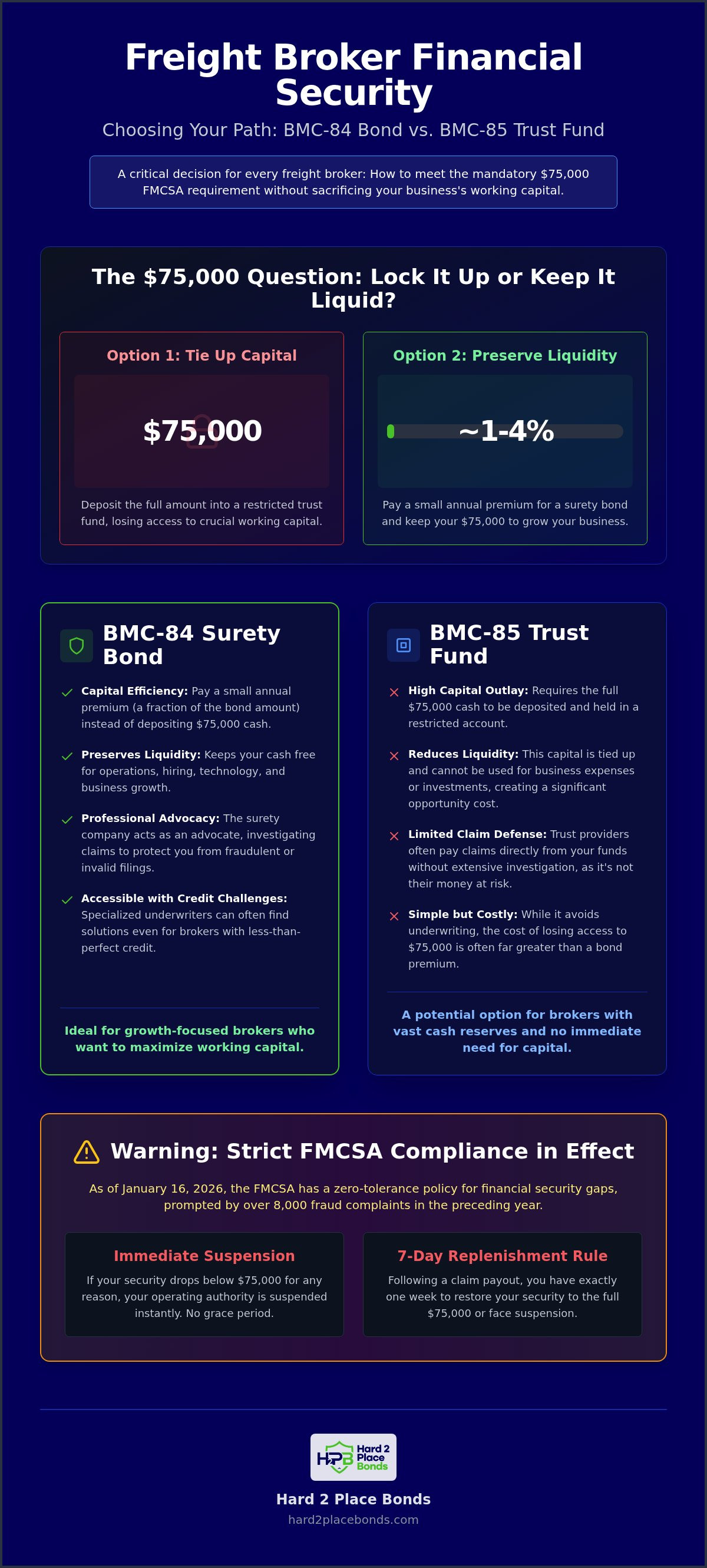
The 2026 regulatory environment is unforgiving. Effective January 16, 2026, the FMCSA adopted a zero-tolerance policy for coverage gaps. This shift follows a staggering 8,000 complaints related to broker fraud in 2025 alone. If your financial security drops below the $75,000 mark or expires, the agency will move to suspend your operating authority immediately. You no longer have a lengthy grace period to fix the issue. A lapse doesn't just halt your loads; it flags your DOT number, signaling to every carrier in the country that you are out of service. It's a scarlet letter that can take months to remove from industry monitoring databases.
New rules also dictate a strict seven-day replenishment window. If a claim reduces your security, you have exactly one week to bring it back to $75,000 or face the off switch on your authority. The BMC prefix seen on these forms stands for Bureau of Motor Carriers, a nod to the historical regulatory body that preceded the current FMCSA. Whether you choose the freight broker trust fund vs bond path, ensuring your filing remains active is the only way to keep your trucks moving. Don't risk a suspension that could take weeks to resolve while your competitors pick up your customers.
BMC-84 Surety Bond vs. BMC-85 Trust Fund: Key Differences
Choosing between a BMC-84 and a BMC-85 is one of the most consequential financial decisions a new or scaling brokerage will make. While both satisfy federal mandates, they function in completely different ways. Think of the BMC-84 as a specialized insurance product and the BMC-85 as a restricted savings account. The freight broker trust fund vs bond debate often centers on immediate cost, but the long-term impact on your liquidity is where the real difference lies. The final rule on financial security requirements clarified these paths, making it essential to understand which structure supports your specific business model.
The Mechanics of the BMC-84 Surety Bond
A BMC-84 surety bond is a three-party agreement between you (the principal), the surety company, and the FMCSA (the obligee). Instead of handing over $75,000 in cash, you pay an annual premium. This premium is a small percentage of the total bond amount, determined by your credit profile and business history. The surety company uses its own financial strength to guarantee to the FMCSA that any valid claims will be paid. This setup allows you to keep your capital in your business, where it can generate a return, rather than sitting in a vault. It's a strategic move for brokers who want to leverage their credit to maintain cash flow.
The Mechanics of the BMC-85 Trust Fund
In contrast, a BMC-85 trust fund requires you to deposit the full $75,000 into a trust account held by a financial institution. Under the 2026 regulations, these funds must be held in highly liquid assets, specifically cash or U.S. Treasury bonds. There is no traditional underwriting process because the money is already there. While this might seem simpler because you aren't relying on an external company's approval, it creates a massive opportunity cost. You're effectively losing the use of $75,000 for as long as you hold your authority. If you have the cash but would rather use it for growth, the trust fund might actually be a hurdle rather than a help.
A common misconception is that a trust fund protects the broker better than a bond. In reality, trust providers often pay out claims more readily because they're simply drawing from your cash. A surety company has a vested interest in investigating and defending against invalid claims. If you're ready to see how a bond can preserve your cash flow and provide an extra layer of defense, you can submit your information for a quote to see what options are available for your situation.
Evaluating Cash Flow: Why Capital Retention Matters in 2026
Liquidity is the lifeblood of any successful brokerage. In a 2026 freight market projected to reach $21.28 billion, having liquid capital isn't just a luxury; it's a competitive necessity. When you weigh the freight broker trust fund vs bond , you're really deciding between dead capital and active growth. A BMC-85 trust fund locks your money away in cash or treasuries, as mandated by the January 16, 2026 rules. That's $75,000 that isn't working for you. By choosing a BMC-84 bond instead, you keep that cash in your business to fund payroll, upgrade your technology, or launch a new marketing campaign.
Opportunity Cost and Business Scalability
Consider the real-world impact of $75,000. For a new brokerage, that sum could cover the initial six months of a high-performing sales team or the implementation of a top-tier Transportation Management System (TMS). When that capital is sitting in a trust account, it's essentially "dead." It earns minimal interest and remains untouchable for as long as you hold your authority. This creates a massive opportunity cost that can stifle your ability to scale when a new contract or lane opens up.
Encumbering $75,000 also affects your broader financial health. Most banks and lenders view that money as restricted or pledged. This means it won't help you secure a line of credit or a loan for fleet expansion or facility upgrades. A surety bond keeps your balance sheet clean and your assets flexible. It allows you to present a stronger financial position to partners and investors while maintaining the federal security required to operate. We focus on helping you stay agile so you can pivot as market demands change.
Premium Rates and Financial Planning
The BMC-84 model replaces a heavy cash outlay with a predictable annual premium. These rates are determined by your financial stability, experience, and credit history. Instead of losing $75,000 upfront, you pay a small percentage of that amount once a year. This makes budgeting far easier, as the bond becomes a fixed operating expense rather than a massive capital drain. Understanding the steps for Obtaining a Surety Bond can help you plan your launch or renewal without the stress of a liquidity crisis.
Bond premiums are typically considered tax-deductible business expenses, though you should always verify this with a qualified tax professional. This adds another layer of financial efficiency that trust funds, with their non-deductible principal deposits, simply cannot match. By treating your financial security as a manageable expense rather than a frozen asset, you position your brokerage for long-term stability and rapid growth in an increasingly professionalized industry.
Claim Defense and Dispute Resolution: Bond vs. Trust
Imagine a scenario where a carrier demands payment for a load that was actually double-brokered without your knowledge. How your financial security handles this dispute can mean the difference between a minor headache and a major financial loss. This is where the freight broker trust fund vs bond debate moves from the balance sheet to the frontline of your daily operations. While you always aim to pay legitimate invoices on time, the FMCSA received over 8,000 fraud complaints in 2025. You need a security structure that doesn't just sit there; you need one that actively protects your interests.
The Surety Investigation Process
When a claim is filed against a BMC-84 bond, the surety company acts as a professional buffer. They don't simply cut a check to the first person who asks. Instead, they launch a formal investigation to verify the claim's validity. They'll request specific documentation, such as the signed bill of lading, the original rate confirmation, and proof of delivery. If the carrier hasn't fulfilled their contractual obligations or if the claim is fraudulent, the surety company will deny the payout. This level of advocacy is a core benefit of Commercial Surety Bonds. You have a team of experts standing between your business and inaccurate demands. If a claim is proven valid, you'll be required to indemnify the surety, ensuring that only legitimate debts are settled using your coverage.
The BMC-85 Trust Fund "Pay-First" Risk
Trust fund providers operate under a fundamentally different model. Most institutions serving as BMC-85 trustees are not equipped with investigative departments. Their primary role is to manage the trust assets and ensure they remain compliant with federal liquid asset rules. Because they're holding your actual cash, they often have a "pay-first" mentality to avoid administrative friction or potential legal liability. If a claim appears legitimate on the surface, the trustee may release your funds to the carrier without the deep dive a surety would perform.
This creates a dangerous vulnerability for your brokerage. Once your cash is paid out of a trust, it's nearly impossible to recover it from a fraudulent actor. Furthermore, you're then forced into that strict seven-day replenishment window to bring your balance back to $75,000. In the freight broker trust fund vs bond comparison, the bond provides a layer of professional scrutiny that keeps your money where it belongs. Don't let your hard-earned capital be handed away without a thorough defense.
Protect your brokerage from invalid claims and keep your cash flow flexible by choosing a bond that provides real advocacy. Apply for a BMC-84 bond today to get the professional support your business deserves.
How to Secure a BMC-84 Bond with Credit Challenges
Have you been told that your credit score makes you ineligible for a surety bond? It's a common frustration for brokers who've faced personal financial hurdles like bankruptcies or tax liens. Many assume that the freight broker trust fund vs bond choice is made for them by their FICO score, forcing them to tie up $75,000 in a trust fund. We believe your past doesn't have to dictate your business's future. Specialized underwriters look at the bigger picture, finding paths to approval where traditional agencies only see risk. We act as your advocate, focusing on your current business potential rather than just a three-digit number.
Factors Beyond Credit: Building a Strong Application
Industry experience is a powerful asset. If you've spent years in logistics, that knowledge carries weight during the underwriting process. A detailed business plan and additional financial disclosures can help an underwriter see your operational stability. In some cases, bringing in a co-signer or providing partial collateral can bridge the gap for a difficult placement. These tools allow us to secure approvals for brokers who thought they were out of options. Our High-Risk Surety Bond Placement guide provides deeper insights into how we navigate these specific hurdles to get you the coverage you need.
Transitioning from a Trust Fund to a Bond
If you're currently using a BMC-85 trust fund, you aren't locked in forever. You can reclaim your $75,000 by switching to a BMC-84 bond to regain your liquid capital. The process involves securing your new bond first to ensure there's no gap in FMCSA coverage. Once the bond is filed and active, you can cancel the trust and wait for the institution to release your funds. Given the 2026 zero-tolerance policy, timing is everything. You must coordinate the effective date of the bond with the cancellation of the trust to avoid an automatic suspension of your authority. Reclaiming that liquid capital can be the catalyst your brokerage needs to reach the next level. The freight broker trust fund vs bond transition is a proven strategy for brokers looking to reinvest in their own growth. You can start your BMC-84 application with a specialist today to see how quickly you can free up your working capital.
Securing Your Brokerage’s Future in a Regulated Market
The 2026 logistics landscape demands more than just compliance; it requires strategic financial agility. Choosing the right path in the freight broker trust fund vs bond debate is about protecting your $75,000 in liquid capital while ensuring you have a professional advocate in your corner. We've seen how a BMC-84 bond provides the investigation and defense support that a trust fund lacks, keeping your authority active and your reputation intact.
You don't have to navigate these hurdles alone, especially if credit challenges have held you back in the past. We provide specialized underwriting for high-risk logistics and maintain deep expertise in bad credit bond approvals across all 50 states. Our team is dedicated to finding a way to "yes" when others have said no, ensuring your business stays compliant without sacrificing its growth potential.
Take control of your cash flow and secure your operations with a partner who understands the high stakes of the brokerage industry. Get Your BMC-84 Freight Broker Bond Quote Today and put our national reach to work for you. Your brokerage is ready to scale, and we're here to help you clear the path forward.
Frequently Asked Questions
What is the main difference between BMC-84 and BMC-85?
The primary distinction in the freight broker trust fund vs bond debate is how you meet the federal financial security requirement. A BMC-84 is a surety bond where you pay an annual premium to a provider who guarantees the $75,000. In contrast, a BMC-85 trust fund requires you to deposit the full $75,000 into a trust account. This means the bond preserves your business liquidity while the trust fund ties up your working capital.
Can I switch from a trust fund to a surety bond?
You can absolutely switch from a BMC-85 trust fund to a BMC-84 surety bond to free up your cash. The process requires careful timing to ensure there's no gap in your FMCSA coverage. You must secure and file the new bond before canceling the trust fund. Once the bond is active, the trust provider will release your $75,000 after their required waiting period, providing a significant boost to your business liquidity.
How much does a $75,000 freight broker bond cost per year?
Annual costs for a BMC-84 bond are calculated as a percentage of the $75,000 total. Your specific rate depends on factors like your personal credit score, industry experience, and business financials. While trust funds often charge annual administrative fees, the bond premium is a one-time yearly payment. We focus on providing options for brokers with various credit backgrounds to ensure you get the most capital-efficient solution for your authority.
What happens if a claim is filed against my freight broker bond?
When a claim is filed, the surety acts as an investigator to protect you from fraudulent or inaccurate demands. They'll ask for documentation like the bill of lading and rate confirmation to ensure the carrier's claim is legitimate. If the claim is valid, the surety pays the carrier, and you must then reimburse the surety. This process provides a layer of defense that trust funds, which often pay out automatically, simply don't offer.
Does the FMCSA accept both bonds and trust funds for new authority?
The FMCSA recognizes both forms of financial security as valid for obtaining and maintaining your freight broker authority. However, the 2026 regulations have made trust funds more restrictive by limiting them to specific liquid assets like cash and U.S. Treasury bonds. Most new brokers choose the BMC-84 surety bond because it satisfies federal requirements without requiring an immediate $75,000 cash outlay, allowing them to launch their business with more available capital.
Can I get a BMC-84 bond if I have a credit score below 600?
A low credit score doesn't automatically disqualify you from getting a BMC-84 bond. We specialize in bad credit surety bonds and look at your entire professional profile, including your industry experience and business plan. While traditional providers might turn you away, we work with niche underwriters who understand the logistics market. This ensures that brokers with credit challenges can still avoid the cash-heavy trust fund and keep their capital working for their business.
How long does it take to get a freight broker bond approved?
Approval times are generally very efficient, often taking just 24 to 48 hours when you work with an expert provider. The speed depends on how quickly you provide necessary documentation like financial statements or experience history. Because we focus on hard-to-place bonds, we've streamlined our intake process to reduce friction. This fast turnaround is critical for new brokers who need to meet FMCSA deadlines and avoid delays in starting their operations.
Why did the FMCSA change trust fund requirements for 2026?
The changes were implemented to increase financial transparency and protect carriers from broker fraud. The FMCSA updated the rules in response to a surge in fraud complaints, which reached over 8,000 in 2025. By requiring trust funds to hold only highly liquid assets and disqualifying certain trustees, the agency aims to ensure funds are actually available. These 2026 regulations make the freight broker trust fund vs bond decision even more important for brokers.