

August 23, 2026

High-Risk Surety Bond Placement: 2026 Guide

What if a "no" from a standard carrier wasn't the end of your project, but simply a sign that you're talking to the wrong underwriter? It's incredibly frustrating to watch a lucrative contract stall because of a credit hiccup or a "high-risk" industry label. You know your business is capable. Yet, traditional sureties often demand impossible collateral or issue flat denials that ignore the nuances of your operation. Securing surety bonds for high-risk industries requires a shift from standard checklists to expert advocacy.

This 2026 guide is designed to bridge that gap. You'll learn how to navigate complex underwriting for everything from solar decommissioning to the stricter FMCSA enforcement rules effective January 16, 2026. We'll explore how specialized placement can bypass traditional roadblocks, providing the fast approvals and national coverage you need to keep moving forward. From the new New York energy broker bond mandates due by April 30 to managing bad credit challenges, we're outlining the path to "yes." This ensures you can stop worrying about paperwork and start executing on your next big project.

Key Takeaways

  • Distinguish between industry-specific risks and credit-related challenges to better position your business for a successful placement.
  • Learn how specialized underwriters evaluate Character, Capacity, and Capital to find paths to approval that traditional carriers often overlook.
  • Master the 2026 requirements for surety bonds for high-risk industries, ensuring your solar or freight projects stay on schedule despite stricter regulations.
  • Follow a proven documentation strategy to flip a "denied" status into a "conditional approval" through expert advocacy and clear financial reporting.
  • Understand the competitive advantage of working with a national broker who specializes in hard-to-place bonds rather than a general insurance agent.

Defining High-Risk Industries in the 2026 Surety Market

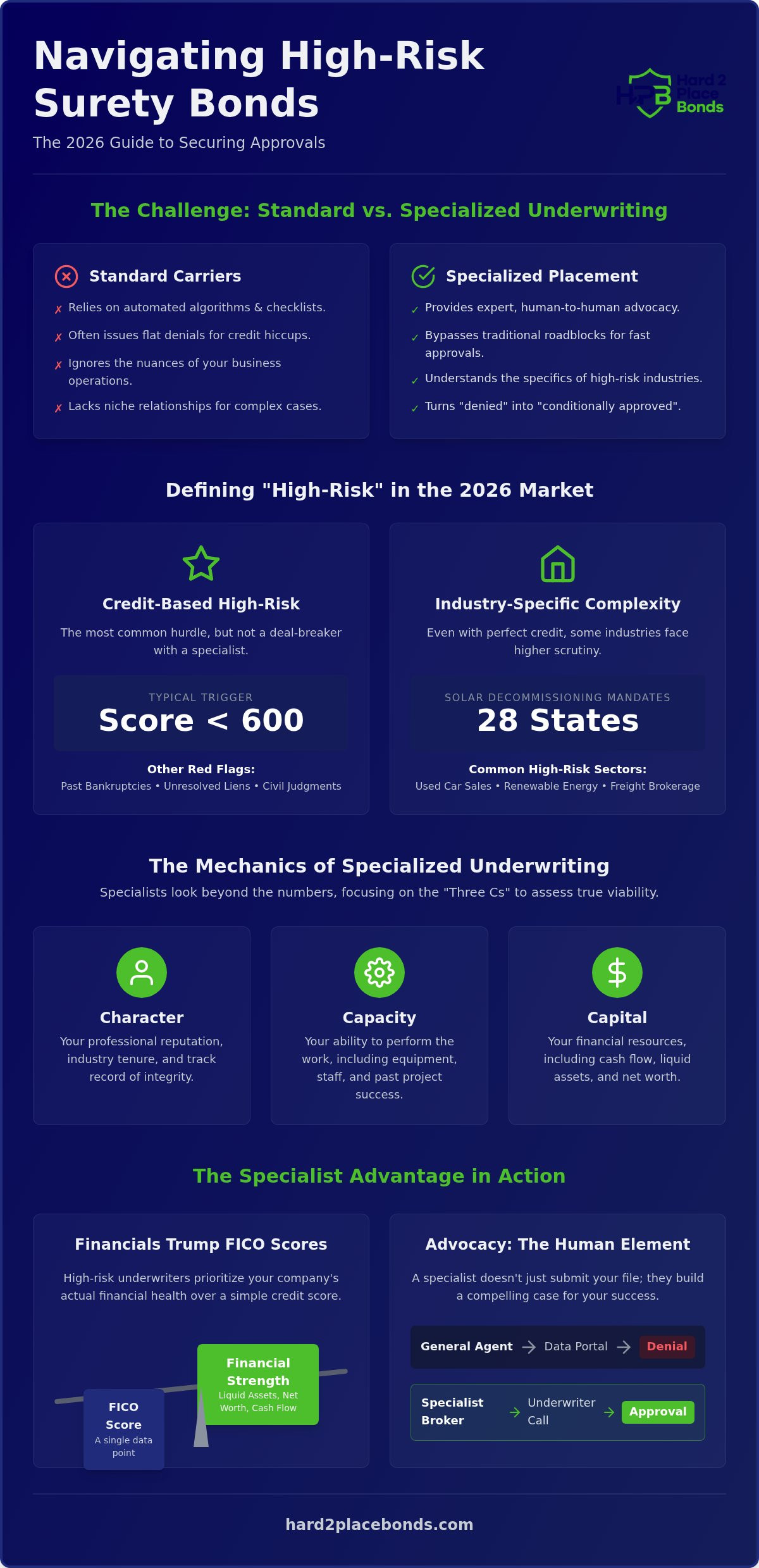
Why does one business get an instant approval while another faces a wall of rejections? For underwriters, "high-risk" isn't just a label; it's a calculation of probability. Traditional insurance companies prefer predictable, low-stakes files. When they encounter industries with high volatility or owners with bruised credit, they often walk away. This is where specialized placement becomes essential. Understanding Surety bond basics is the first step in realizing that a bond isn't insurance for you. It's a financial guarantee for the party requiring the bond. Because the surety pays the claim first and looks to you for reimbursement, they're incredibly cautious about who they back. Generalist agents often lack the niche relationships needed to secure surety bonds for high-risk industries , leaving business owners stranded.

Credit-Based High-Risk Factors

Credit scores are the most common hurdle. In the 2026 market, a score below 600 typically triggers automatic high-risk protocols. Standard carriers see a past bankruptcy or an old civil judgment and stop reading. They view these as indicators of future defaults rather than past mistakes. High-risk credit in 2026 is any financial profile featuring unresolved liens or scores that fail to meet the "prime" threshold of 680, regardless of the business's actual cash flow. If your personal or business credit has taken a hit, you need an underwriter who looks at your current liquidity and project history rather than just a three-digit number.

Industry-Specific Complexity and Volatility

Sometimes your credit is perfect, but your industry is the problem. Sectors like used car sales are flagged due to historically high failure rates and consumer protection risks. You can find specialized motor vehicle dealer bonds through advocates who understand the specific risks of your trade. We also see increased scrutiny in the renewable energy sector. As of 2026, 28 states now enforce statutory rules for solar decommissioning bonds. These regulations require cost updates every five years to account for inflation and salvage value shifts. This level of complexity creates a "high-risk" environment that standard agents simply aren't equipped to handle. Securing surety bonds for high-risk industries requires a partner who stays ahead of these shifting regulatory standards.

The Mechanics of Specialized Surety Bond Underwriting

Standard surety carriers often rely on automated algorithms that see a low credit score and issue an immediate denial. They treat risk as a binary switch. Specialized underwriting works differently. It's a consultative process that looks past the surface level to understand the actual viability of your business. When securing surety bonds for high-risk industries , underwriters focus on the "Three Cs": Character, Capacity, and Capital. Your industry tenure and professional reputation (Character) carry significant weight. Underwriters also evaluate your equipment, staff, and past project success (Capacity) to ensure you can actually fulfill the contract. Finally, they look at your financial resources (Capital) to determine if you can withstand unexpected setbacks.

Risk mitigation isn't just about saying "no." It's about finding creative structures that protect the surety while allowing you to work. This might involve specific bond language that limits certain liabilities or utilizing collateral options like irrevocable letters of credit. For some small businesses, the SBA Surety Bond Guarantee Program provides the necessary backing to help higher-risk profiles qualify for larger contracts that would otherwise be out of reach.

Deep Dive: Financial Statement Analysis

Your business financials are your strongest tool for overcoming a poor FICO score. High-risk underwriters prioritize liquid assets and tangible net worth over a three-digit credit number when evaluating surety bonds for high-risk industries . They want to see that you have the cash flow to handle payroll and materials even if a payment is delayed. Presenting clean, CPA-prepared statements builds immediate trust. It shows you're transparent and organized. If your personal credit is credit-challenged, highlighting a strong debt-to-equity ratio in your business can flip a denial into an approval.

Advocacy in the Underwriting Process

The biggest difference between a generalist and a specialist is advocacy. A general agent simply uploads your data to a portal. A specialist broker engages in a human-to-human conversation with the underwriter. They explain the "why" behind a past bankruptcy or the "how" of your plan to scale. This level of Specialized Surety Bond Placement is what turns complex risks into issued bonds. We don't just submit files; we build cases for our clients' success. If you're tired of being treated like a number, it's time to begin your specialized bond application today.

Critical High-Risk Categories: From Solar to Freight Brokerage

In the 2026 market, "high-risk" isn't a generic label. It's a specific designation based on shifting regulations and industry volatility. While standard carriers run from complexity, specialized placement finds the path forward. Whether you're navigating federal mandates or state-specific statutes, your project shouldn't stall because of a rigid underwriting checklist. Securing Contract Surety Bonds for specialized projects requires a deep understanding of these niche categories. We've identified the most challenging sectors where surety bonds for high-risk industries are currently essential for operation.

Solar and Energy Infrastructure Bonds

The renewable energy sector faces unprecedented scrutiny. As of 2026, 28 states have implemented statutory rules for Solar Decommissioning Bonds, a massive jump from just nine states a decade ago. These bonds now often require cost estimate reviews every five years to account for inflation. New York has also introduced strict requirements. Energy brokers there must file a $100,000 bond by April 30, 2026. For a deeper look at navigating these hurdles, see our Solar Developer Surety Bonds: 2026 Project Approval Guide. We specialize in securing the security needed for large-scale utility projects and PPA agreements that standard insurers won't touch.

Transportation and Dealer Bonds

The transportation industry is currently facing a regulatory overhaul. Effective January 16, 2026, the FMCSA is implementing stricter enforcement of the $75,000 financial responsibility requirement for freight brokers. If your Freight Broker Bonds(BMC-84) fall below this limit, you only have seven days to replenish them before authority is suspended. Similarly, Motor Vehicle Dealer Bonds remain difficult to place for those with credit challenges due to high consumer claim volumes. We provide the advocacy needed to satisfy these federal and state mandates, even when your financial history is less than perfect.

Complex Construction and Site Improvement

Developers often struggle with Site Improvement and Subdivision Bonds because they involve long-term obligations that standard sureties find unappealing. High-risk projects also demand robust Payment and Performance Bonds to protect all parties involved. We don't stop at the initial build. Our team also helps secure Warranty Bonds for specialized builds, ensuring your obligations are met long after the heavy machinery leaves the site. When you're managing surety bonds for high-risk industries , you need a partner who understands the full lifecycle of your project.

Strategic Steps to Secure a Bond Despite Credit Challenges

Receiving a denial letter can feel like hitting a brick wall. Most agents simply stop there, leaving you without a path forward. However, a rejection from a standard market is often just the beginning of the specialized placement process. Flipping a "denied" status into a "conditional approval" requires shifting the underwriter's focus from your credit score to your business's operational strength. If you're still unclear on the technical nuances of these agreements, reviewing our guide on surety bond meaning can help you understand exactly what the underwriter is guaranteeing. When applying for surety bonds for high-risk industries , transparency is your greatest asset. Addressing past credit issues proactively demonstrates character and reliability, two traits underwriters value as much as capital.

Building Your High-Risk Application Package

To move past a credit-based denial, you must provide a narrative that the numbers alone don't show. High-risk underwriters look for reasons to say "yes," but they need the right evidence to justify the risk. Follow these steps to build a bulletproof package:

  • Step 1: Gather accurate statements. Provide current year-to-date business financials and personal financial statements. Accuracy builds trust and shows professional oversight.
  • Step 2: Explain previous credit events. Don't hide past judgments or liens. Provide a brief, written explanation of what happened and, more importantly, how the issue was resolved.
  • Step 3: Document your experience. Include a professional resume or a list of successfully completed projects. Your industry tenure proves you have the capacity to fulfill your obligations regardless of personal credit history.

Alternative Solutions: Collateral and Financing

If your application still presents too much risk for an unsecured bond, alternative structures can bridge the gap. Using cash collateral or an Irrevocable Letter of Credit (ILOC) can provide the security an underwriter needs to issue the bond. While this ties up liquidity, it allows you to secure the contract and start generating revenue immediately. You might also explore premium financing to manage the higher costs often associated with surety bonds for high-risk industries . This spreads the expense over time, preserving your working capital for project costs. As your credit score improves and your business grows, you can graduate to standard rates with lower or no collateral requirements. Ready to see what's possible for your business? Submit your high-risk bond application here to begin the advocacy process.

Partnering with a Specialist for Hard-to-Place Placements

Does your current agent understand the nuance of your business, or are they just reading from a standard checklist? Generalist agents often lack the specialized market access required for surety bonds for high-risk industries . When they receive a rejection from a standard carrier, they usually stop, assuming no other options exist. This can lead to project delays or lost contracts. A specialist broker doesn't just submit a file; they build a case. We possess deep knowledge of niche markets and maintain direct relationships with underwriters who specifically look for non-standard risks. Partnering with a specialist ensures you aren't just another number in an automated system.

The Hard 2 Place Bonds Advantage

We operate as a tenacious advocate for your business across all 50 states. Our team excels at creative problem-solving, finding alternative paths where others only see dead ends. Whether you're dealing with the 2026 regulatory shifts in energy or personal credit hurdles, we focus on possibilities. You get direct access to experts who understand your specific industry's mechanics. We don't give up when faced with a standard refusal. We know that a "no" from one carrier is often just the beginning of a successful placement elsewhere. This commitment to securing approvals where others have failed is what defines our approach.

Starting Your Application Today

The intake process for a high-risk bond is designed to be efficient and supportive. You shouldn't feel marginalized by traditional systems. Instead, expect a consultative conversation that aims to reduce friction and move your project forward. Understanding the specific steps to Obtain a Surety Bond quickly is vital for maintaining your business momentum. We'll guide you through the documentation requirements, ensuring your application highlights your operational strengths rather than just your credit setbacks.

Don't let a "hard-to-place" label stop your growth. Securing surety bonds for high-risk industries is a challenge we're equipped to solve every day. Our goal is to provide the relief and confidence you need to sign your next contract. If you're ready to move from frustration to a definitive resolution, it's time to take action. Start Your High-Risk Bond Application now and let us advocate for your success.

Take Control of Your Bonding Requirements

A standard denial doesn't have to be the final word on your business's potential. We've explored how specialized underwriting looks past the FICO score to evaluate your actual capacity and character. Whether you're navigating the stricter 2026 FMCSA rules for freight or the evolving state mandates for solar decommissioning, success comes down to expert advocacy. Securing surety bonds for high-risk industries is about finding a partner who sees your operational strengths where others only see risk. Hard 2 Place Bonds provides nationwide coverage and creative underwriting for rejected applicants, ensuring your projects stay on track.

Our team specializes in bad credit and hard-to-place bonds, acting as a tenacious ally in a complex financial landscape. You've built your business through persistence; you deserve a surety partner that works just as hard. Don't let a "high-risk" label stall your momentum any longer. We're ready to help you navigate the hurdles and secure the approvals you need to grow. Secure Your High-Risk Bond Today and move forward with confidence.

Frequently Asked Questions

Can I get a performance bond if I have a credit score under 500?

You can secure a performance bond with a score under 500, though it requires a consultative underwriting approach. While standard markets will likely issue an automatic denial, specialized brokers look at your project history and current liquidity. We focus on your capacity to complete the work rather than just your credit score. You may need to provide additional documentation or consider collateral options to mitigate the risk and secure the approval you need to start.

What industries are currently considered high-risk for surety bonds in 2026?

In 2026, industries like solar decommissioning and freight brokerage are high-risk due to shifting regulations. Used car dealerships and offshore energy are also under heavy scrutiny because of high claim volumes and long-tail liabilities. These sectors require non-standard placement because traditional sureties often find the compliance requirements too complex. Securing surety bonds for high-risk industries in these fields requires working with an advocate who understands the specific statutory changes.

How much more does a high-risk surety bond cost compared to standard rates?

High-risk bonds typically carry higher premiums because the surety is taking on a greater financial guarantee. While standard rates often fall between 1% and 3.5%, high-risk applicants might see rates reaching 10% or more of the bond amount. These rates reflect the specialized underwriting and advocacy required to secure the placement. As your business builds a successful track record and your credit improves, you can often transition back to lower standard rates.

Will I need to provide collateral for a hard-to-place bond?

Collateral isn't always mandatory, but it's a powerful tool for turning a denial into an approval. If your credit score or industry volatility presents too much risk for an unsecured bond, providing cash collateral or an Irrevocable Letter of Credit can bridge the gap. This security gives the underwriter the confidence to issue the bond. We work to minimize these requirements whenever possible by highlighting your operational experience and project viability during the consultative intake process.

Can a new business in a high-risk industry qualify for a bond?

Yes, new businesses can qualify if the owners demonstrate significant personal experience in the field. Underwriters look at your resume and past successful projects even if the current entity is new. For those seeking surety bonds for high-risk industries, being a startup adds another layer of scrutiny. Providing a solid business plan and proof of liquid assets can help overcome the lack of business history and secure the necessary financial guarantee for your operations.

What happens if my surety bond application is denied by a standard carrier?

A denial from a standard carrier is simply a sign that your profile doesn't fit a generic, automated checklist. It doesn't mean you're unbondable. When this happens, you should immediately pivot to a specialized broker who handles hard-to-place accounts. We take your denied application and build a narrative around your strengths. This advocacy process involves human-to-human negotiation with niche underwriters who specialize in high-stakes markets and complex risk profiles that others avoid.

Are there specific requirements for solar decommissioning bonds?

Solar decommissioning bonds now face more stringent requirements, with 28 states enforcing statutory rules as of 2026. Many jurisdictions now require you to update your cost estimates every five years to account for inflation and salvage value changes. These bonds guarantee that the land will be restored once the project ends. Because of this long-term liability, you need an underwriter who understands the specific environmental regulations and salvage value calculations involved in renewable energy projects.

How long does the specialized underwriting process take for high-risk bonds?

The timeline for specialized underwriting depends on the complexity of your file, but you can typically expect initial feedback within 24 to 48 hours. Because we look beyond the FICO score, we may need time to review your financial statements and project history. This consultative process is designed to be thorough yet efficient. Our goal is to move you from a state of frustration to a definitive approval as quickly as possible to avoid project delays.

Share:

Recent Posts

By cinchweb August 22, 2026
Get your freight broker bond for new authority, even with bad credit. Our 2026 guide shows you how to secure your $75k BMC-84 bond and activate your MC number.
By cinchweb August 21, 2026
Get your 2026 maintenance bond guide. Learn costs, requirements, and how to get approved even with bad credit. Compare with performance bonds & secure yours.
By cinchweb August 20, 2026
Don't let subdivision bond requirements delay your 2026 project. Our essential checklist helps you navigate municipal standards and secure your bond with con...
By cinchweb August 19, 2026
Need a surety bond for solar developers? Our 2026 guide helps you bypass bank hurdles, meet decommissioning mandates, and free up capital for project growth.
By cinchweb August 19, 2026
Navigate 2026 contractor license bond requirements, even with bad credit. Our guide covers state updates, bond types, and how to get approved. Get licensed now!
By cinchweb August 17, 2026
Confused about payment bond vs performance bond? Our 2026 guide explains the differences, Miller Act rules, and how to get bonded with less-than-perfect credit.
By cinchweb August 16, 2026
Worried about the freight broker bond cost with bad credit? Our 2026 guide shows you how to get your $75,000 BMC-84 bond approved despite a low score.
By cinchweb August 15, 2026
Struggling to get payment and performance bonds due to credit? Our 2026 guide covers the Miller Act and non-standard underwriting to get your contract approved.
By cinchweb August 14, 2026
Secure a solar PPA security bond without cash collateral. Our 2026 guide helps developers & investors navigate underwriting to protect capital & launch proje...