

August 22, 2026

2026 Guide: BMC-84 Freight Broker Bond for New Authority

What if the standard "no" from a big name surety company wasn't the end of your business, but simply a sign that you're talking to the wrong people? Most new brokers expect a smooth path to their MC number, only to find that securing a freight broker bond for new authority is the most stressful part of the process. You've likely felt the frustration of being judged solely on a credit score or the fear that a bonding delay will lead to an immediate FMCSA authority suspension before you even book your first load.

It's a high-stakes environment where traditional systems often marginalize the very entrepreneurs who keep the industry moving. We understand that a 500 or 600 credit score or a lack of business history shouldn't disqualify you from your dreams. This 2026 guide teaches you exactly how to secure your $75,000 BMC-84 bond and activate your freight broker authority, even if you've faced rejections elsewhere. We'll walk through the latest FMCSA compliance rules, explore how specialized underwriting turns "impossible" cases into active authorities, and show you how to find an affordable premium that fits your startup budget.

Key Takeaways

  • Understand why the $75,000 BMC-84 bond is a mandatory federal requirement for activating your interstate operating authority.
  • Discover why a freight broker bond for new authority is often superior to a BMC-85 trust fund for startups looking to preserve their working capital.
  • Learn how specialized underwriting makes it possible to secure a bond even with a 500-600 credit score or no prior business history.
  • Follow a clear, five-step process to navigate the FMCSA filing requirements and prevent authority suspension before you start.
  • Shift your perspective from being high risk to finding a tenacious advocate who knows how to navigate standard surety rejections.

Understanding the $75,000 Freight Broker Bond for New Authority

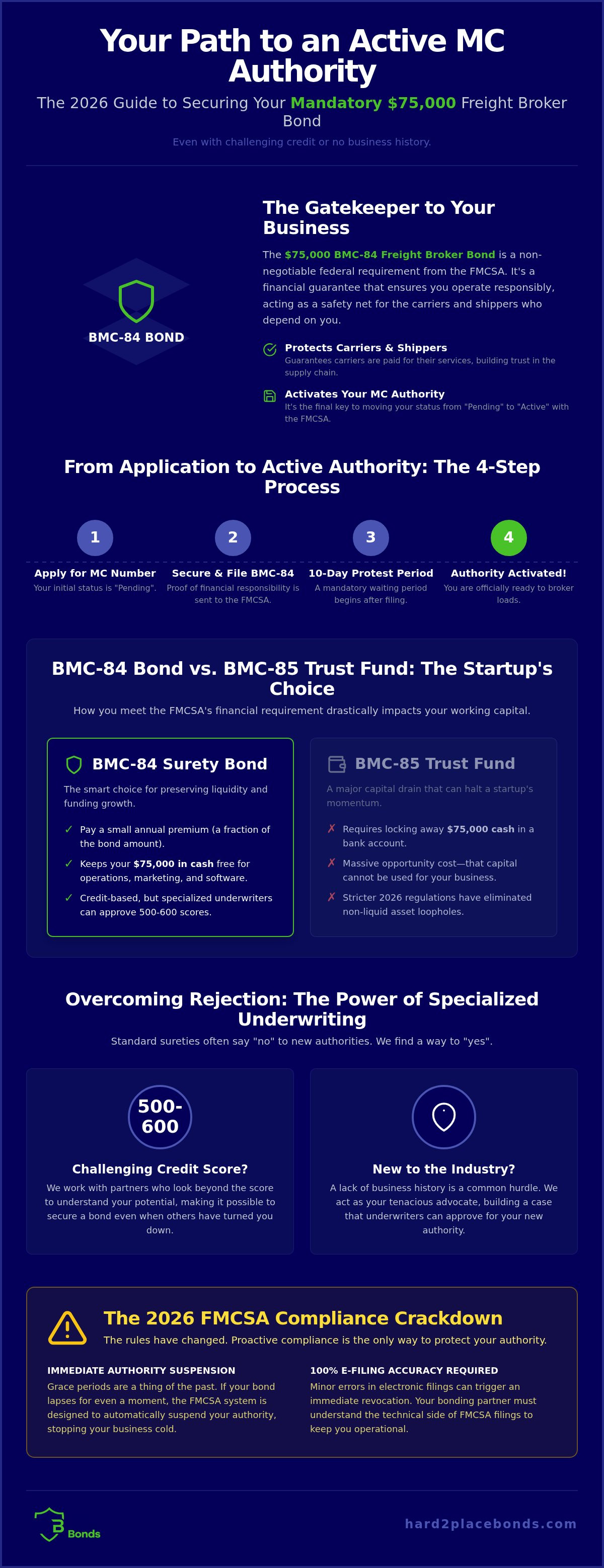
The BMC-84 bond is the gatekeeper to your MC number. Without it, your brokerage is just a plan on paper rather than a functioning business. Effectively, a freight broker bond for new authority is a financial guarantee required by the Federal Motor Carrier Safety Administration (FMCSA) to ensure you play by the rules. It acts as a safety net for the carriers you hire and the shippers who trust you with their freight. If a broker fails to pay a carrier for services rendered, the bond provides a pool of funds to settle those valid claims. The FMCSA mandates a $75,000 minimum because it creates a serious barrier to entry; it ensures only financially responsible entities enter the interstate logistics market. This protection is vital for maintaining trust across the supply chain, as it guarantees that carriers won't be left holding the bill if a broker disappears or mismanages funds.

The Link Between Bonding and Your MC Authority

Applying for authority is just the first step. Once you submit your application, your status sits at "Pending." The FMCSA requires proof of financial responsibility before they'll flip the switch to "Active." This is where your bond filing comes in. After the filing is received, there is a mandatory 10-day public protest period. If no valid objections arise and your bond is on file, your authority becomes official. If you're still confused about the timeline, learning more about obtaining a surety bond can help clarify the sequence of events. We've seen many startups get stuck in this "Pending" limbo because they waited too long to start the bonding process. Don't let a paperwork delay stall your first day of operations.

2026 FMCSA Compliance: The Stakes Have Changed

Compliance in 2026 isn't as lenient as it used to be. The FMCSA has tightened enforcement regarding bond lapses to flush out "ghost" brokers. In the past, you might have had a grace period if your bond expired or was canceled. Today, immediate suspension is the new reality. If your surety company doesn't handle electronic e-filings with 100% accuracy, your authority could be revoked within hours of a lapse. This isn't just about the money; it's about your reputation with carriers who check your authority status daily. This is why choosing a partner who understands the technical side of FMCSA filings is non-negotiable. You need a tenacious advocate who ensures your paperwork is bulletproof, especially when you're securing a freight broker bond for new authority in a high-risk environment. We focus on getting it right the first time so you can focus on moving freight.

BMC-84 Bond vs. BMC-85 Trust Fund: Which is Best for Startups?

Starting a brokerage requires significant capital, and how you handle the FMCSA financial security requirement determines how much of that cash stays in your pocket. The choice between a BMC-84 bond and a BMC-85 trust fund is a choice between paying a small annual premium or locking away $75,000 in cash. For most, securing a freight broker bond for new authority is the only logical path to maintaining liquidity. Tying up $75,000 in a trust fund creates a massive opportunity cost. That capital could instead fund your TMS software, marketing campaigns, or initial carrier payments. Specialized sureties understand this struggle and offer paths to keep your capital working for your operations instead of sitting stagnant in a bank account.

Pros and Cons for New Freight Brokers

The primary draw of the BMC-84 bond is its low upfront cost. It's a credit-based product, which means your premium is a percentage of the total bond amount. This keeps your business liquid and ready to scale. Conversely, a BMC-85 trust fund requires no credit check, but it demands $75,000 in cash or an Irrevocable Letter of Credit (ILC). For a new authority with limited capital, the trust fund often feels like a brick wall. We specialize in finding solutions for those who might be rejected by standard sureties, ensuring you don't have to choose between a trust fund and your business goals. If you're ready to see your options, you can begin your application today.

Impact of New 2026 Trust Fund Regulations

The regulatory landscape has shifted significantly in 2026. The FMCSA has initiated a crackdown on non-liquid assets within trust funds, requiring that all $75,000 be held in readily available cash or specific government-backed securities. This change eliminated the "creative" asset-backing some trust providers previously allowed. Because of these stricter rules, the BMC-84 bond has become even more competitive. It offers a straightforward financial guarantee without the administrative headache or liquidity drain of a modern trust. Understanding the broader surety bond meaning helps clarify why these instruments are the gold standard for federal compliance. When you're seeking a freight broker bond for new authority , you're looking for a tool that enables growth, not one that restricts your cash flow.

Underwriting Challenges for New Broker Authorities

Traditional surety companies love predictability. When you apply for a freight broker bond for new authority , you're essentially asking them to bet on a business that doesn't exist yet. They see a lack of operational history as a red flag because they can't review your past profit and loss statements or carrier payment records. This "No History" paradox creates a cycle where you need a bond to start, but many companies won't give you one until you've already started. It's frustrating to be met with a standard refusal just because you're new. However, your startup status is a risk factor, not a disqualifier. Specialized underwriters look beyond the lack of business history to find reasons to say yes.

Getting Approved with Bad Credit

If your personal credit score sits in the 500s or 600s, traditional insurance channels will likely reject you immediately. We take a different approach. Specialized underwriting allows us to advocate for brokers who have faced financial hurdles. One of the most effective tools for securing high-risk approval is the indemnity agreement. This document is a legal promise that you will reimburse the surety for any claims paid out. While it sounds intimidating, it's the bridge that allows you to secure a bond despite past credit challenges. If you're navigating these hurdles, working with a partner who understands freight broker bonds can help you find a path forward.

Factors That Lower Your Premium Rate

Even as a new authority, you can take steps to make your application more attractive and lower your annual premium. Underwriters value industry experience. If you were a former dispatcher, owner-operator, or driver, that knowledge reduces the perceived risk of operational errors. Another powerful lever is adding a strong co-signer with better credit to the bond. This provides additional security for the underwriter and often results in a significantly lower rate. Finally, be transparent about your business plan. When you're honest about your background and goals, it builds the trust necessary for an underwriter to offer you the best possible terms for your freight broker bond for new authority .
How to Secure Your Freight Broker Bond: A 5-Step Guide

Securing a freight broker bond for new authority doesn't have to be a source of anxiety. While the process involves several layers of federal oversight, following a clear sequence prevents common mistakes that lead to authority delays. We recommend a methodical approach to move your status from "Pending" to "Active" as efficiently as possible.

  • Step 1: Obtain your USDOT and MC numbers. You must register with the FMCSA first. You can't apply for a bond without these unique identifiers, as the surety uses them to link your financial guarantee to your federal record.
  • Step 2: Partner with a specialized expert. Work with a freight broker bond expert who knows how to navigate the 2026 compliance landscape. General insurance agents often lack the niche underwriting connections needed for new authorities.
  • Step 3: Submit your application. Provide your personal credit information and business details. If you have credit challenges, don't hide them; transparency allows your advocate to build a stronger case for your approval.
  • Step 4: Review and sign. Once you receive your quote, you'll need to sign an indemnity agreement. This is a standard legal requirement that reinforces your commitment to resolving future claims.
  • Step 5: Confirm electronic filing. Your surety must file Form BMC-84 electronically with the FMCSA. Paper filings are no longer the standard and can lead to significant delays in your authority activation.

Managing the FMCSA Filing Process

Always verify that your chosen surety is on the FMCSA authorized list before signing. If they aren't, the federal government won't accept the filing. You can track your progress in real-time using the FMCSA Licensing & Insurance (L&I) portal. If your filing is rejected, it's often due to a data mismatch. Ensure your business name and address on the bond match your FMCSA application exactly. Even a missing "Inc." or a slightly different zip code can trigger a rejection, stalling your business before it starts.

Activating Your Operating Authority

Your bond is a major piece of the puzzle, but it's not the only one. You must also complete the BOC-3 (Process Agents) requirement. This filing designates individuals who can accept legal documents on your behalf in every state where you operate. Once the FMCSA has your bond, your BOC-3, and your insurance filings, they'll issue your official "Grant Letter." This letter is your ticket to start booking loads and generating revenue. If you're ready to clear these hurdles and get on the road, you can start your application now.

Why Specialized Underwriting is the Key to Your Startup Success

Traditional lenders often stop at the credit report. When a bank sees a 580 score, they see a liability; we see an entrepreneur ready to build a legacy. The difference between a "No" and a "Yes" usually comes down to the expertise of the person reviewing your file. While standard insurance agents might offer a basic product, they often lack the depth to handle a freight broker bond for new authority when the applicant's profile isn't "perfect." We don't see walls. We see hurdles that require creative problem-solving and a tenacious advocate. At Hard 2 Place Bonds, we specialize in the complexities of commercial surety bonds for new ventures. Building a relationship with a high-risk specialist early on provides long-term value. As your business grows and your credit improves, having a partner who already knows your story makes renewals and future bonding needs much smoother.

Tenacious Advocacy for New Brokers

Our process involves a deep dive into applications that were rejected elsewhere. We don't just look at a number on a screen. We look at your operational plan and industry experience. We believe your future potential is a far better indicator of success than a past credit hiccup. We focus on finding paths where others see dead ends, acting as a supportive ally in a high-stakes environment where traditional systems might marginalize you. To see how we can support your full range of bonding needs beyond the BMC-84, explore our comprehensive services.

Securing Your 2026 Authority Today

To ensure you are fully compliant with the 2026 FMCSA rules and avoid immediate suspension, use this final checklist before you launch. First, verify your business name matches your FMCSA filing exactly. Second, confirm your surety provider uses real-time electronic filing. Third, ensure your bond amount is the full $75,000 required. Finally, double-check that your BOC-3 process agents are correctly designated. Securing an affordable annual quote for a freight broker bond for new authority that fits your startup budget is possible when you work with a team that doesn't give up. Don’t let a credit score stop your brokerage. We are ready to help you cross the finish line. Apply for your BMC-84 bond today and take the final step toward activating your MC authority.

Launch Your Brokerage with Confidence in 2026

Activating your MC number is the final hurdle in your journey toward business ownership. You now understand that while the $75,000 requirement is steep, choosing a BMC-84 bond keeps your capital liquid and your operations moving. By leveraging specialized high-risk underwriting experts, you can overcome the paradox of having no business history or a less-than-perfect credit score. Securing a freight broker bond for new authority shouldn't be a source of stress when you have a tenacious advocate on your side.

We offer national bonding capacity for all US states and include FMCSA-compliant electronic filing to ensure your authority is activated without delay. Our team focuses on finding paths forward where traditional sureties only see risk. Don't let a standard rejection letter stall your dreams. We're here to help you navigate the 2026 compliance landscape and build a successful logistics business from the ground up.

Frequently Asked Questions

Can I get a freight broker bond for new authority with a 500 credit score?

Yes, you can absolutely secure a freight broker bond for new authority even with a 500 credit score. Traditional sureties often reject anything below 650, but we focus on specialized high risk underwriting. We look at your industry experience and business plan rather than just a three digit number. By using an indemnity agreement, we provide a path for entrepreneurs who have faced financial setbacks to activate their MC authority and start booking loads.

How long does it take for the FMCSA to see my bond filing?

Electronic filings are typically transmitted to the FMCSA immediately after your bond is issued and signed. However, the FMCSA Licensing and Insurance (L&I) portal usually takes 24 to 48 hours to reflect the update. It is vital to ensure your business name on the bond matches your federal application exactly. Any minor discrepancy in your address or legal name can cause the system to reject the filing, leading to unnecessary delays.

What happens if my freight broker bond cancels or lapses in 2026?

Under the 2026 enforcement rules, a bond lapse results in the immediate suspension of your operating authority. The FMCSA has removed the lenient grace periods seen in previous years to eliminate non compliant brokers from the market. If your bond is canceled, your surety must provide 30 days' notice to the FMCSA. If a replacement bond isn't filed before that window closes, your MC number becomes inactive, and you must stop all brokerage operations immediately.

Do I need to provide collateral for a BMC-84 bond as a new broker?

Most BMC-84 bonds do not require collateral, even for new brokers. Unlike a BMC-85 trust fund, which requires $75,000 in cash, a bond is a credit based guarantee. You pay an annual premium, and the surety provides the financial guarantee to the FMCSA. In rare cases involving extremely high risk, an underwriter might request partial collateral, but our goal is always to keep your working capital liquid so you can fund your startup operations.

Is the $75,000 bond amount the same in every state?

Yes, the $75,000 bond amount is a federal mandate set by the FMCSA for all interstate freight brokers. This requirement does not vary by state because it is governed by federal law rather than local regulations. Whether you are operating in Florida, California, or Texas, you must maintain this specific level of financial security to keep your authority active. This uniform standard ensures that carriers and shippers receive the same protection regardless of where the broker is based.

What is the average cost of a freight broker bond for a startup?

The cost of a freight broker bond for new authority is calculated as a percentage of the $75,000 bond amount. This annual premium varies significantly based on your personal credit score, business history, and industry experience. While startups are viewed as higher risk, specialized underwriting helps keep these premiums manageable. We focus on finding the most competitive rates available for your specific situation, ensuring that your initial overhead costs don't prevent you from launching your new venture.

Do I need a bond if I am only a freight forwarder and not a broker?

Yes, freight forwarders are subject to the same $75,000 financial security requirement as freight brokers. While the roles differ in terms of cargo liability and physical handling of goods, the FMCSA requires both entities to maintain proof of financial responsibility. You will still file a BMC-84 bond or a BMC-85 trust to satisfy this federal rule. Failing to have this bond on file will prevent your freight forwarder authority from moving from pending to active status.

Can I switch from a BMC-85 trust to a BMC-84 bond later?

You can switch from a trust fund to a surety bond at any time during your business lifecycle. Many brokers start with a trust fund when they have high cash reserves but eventually switch to a BMC-84 bond to free up that $75,000 for business expansion. The process involves your new surety filing the bond with the FMCSA, which then replaces the trust fund on your record. This transition is a smart way to increase your business liquidity.

Share:

Recent Posts

By cinchweb August 21, 2026
Get your 2026 maintenance bond guide. Learn costs, requirements, and how to get approved even with bad credit. Compare with performance bonds & secure yours.
By cinchweb August 20, 2026
Don't let subdivision bond requirements delay your 2026 project. Our essential checklist helps you navigate municipal standards and secure your bond with con...
By cinchweb August 19, 2026
Need a surety bond for solar developers? Our 2026 guide helps you bypass bank hurdles, meet decommissioning mandates, and free up capital for project growth.
By cinchweb August 19, 2026
Navigate 2026 contractor license bond requirements, even with bad credit. Our guide covers state updates, bond types, and how to get approved. Get licensed now!
By cinchweb August 17, 2026
Confused about payment bond vs performance bond? Our 2026 guide explains the differences, Miller Act rules, and how to get bonded with less-than-perfect credit.
By cinchweb August 16, 2026
Worried about the freight broker bond cost with bad credit? Our 2026 guide shows you how to get your $75,000 BMC-84 bond approved despite a low score.
By cinchweb August 15, 2026
Struggling to get payment and performance bonds due to credit? Our 2026 guide covers the Miller Act and non-standard underwriting to get your contract approved.
By cinchweb August 14, 2026
Secure a solar PPA security bond without cash collateral. Our 2026 guide helps developers & investors navigate underwriting to protect capital & launch proje...
By cinchweb August 14, 2026
Learn the 2026 performance bond cost for high risk contractors. This guide breaks down premiums, SBA programs, and actionable steps to get approved and lower...