

August 21, 2026

Maintenance Bond Guide: 2026 Requirements, Costs, and Comparisons

Why does the final walkthrough often feel like the start of a new set of risks rather than the successful end of a project? You've finished the work, but the requirement for a maintenance bond keeps your liability active long after the crew has moved on. It's common to feel a sense of dread when faced with terms that seem to overlap or when you're worried that a less-than-perfect credit score will stall your progress. We know the frustration of being held back by technicalities when you've already proven your ability to deliver quality results.

We understand that navigating these financial guarantees can feel like a high-stakes hurdle designed to trip you up. This guide will help you master the essentials of maintenance bonds and clarify exactly how they differ from the performance bonds you likely already carry. You'll gain a clear framework to compare different bond types and, more importantly, discover a path to approval despite financial hurdles or credit challenges. We'll preview the 2026 requirements and cost structures so you can move forward with confidence and keep your business growing. By the end of this article, you'll have a concrete strategy to secure the bonds you need without the usual anxiety.

Key Takeaways

  • Learn how a maintenance bond protects project owners from post-completion defects and why understanding the three-party structure is vital for your contract obligations.
  • Identify the specific trigger points that separate performance bonds from maintenance bonds to ensure you aren't over-leveraged after the project ends.
  • Discover how specialized underwriting can secure approval for hard-to-place bonds, even if you're navigating a credit score below 500 or past financial setbacks.
  • Understand the "Right to Cure" and how it protects your business by giving you the first opportunity to resolve workmanship issues before a claim is finalized.
  • Get a clear framework for how current underwriting trends prioritize your overall business health over traditional credit metrics to help you manage long-term liability.

What is a Maintenance Bond? Defining Post-Completion Security

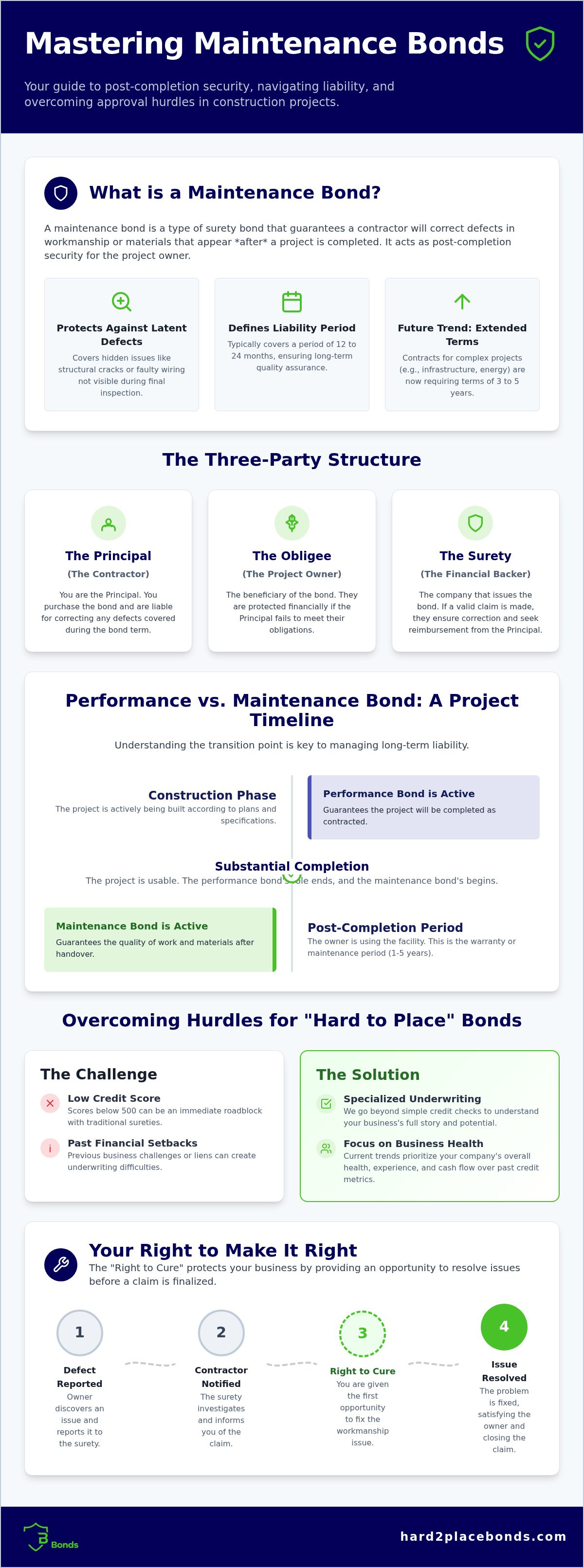
Think of the final walkthrough as a milestone rather than a total release of responsibility. A maintenance bond serves as a legal guarantee that a contractor will return to fix any defects in workmanship or materials discovered after the project is complete. It defines the finish line of your liability by setting a clear timeframe for post-construction accountability. This bond ensures that the quality promised during the bidding phase is actually delivered in the final product.

Project owners require these bonds primarily to protect against "latent defects." These are issues like structural cracks, leaking seals, or faulty wiring that aren't visible during the final inspection but appear months later. Typically, a maintenance bond covers a duration of 12 to 24 months. However, some 2026 contracts for complex infrastructure or specialized energy projects now request terms of three to five years. Understanding the broader concept of a Surety Bond is essential for seeing how these specific obligations fit into your overall contract package.

To better understand how this post-completion security works in practice, watch this helpful video:

The Role of the Principal, Obligee, and Surety

Every maintenance bond relies on a three-party structure that balances risk and ensures accountability. This framework prevents the owner from being left with a failing asset and keeps the contractor focused on quality. The three parties include:

  • The Principal: This is you, the contractor. You remain liable for the quality of the build and must rectify any covered defects that arise during the bond term.
  • The Obligee: This is the project owner or government entity. They are the beneficiary who receives the financial guarantee that the work will meet specifications.
  • The Surety: This is the financial backer. If the Principal fails to address a valid defect, the Surety ensures the work is corrected, though they'll seek reimbursement from the contractor afterward.

Maintenance Bonds vs. Traditional Insurance

It's a common mistake to view these bonds as just another insurance policy. In reality, a surety bond functions more like a line of credit. Standard insurance usually covers "accidents" and carries a duty to defend the policyholder. Conversely, a maintenance bond focuses on a "duty to perform." It ensures that the specific terms of the contract are met, even after the final payment is made. For a deeper dive into these distinctions, check out our guide on Understanding Surety Bond Meaning. This distinction is crucial for contractors who want to maintain their bonding capacity and avoid unnecessary claims that could impact future eligibility.

Maintenance Bond vs. Performance Bond: Key Differences

Many contractors feel a wave of relief when they secure their initial project bonds, only to face confusion when the owner asks for post-completion security. While they sound similar, the distinction between a performance bond and a maintenance bond is a matter of timing and intent. A performance bond ensures the project is built according to the plans and specifications. In contrast, the maintenance bond ensures that the work stays in good condition once the keys are handed over. We've seen many contractors get caught in the terminology trap, but understanding this hand-off is essential for managing your long-term liability.

When Does One End and the Other Begin?

The transition point usually occurs at the milestone of "Substantial Completion." This is the moment the owner can use the project for its intended purpose. At this milestone, the performance bond has generally done its job. The maintenance bond then steps in to cover the durability of materials and the quality of the workmanship. For high-risk infrastructure, such as solar farms or large-scale utility projects, owners might require a standalone bond to extend this protection for several years. If you're currently managing an active build, you're likely already familiar with Payment and Performance Bonds, which handle the heavy lifting during the execution phase.

Maintenance vs. Warranty Bonds

Don't let the technical jargon slow you down. In the 2026 construction market, the terms "maintenance bond" and "warranty bond" are frequently used interchangeably. However, the specific language in your contract is what dictates your actual liability. A warranty bond specifically guarantees that the materials and equipment used meet the standards promised. If a pump fails or a roof leaks within the first year, this bond provides the owner with financial recourse. It's about the durability of the materials rather than just the execution of the labor.

The cost structure for these protections is often more favorable than many contractors expect. Most sureties bundle a standard 12-month maintenance period into the initial performance bond premium at no extra charge. If the owner requires a longer term, such as three or five years, an additional premium is typically required. If you're navigating a complex contract and need to clarify these obligations, you can begin your bonding assessment here to find a solution that fits your business profile and protects your bottom line.

Determining Maintenance Bond Costs and Requirements

How much will this cost? That's the first question we hear from contractors facing a new project requirement. In 2026, the answer depends on several moving parts. A maintenance bond premium isn't a random number; it's a reflection of the risk the surety takes on your behalf. Underwriters primarily look at your contract value and the length of the maintenance period to set a baseline. However, your business's financial health is the real engine behind the rate you'll pay.

Many contractors believe a credit score below 500 is an automatic rejection. That's a lingering stigma we're working to change. Modern underwriting increasingly looks at the whole business rather than a single score. If you have a solid track record of successful completions, that experience often carries more weight than a snapshot of your credit history. We prioritize your ability to finish the job correctly, which naturally reduces the likelihood of a claim on a maintenance bond .

The complexity of the project also plays a major role in the approval process. Underwriters assess the specific "obligation" of the work. For example, structural repairs or underground utility work carry a higher risk profile than finish carpentry or landscaping. A defect in a foundation is far more expensive to rectify than a loose cabinet handle or a faulty HVAC sensor. Showing an underwriter that you specialize in your field and have the right equipment for the task can help lower your perceived risk.

Financial Indicators Underwriters Look For

Underwriters focus on your balance sheet to ensure you have the staying power to fix defects a year or more after the project ends. They specifically look at your working capital and debt-to-equity ratios. In 2026, the shift toward digital accounting practices has changed the game. Real-time data access allows us to speed up the approval process significantly, often cutting days off the traditional wait time. For "Hard to Place" risks, we move beyond the spreadsheets. We use a narrative underwriting approach to explain the context of your financial situation, turning a standard rejection into a successful approval.

The Impact of the Maintenance Period Length

The clock starts ticking the moment a project is accepted. While a standard one-year bond is the industry norm, multi-year obligations are becoming more frequent in public works. You'll likely notice that premiums increase significantly once you cross into the third year of coverage. This happens because the surety's exposure to risk grows as the structure or system ages. To keep your costs manageable, we recommend leveraging material-specific warranties from your suppliers. Providing proof that your materials are backed by the manufacturer shows the underwriter that the risk is shared across the supply chain.

The Claims Process: Navigating Defects and Disputes

Facing a claim on your maintenance bond can feel like a personal attack on your professional reputation. It's a high-stakes moment that requires a level head and a clear understanding of your rights. Unlike traditional insurance where a carrier might settle a claim without your input, the surety process includes a rigorous investigation phase. The surety's primary role is to act as an impartial referee, determining whether the reported issue is a genuine defect in workmanship or simply the result of normal wear and tear. They won't just cut a check to the owner without verifying the facts first.

One of the most important protections you have is the "Right to Cure." This legal principle ensures that you're given the first opportunity to fix a confirmed defect before the surety steps in with financial compensation. It's often the fastest way to resolve a dispute and keep your bonding record clean. If the investigation confirms a valid claim and you're unable to perform the repairs, the surety has options. They might hire a different contractor to complete the work or provide a cash payout to the owner to cover the costs. Either way, the goal is to fulfill the original contract promise while minimizing further disruption.

Defective Workmanship vs. Design Flaws

It's vital to recognize the boundaries of your liability. Your maintenance bond covers your execution of the plans, not the plans themselves. If you followed the architect's specifications perfectly and the structure failed due to a design error, you shouldn't be held responsible. To defend against frivolous claims, you must keep meticulous documentation from the day you receive your "Final Acceptance" certificate. This document is a critical milestone that marks the official start of the maintenance period and provides a baseline for the condition of the work at the time of handover.

Mitigating the Risk of a Bond Claim

The most effective strategy for handling a claim is to prevent it from ever being filed. Establishing a clear communication protocol with the project owner after completion can stop minor grievances from escalating into formal bond demands. We've seen that a proactive check-in six months after completion can catch small issues before they become expensive defects. Remember that any claim on your record can affect your future bonding capacity and premiums. If you're looking to strengthen your business's standing or need help navigating a complex requirement, you can connect with our expert underwriting team to find a solution that protects your professional future.

Securing a Maintenance Bond with Credit Challenges

Why does a standard rejection feel like a permanent roadblock for your business? Most traditional sureties rely on rigid, automated systems that flag a low credit score as an instant reason to decline. They don't see the skilled contractor or the successful project history behind the number. If your credit has taken a hit from a past bankruptcy or a slow-paying client, those systems will likely reject your maintenance bond request without a second look. We believe your business is more than a three-digit score, and we're here to act as your tenacious advocate.

Our "Hard to Place" advantage lies in specialized underwriting that focuses on your current capacity and project history. We look at the whole picture to find a path forward where others only see a dead end. This approach allows us to provide solutions for contractors who have been marginalized by traditional financial systems. By demonstrating your reliability through a "Bonding Resume," you can prove your durability as a professional. This resume should document every project you've successfully completed, showing that your workmanship stands the test of time regardless of your personal financial history.

To secure approval when credit is a hurdle, we often look at specific risk-mitigation strategies. These aren't meant to be obstacles; they're tools to build trust with the underwriter. Common strategies include:

  • Personal Indemnity: Showing your personal commitment to the project's long-term success.
  • Funds Control: Using a third-party service to manage project disbursements, ensuring all obligations are met.
  • Collateral: Providing liquid assets or a letter of credit to offset the surety's risk during the bond term.

Steps to Approval for High-Risk Contractors

The first step is gathering comprehensive financial statements and a detailed project history. Transparency is your best asset when dealing with specialized underwriters. Don't shy away from explaining credit "blips"; instead, provide professional reassurance and context for those events. Showing that you've learned from past setbacks and have a solid plan for the future makes a significant difference. For a deeper dive into this process, read our guide on How to Secure a Contract Surety Bond with Bad Credit.

The Role of a Specialized Surety Broker

A general insurance agent often lacks the niche market access required to place a high-risk maintenance bond . They might only have relationships with standard carriers who have strict credit requirements. A specialized broker, however, has national access to niche underwriting markets that understand complex financial situations. We know how to navigate the hurdles that stop other agents in their tracks. If you're ready to move past the frustration of rejection and get the bonding you need, you can Start Your Bond Application today and let us find a solution that works for you.

Secure Your Project’s Future with Confidence

You now have a clear roadmap for managing post-completion liability and understanding how a maintenance bond protects both your reputation and the project owner's investment. We've explored the critical "hand-off" from performance obligations and how modern underwriting in 2026 prioritizes your total business capacity over a single financial metric. You don't have to navigate these complex requirements alone or fear that a past credit hurdle will block your path.

We've specialized in hard-to-place contract bonds for years, offering expert national underwriting that looks for solutions instead of excuses. Our team regularly secures approvals for contractors with credit scores as low as 500, ensuring you can meet your contract duties without delay. If you're ready to lock in your next project, Get Your Maintenance Bond Approved Today. We're committed to being the tenacious advocate you need to keep your business moving forward. Your next successful project completion is within reach, and we're ready to help you secure it.

Frequently Asked Questions

Is a maintenance bond the same as a warranty?

No, they are related but distinct. A maintenance bond is a three-party surety agreement that guarantees a contractor's warranty obligations will be met. While a warranty is a promise from the contractor to the owner, the bond provides the financial backing if the contractor fails to fulfill that promise. It ensures the owner isn't left paying for repairs due to workmanship defects or material failures discovered after the project ends.

Can I get a maintenance bond with a 500 credit score?

Yes, you can secure a maintenance bond even with a credit score as low as 500. Traditional sureties often reject applicants with lower scores, but specialized underwriters look at your overall business health and project history. We act as a tenacious advocate for contractors with credit challenges, using narrative underwriting to explain financial setbacks. Our focus remains on your ability to deliver quality work rather than just a snapshot of your past.

Who pays for the maintenance bond in a construction contract?

The contractor is responsible for paying the premium for the bond, though this cost is typically factored into the total project bid. In many cases, a one-year maintenance period is bundled into the cost of the performance bond at no extra charge. If the project owner requires a standalone bond or an extended term, the contractor pays the additional premium to the surety provider before the project is finalized and accepted.

How long does a maintenance bond typically last?

Most maintenance bond agreements cover a period of 12 to 24 months following the date of substantial completion. While a one-year term is the standard industry norm, some 2026 public works contracts or specialized infrastructure projects now require coverage for three to five years. The specific duration is dictated by the contract language and the owner's assessment of the project's long-term risk profile. It ensures accountability remains active long after handover.

What happens if a contractor goes out of business during the maintenance period?

The surety provider steps in to fulfill the contractor's obligations if they are no longer in business. If a defect is discovered and the original contractor cannot perform the repairs, the surety will either hire a new contractor to fix the issue or provide a cash settlement to the project owner. This financial safety net is the primary reason owners require these bonds in high-stakes construction environments where long-term durability is essential.

Are maintenance bonds required for private construction projects?

While they are almost always mandatory for public works, these bonds are becoming increasingly common in private construction as well. Private owners use them to mitigate the risk of latent defects in large-scale developments, such as solar farms or commercial complexes. The requirement depends entirely on the owner's risk management strategy and the specific terms negotiated within the construction contract. It provides peace of mind that the investment is protected against poor workmanship.

Can a maintenance bond be canceled once the project is finished?

No, a maintenance bond cannot be canceled by the contractor once it has been issued and the project is complete. The bond remains in effect for the entire duration of the maintenance period specified in the contract. It only expires once that timeframe has passed without any unresolved claims. This ensures the owner has continuous protection during the most critical phase of the project's early lifecycle when defects are most likely to surface.

Does a maintenance bond cover damage caused by natural disasters?

No, these bonds do not cover damage resulting from natural disasters like floods, fires, or earthquakes. A maintenance bond is strictly designed to address defects in workmanship and materials provided by the contractor. Damage caused by external environmental factors or a lack of proper maintenance by the owner falls under standard property insurance. This distinction is vital for understanding where your liability ends and where general insurance coverage begins for the finished asset.

Share:

Recent Posts

By cinchweb August 20, 2026
Don't let subdivision bond requirements delay your 2026 project. Our essential checklist helps you navigate municipal standards and secure your bond with con...
By cinchweb August 19, 2026
Need a surety bond for solar developers? Our 2026 guide helps you bypass bank hurdles, meet decommissioning mandates, and free up capital for project growth.
By cinchweb August 19, 2026
Navigate 2026 contractor license bond requirements, even with bad credit. Our guide covers state updates, bond types, and how to get approved. Get licensed now!
By cinchweb August 17, 2026
Confused about payment bond vs performance bond? Our 2026 guide explains the differences, Miller Act rules, and how to get bonded with less-than-perfect credit.
By cinchweb August 16, 2026
Worried about the freight broker bond cost with bad credit? Our 2026 guide shows you how to get your $75,000 BMC-84 bond approved despite a low score.
By cinchweb August 15, 2026
Struggling to get payment and performance bonds due to credit? Our 2026 guide covers the Miller Act and non-standard underwriting to get your contract approved.
By cinchweb August 14, 2026
Secure a solar PPA security bond without cash collateral. Our 2026 guide helps developers & investors navigate underwriting to protect capital & launch proje...
By cinchweb August 14, 2026
Learn the 2026 performance bond cost for high risk contractors. This guide breaks down premiums, SBA programs, and actionable steps to get approved and lower...
By cinchweb August 13, 2026
Wondering can you get a bid bond with bad credit? Yes! Our 2026 guide shows how specialty programs help contractors with low scores win lucrative contracts.