
What if the biggest threat to your 2026 development timeline isn't the rising cost of raw materials, but a single missing document in your bonding application? With housing starts down 13.5 percent compared to last year, every day your project sits idle costs you more in a high-interest environment. You're likely already feeling the pressure of tightening municipal standards and the confusion of managing complex subdivision bond requirements. It's frustrating to face a wall of jargon when you just want to break ground on your site improvements.
We understand that a rejection from a traditional surety can feel like a dead end, but it's often just a sign that you need a more strategic approach. You deserve a clear path to approval that doesn't tie up every cent of your working capital in collateral. This guide provides the essential 2026 checklist you need to stay on track. We'll walk you through the specific financial markers, the necessary technical documents, and the cost structures that define today's market. This ensures you have the tools to secure your bond and move your project forward with confidence.
Key Takeaways
- Learn how subdivision bonds protect municipal infrastructure and why they are a mandatory safeguard for 2026 development projects.
- Identify the technical documents needed to satisfy subdivision bond requirements, specifically focusing on approved engineering plans and the underlying subdivision agreement.
- Evaluate the liquidity benefits of surety bonds over Letters of Credit to keep your cash flow accessible for actual construction costs.
- See how a strong project track record can outweigh credit challenges during the underwriting process for hard-to-place bonds.
- Move your project forward by following a streamlined submission process designed to navigate today's tightening municipal standards.
Understanding Subdivision Bonds and Municipal Requirements
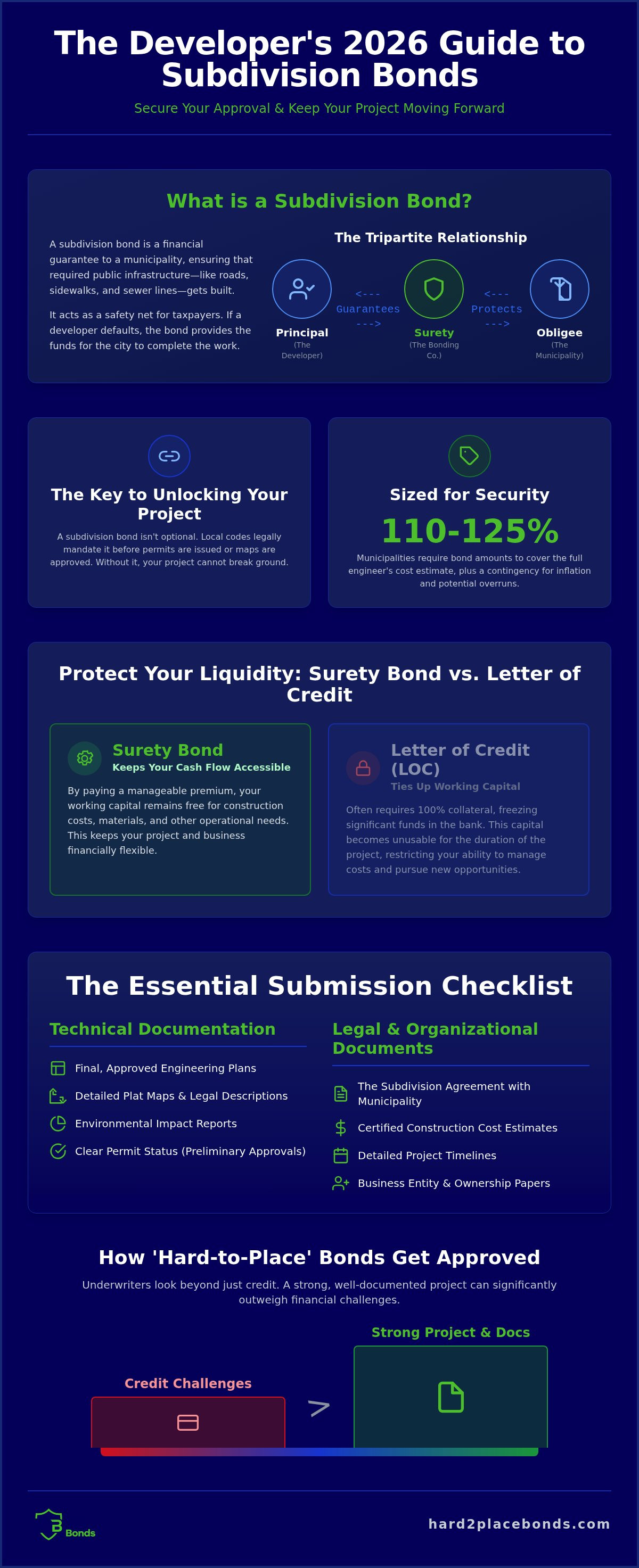
A subdivision bond is more than just a regulatory box to check; it is a financial guarantee that ensures public infrastructure actually gets built. When you take on a new development, the local municipality needs to know that the planned roads, sidewalks, and sewer lines won't become a public burden if your project hits a snag. These instruments, often referred to as site improvement and subdivision bonds, act as a safety net for taxpayers. If a developer defaults, the bond provides the funds necessary for the city to complete the work itself.
The structure of these bonds relies on Surety bond basics, which involve a tripartite relationship. You, the developer, are the Principal. The municipality or government agency is the Obligee. The Surety is the company that backs your promise with financial weight. While standard performance bonds usually protect a private owner in a construction contract, subdivision bonds are specifically designed to cover public improvement obligations required by law. Understanding these subdivision bond requirements is the first step toward securing approval for your 2026 project.
Common Names for Subdivision Bonds in 2026
Terminology can shift depending on where you are building. You might hear these called plat bonds, especially during the land recording process. A plat bond is often a prerequisite for getting your final map recorded with the county. In other jurisdictions, they are simply called site improvement bonds, focusing on the physical grading and utility work. You may also encounter the term completion bonds. While this is a broader category, it frequently overlaps with subdivision needs when a guarantee of total project finishing is required.
The Legal Framework of Land Development
Local codes and ordinances are the primary drivers of subdivision bond requirements . These laws dictate exactly how much coverage you need and how long the bond must remain in effect. For example, many municipalities now require bond amounts to cover 110 percent to 125 percent of the engineer's estimated cost to account for inflation and potential cost overruns. The Obligee is the government entity receiving the guarantee. Your ability to move from the planning phase to active construction is legally tied to the issuance of this bond. Without it, the city will typically withhold the permits or map approvals you need to break ground. We help you navigate these hurdles by focusing on the legal necessity of the bond rather than just the credit score of the applicant.
The Essential Checklist: Technical and Legal Documentation
Securing a bond isn't just about your credit score; it's about the quality of the package you present to the underwriter. When you're preparing to meet subdivision bond requirements , your documentation acts as the roadmap for the surety company. They need to see that your project is technically sound and legally cleared before they'll back your obligations. If you've felt overwhelmed by the volume of paperwork requested, remember that each piece reduces the perceived risk and brings you one step closer to breaking ground.
Technical Documentation Requirements
Your engineering plans are the foundation of your application. Underwriters require final, approved blueprints for paving, drainage, and utilities to understand exactly what they are guaranteeing. Along with these plans, you'll need to provide detailed plat maps and precise legal descriptions of the development area. These documents prove that the land is properly subdivided and ready for the improvements listed in your agreement.
Environmental impact reports also play a significant role in Subdivision bond underwriting. These reports help the surety assess if there are hidden risks that could stall construction or increase costs. Additionally, your permit status must be clear. While you might be seeking the bond to get your final approvals, having preliminary permits in place shows the underwriter that the municipality is already on board with your vision. If you're managing a particularly complex project, it's helpful to understand how site improvement and subdivision bonds differ in their technical demands.
Legal and Organizational Documents
The core of your application is the Subdivision Agreement. This is the legally binding contract between you and the municipality that outlines your specific duties. To support this, you must provide construction cost estimates that are certified by a licensed engineer. These estimates are non-negotiable because they determine the total bond amount. Underwriters also scrutinize your project timelines to calculate the "tail" of the risk, ensuring they know exactly when their liability begins and ends.
Finally, don't overlook your organizational paperwork. You'll need to submit business entity papers, such as LLC or Corporate agreements, along with clear proof of land ownership or title documentation. This establishes your legal authority to develop the property and enter into a bonding agreement. If you're ready to move past the paperwork and get a professional eyes-on review of your file, you can start your application today and let our team help you organize these essentials.
Financial Requirements: Subdivision Bonds vs. Letters of Credit
Choosing how to secure your public improvement obligations is a pivotal financial decision that impacts your entire project's cash flow. Many developers default to a Letter of Credit (LOC) because it is what their local bank suggests, but this often requires freezing the full bond amount in a restricted account. Meeting subdivision bond requirements through a surety company allows you to pay a premium instead of tying up your liquid assets. This keeps your working capital where it belongs; on the job site, paying subcontractors and purchasing materials. Because a bond is not a loan, it typically does not count against your aggregate borrowing capacity, leaving your bank lines open for construction financing.
The cost comparison goes beyond just the annual fee. While a bank might charge a low percentage for an LOC, the opportunity cost of frozen cash can be devastating to your growth. If you have a large sum sitting in a bank to back an LOC, you can't use those funds to acquire your next parcel of land. Furthermore, the process of release is often smoother with a bond. Once the municipality signs off on the improvements, the bond is exonerated. Closing an LOC can sometimes be a slower, more rigid process that keeps your capital locked away longer than necessary.
Financial Statement Checklist
Underwriters need a clear picture of your financial health to approve your application. To speed up the review of your site improvement and subdivision bonds, you'll need to prepare a professional package. This should include personal and business financial statements, preferably prepared by a CPA. You must also provide proof of project funding to show you have the means to finish the improvements you are guaranteeing. Finally, a Schedule of Real Estate Owned (SREO) is essential to demonstrate your total asset depth and experience as a developer.
The Role of Collateral in 2026
In today's market, collateral isn't always a mandatory part of subdivision bond requirements , but it's a helpful option for complex projects or credit-challenged applicants. Collateral is a tool to bridge the gap between a "no" and a "yes" for high-risk applicants. Instead of cash, we often look for alternative options like real estate equity to secure the bond. This flexibility allows you to satisfy municipal demands without draining your project's bank account. If you're ready to see which financial structure works best for your current project, you can start an application to get a professional assessment of your options.