

August 19, 2026

Solar Developer Surety Bonds: 2026 Project Approval Guide

What if the biggest threat to your 2026 solar project isn't the supply chain or the weather, but a rigid bank demanding 100% collateral for a Letter of Credit? You've spent months on site acquisition and permitting, only to hit a wall when it comes to financial assurance. With 28 states now mandating decommissioning security, the pressure to find a flexible surety bond for solar developers has never been higher. You know that tying up your working capital in a bank vault is a recipe for stagnation, yet standard markets often turn away from non-standard risks or credit challenges.

It's a stressful position, but you don't have to choose between compliance and growth. This guide unlocks the financial leverage you need to meet Bureau of Land Management requirements and state-level mandates without draining your liquidity. We'll show you how to navigate the 2026 project approval landscape, satisfy the "beginning of construction" deadlines, and secure the decommissioning and performance bonds necessary to scale. From understanding new IRS physical construction rules to bypassing traditional bank hurdles, you're about to discover a path to project approval that keeps your capital where it belongs: in the field.

Key Takeaways

  • Learn how to replace restrictive Letters of Credit with surety bonds to free up your working capital and increase your borrowing capacity.
  • Identify the specific performance, payment, and decommissioning bonds required to satisfy local and federal regulators at every project phase.
  • Discover how specialized underwriting can secure a surety bond for solar developers even if you have faced prior rejections due to credit scores or project complexity.
  • Understand the strategic advantage of "off-balance sheet" credit facilities and how they allow you to scale your portfolio faster than traditional bank products.
  • Find out how partnering with a dedicated advocate can bridge the gap between niche solar risks and the specific requirements of high-capacity surety carriers.

The Strategic Role of Surety Bonds in Solar Development

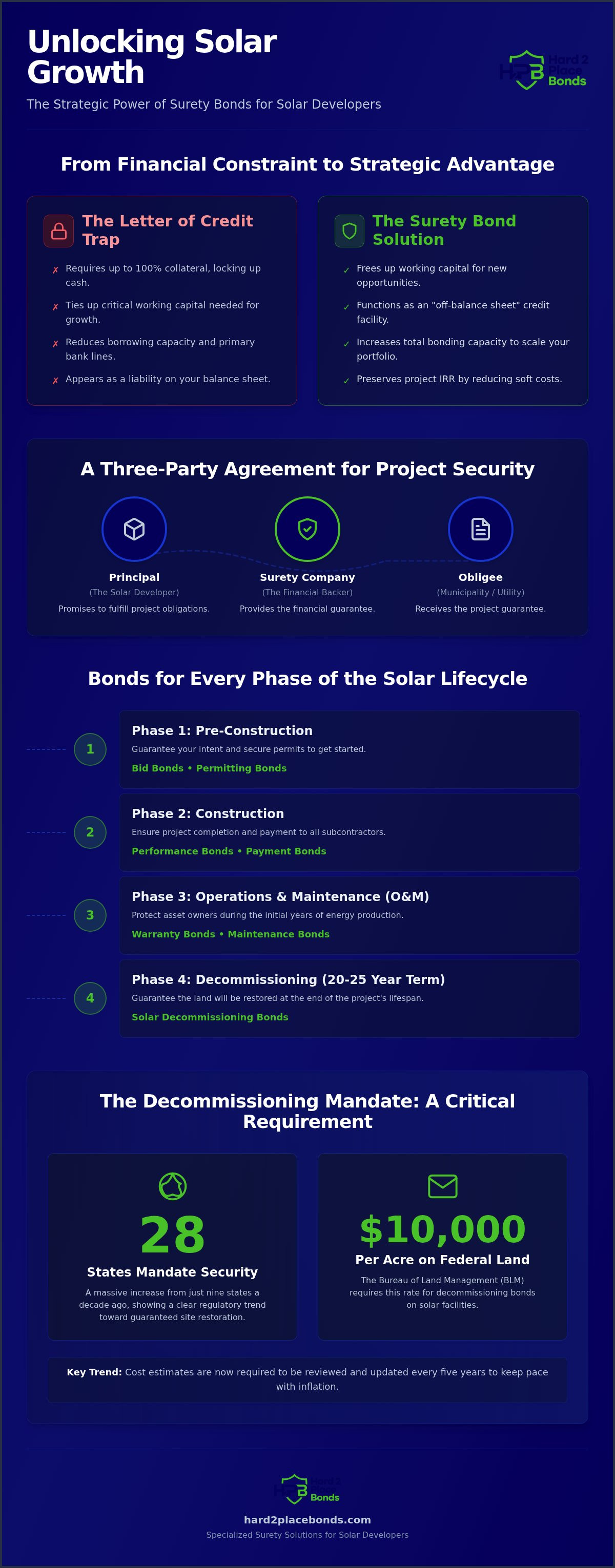
Solar projects are high-stakes investments with lifecycles spanning decades. To ensure these sites don't become environmental liabilities, regulators require financial guarantees. At its core, what a surety bond is is a three-party agreement. The developer (principal) promises to fulfill a specific obligation, the municipality or utility (obligee) receives the guarantee, and the surety company provides the financial backing. This third-party layer of protection is what makes utility-scale development possible in today's regulatory environment.

Securing a surety bond for solar developers isn't just about checking a box for a permit. It's a strategic move to preserve your project's Internal Rate of Return (IRR). If you choose cash escrow or a Letter of Credit, you're locking up liquid capital that could be used for your next site acquisition or equipment purchase. In 2026, the landscape is shifting toward much higher standards of accountability. With 28 states now enforcing statutory decommissioning rules, the demand for these bonds has reached an all-time high. Federal land requirements are equally stringent, with the Bureau of Land Management requiring decommissioning bonds at a rate of $10,000 per acre for solar facilities. For developers facing tight margins, these bonds offer a lifeline that keeps projects viable when banks demand too much collateral.

Why Obligees Prefer Surety Over Corporate Guarantees

Local governments and utilities rarely accept a corporate guarantee because it lacks the security of a third-party audit. A surety company acts as an essential external prequalification filter. When a surety issues a bond, they're signaling to the local government that they've thoroughly vetted your financials, experience, and project viability. This protects local taxpayers from the massive costs of removing abandoned solar infrastructure. Unlike a simple financial reimbursement, a bond often guarantees the actual completion of the work, ensuring the land is restored regardless of the developer's future status.

The Economic Impact of Bonding on Solar Project Feasibility

Your total bonding capacity directly dictates how many projects you can bid on and manage simultaneously without hitting a financial ceiling. By utilizing a surety bond for solar developers , you effectively move these liabilities off your balance sheet. This approach reduces soft costs and keeps your primary bank lines open for critical operational needs. Understanding the Surety Bond Meaning and how it functions as an "off-balance sheet" credit facility is the first step toward scaling your portfolio in this competitive environment.

Essential Bond Types for Every Phase of the Solar Life Cycle

Solar development isn't a one-time transaction; it's a multi-decade commitment that requires different financial protections at every turn. From the initial bid to the final site restoration, regulators and partners look for specific guarantees to mitigate risk. Failing to secure the right surety bond for solar developers at the correct time can lead to permit denials or project delays that jeopardize your federal tax credit eligibility. As you navigate the 2026 landscape, you'll need a bonding strategy that covers these four critical phases:

  • Phase 1: Pre-Construction. This includes bid bonds that guarantee you'll enter the contract if awarded, along with permitting bonds required by local jurisdictions.
  • Phase 2: Construction. Performance and payment bonds ensure the EPC contractor completes the work according to the design and pays all subcontractors to keep the title clear of liens.
  • Phase 3: Operations and Maintenance (O&M). Warranty and maintenance bonds often cover 5% to 10% of the contract amount, protecting the asset owner during the early years of energy production.
  • Phase 4: Decommissioning. This is the long-term security that ensures the land is restored to its original state once the project's 20-25 year lifespan ends.

Solar Decommissioning Bonds: Meeting Long-Term Compliance

The regulatory environment for site restoration has tightened significantly. Today, 28 states have established statutory rules for solar decommissioning bonds, a massive increase from just nine states a decade ago. These mandates often follow the Code of Federal Regulations regarding financial assurance for renewable leases. A key trend in 2026 is the requirement for cost estimates to be reviewed and updated every five years. This ensures the bond amount keeps pace with inflation and changing salvage values, preventing a "funding gap" decades down the line. If you're feeling overwhelmed by these shifting rules, you can submit your project details here for a specialized review.

Performance and Payment Bonds for EPC Contractors

Construction is the most volatile phase of any solar project. Supply chain disruptions or contractor insolvency can halt progress instantly, putting your "in-service" deadlines at risk. By requiring payment and performance bonds, you transfer the risk of default to the surety. These bonds protect the project owner by ensuring that if a contractor fails, the surety steps in to complete the project or provide the funds to do so. They also guarantee that material suppliers are paid, which is vital for avoiding costly mechanics' liens that can complicate your project financing or eventual sale.

Surety Bonds vs. Letters of Credit: Maximizing Developer Liquidity

For many CFOs in the renewable space, the choice between a bank and a surety provider isn't just about the rate. It's about borrowing capacity. When you use a Letter of Credit (LOC), your bank typically reduces your available credit line by the full amount of the guarantee. In many cases, banks demand 100% cash collateral to issue the LOC, effectively freezing your cash. A surety bond for solar developers operates differently. It is an off-balance sheet credit facility that provides the same level of security to the obligee without cannibalizing your primary bank lines.

The cost comparison also favors the bond. Consider these factors when evaluating your options for your next project:

  • Collateral Requirements: LOCs often require dollar-for-dollar collateral; bonds typically do not for qualified developers.
  • Balance Sheet Impact: Bonds are contingent liabilities, whereas LOCs directly impact your debt-to-equity ratios and borrowing limits.
  • Premium Costs: Surety premiums are a manageable operational expense rather than a capital-intensive hurdle that drains your reserves.

For established developers, even those considered high-risk due to project size or niche technology, bonding without collateral is often achievable through specialized underwriting. This shift from bank-led guarantees to surety-led programs is a key driver for scaling portfolios in 2026. It allows you to move faster and bid more aggressively without the constant fear of a liquidity crunch.

Preserving Working Capital for Project Acquisition

Maintaining liquidity is the difference between winning one project and dominating a region. By moving your financial assurance obligations to a surety, you free up your credit lines to fund early-stage development, site options, and interconnection deposits. While LOCs often require 100% collateral, bonds typically do not, allowing you to use that same capital to leverage additional project financing. This strategic use of bonding capacity enables you to bid on multiple projects simultaneously, a necessity as federal deadlines approach. You're essentially turning a regulatory hurdle into a growth engine for your firm.

The Claims Process: Surety Advocacy vs. Bank Neutrality

Another critical distinction lies in the claims process. Banks are neutral parties; if a demand is made on an LOC, the bank pays immediately without investigating whether the claim is valid. This "pay first, ask later" approach leaves you vulnerable to frivolous demands from municipalities or partners. A surety, however, acts as your advocate. They have a legal right and a duty to investigate the claim before any payment is made. If the claim is unjustified, the surety will defend you, providing a layer of protection that a bank simply won't offer. This is especially relevant for complex commercial surety bonds used in power purchase agreements and long-term utility contracts. We understand the frustration of being at the mercy of a bank's rigid policies, which is why we focus on solutions that protect your interests and your cash flow.

Navigating Underwriting for High-Risk and Hard-to-Place Solar Projects

It's a common frustration: you have a viable project and a signed Power Purchase Agreement (PPA), but a standard carrier rejects your application because of a past financial setback or a low credit score. You might feel like your project is stalled before it even begins. However, securing a surety bond for solar developers doesn't always require a perfect balance sheet. Specialized underwriting looks beyond a simple credit score to evaluate the intrinsic value and technical viability of the project itself.

When we review a hard-to-place risk, we focus on the "Solar Surety Package." This comprehensive file includes your interconnection agreement, the strength of your PPA, and the technical expertise of your engineering team. If the project's cash flow is robust and the technical risks are managed by experienced professionals, there is often a path to approval that traditional insurers simply can't see. We act as your advocate, presenting the full story of your project to niche carriers who understand the renewable energy market.

Securing Bonds with Credit Challenges or Bankruptcy History

If you're operating with a credit score in the 500 to 600 range, you've likely been told that multi-million dollar bonding is impossible. It isn't. We utilize specific strategies like funds control or escrow accounts to mitigate the surety's risk. This setup ensures that project funds are directed solely toward project completion, which allows the carrier to focus on the project's success rather than your personal financial history. Learning how to secure a contract surety bond with bad credit involves demonstrating transparency and project control. This approach builds the trust necessary to secure high-capacity bonds even when your credit history is less than ideal.

Bonding for New Developers and Startups

New developers often face a "chicken and egg" problem: they need a bond to get their first project, but they need a track record to get the bond. To bridge this gap, we lean heavily on the reputation of your EPC contractor. If you've partnered with a Tier 1 contractor with a proven history of successful solar installs, their credibility becomes your leverage during the underwriting process. Additionally, be prepared to offer personal indemnity to show the surety you're fully committed to the project's outcome. Leveraging the experience of your partners is a proven way to build the credibility needed for your initial project bonds.

Don't let a standard rejection letter end your project's potential. If you're ready to move past the automated "no" and find a solution tailored to your specific situation, start your application here today.

Partnering with a Specialist: The Hard 2 Place Bonds Advantage

A general insurance agent might handle your workers' comp or property insurance, but they often lack the deep-seated relationships required to place complex solar risks. When a standard carrier says no, a generalist usually stops there. We don't. As specialized surety brokers, we focus exclusively on the high-stakes world of financial guarantees. We understand that a surety bond for solar developers is a specialized instrument that requires a deep understanding of energy markets, regulatory shifts, and long-term land use obligations.

We act as your tenacious advocate. Instead of just forwarding a set of financial statements, we engage in a consultative process with niche carriers who are comfortable with the specific risks of utility-scale solar. Our national reach ensures that we can satisfy bonding requirements across the United States, regardless of local variations in decommissioning laws or site improvement standards. This specialized focus transforms the bonding process from a point of friction into a strategic advantage for your development pipeline.

Our Consultative Approach to Solar Risk

We don't just submit an application; we tell your project's story. This involves highlighting the strength of your EPC partners, the reliability of your Power Purchase Agreement, and the technical feasibility of the site. By identifying the right market for specific decommissioning or site improvement needs, we bridge the gap between a standard rejection and a project approval. Understanding the steps for Obtaining a Surety Bond is easier when you have a partner who speaks the language of the underwriters and knows which levers to pull to mitigate perceived risks.

Get Started with Your 2026 Solar Bonding Program

Early engagement is the best way to prevent permitting delays. If you wait until the last minute, you risk missing the 2026 "beginning of construction" deadlines for federal tax credits. To get a quick quote and move toward project commencement, prepare a checklist that includes your current financial statements, a detailed project description, and a copy of the bond requirement from the obligee. We specialize in finding paths forward when others see only limitations. Don't let a standard refusal stall your progress. You can Start your solar bond application today and partner with a team that is as committed to your project's success as you are.

Powering Your 2026 Solar Pipeline

The 2026 solar landscape is defined by tighter decommissioning mandates and urgent federal deadlines. Successfully navigating these hurdles requires more than just a permit; it requires a financial strategy that keeps your capital in the field. By choosing a surety bond for solar developers over restrictive bank products, you unlock the liquidity needed to scale your portfolio without hitting a collateral ceiling. You've worked hard to bring your project to this stage, and your financial assurance partner should be an asset, not a roadblock.

We specialize in placing hard-to-place and bad credit surety bonds for developers who have been turned away by standard markets. Whether you're managing complex decommissioning requirements or starting your first utility-scale project, our team provides national coverage and the specialized underwriting expertise you need to move forward. Rejection from a standard carrier doesn't have to be the end of your project's potential.

It's time to stop worrying about bank collateral and start focusing on project commencement. We're ready to advocate for your project and help you meet every regulatory milestone with confidence.

Solar Bonding Frequently Asked Questions

What is a solar decommissioning bond and why do I need one?

A solar decommissioning bond is a financial guarantee that ensures a project site is restored to its original condition at the end of its operational life. You need one because 28 U.S. states now have statutory or administrative rules requiring this security for utility-scale projects. This bond protects local municipalities and taxpayers from the costs of removing abandoned infrastructure if a developer becomes insolvent or fails to fulfill their land restoration obligations.

How much does a surety bond for a solar farm cost?

The premium for a surety bond for solar developers typically ranges from 1% to 3% of the bond amount for contract-class obligations, though rates vary based on credit and project complexity. Factors such as your financial strength, the project's scale, and specific state requirements influence the final premium. While well-qualified applicants receive the lowest rates, specialized markets offer competitive options for developers with non-standard risks or complex project structures.

Can I get a solar performance bond with a 500 credit score?

Yes, you can secure bonding even with a 500 credit score through specialized underwriting programs. We look beyond the credit score to evaluate your project's overall viability and the reputation of your EPC contractor. To mitigate risk, we might utilize tools like funds control or escrow accounts. These strategies allow the surety to focus on the project's success rather than past financial challenges, turning a potential rejection into a project approval.

How long does it take to get approved for a solar developer bond?

Initial review of your application typically takes 24 to 48 hours. For standard risks, we can often provide a quote within this window. However, utility-scale projects or those involving complex decommissioning requirements may take five to seven business days for full underwriting. Engaging a specialized broker early in the process prevents delays during the permitting phase and ensures you meet critical construction deadlines for federal tax credit eligibility.

What is the difference between a surety bond and a Letter of Credit for solar projects?

The primary difference is how they impact your liquidity and balance sheet. A Letter of Credit (LOC) usually requires 100% collateral and reduces your available bank credit. In contrast, a surety bond is an off-balance sheet credit facility that typically does not require collateral for qualified developers. Additionally, a surety will investigate a claim's validity before paying, whereas a bank will pay an LOC demand immediately without any investigation.

Do solar decommissioning bonds require collateral?

Solar decommissioning bonds often do not require collateral for developers with strong financial statements and a proven track record. This is a significant advantage over bank-issued guarantees. For high-risk or credit-challenged applicants, a surety might require a partial collateral deposit or the use of funds control. Our goal is always to structure a deal that satisfies the obligee's requirements while preserving as much of your working capital as possible.

What happens if a solar developer defaults on a bonded project?

If a developer defaults, the surety company first conducts a thorough investigation to confirm the validity of the claim. If the claim is verified, the surety fulfills the obligation by either hiring a new contractor to complete the work or paying the bond amount to the obligee. It's important to remember that the developer (principal) is legally required to reimburse the surety for any losses paid out under the bond agreement.

Are these bonds required for both residential and utility-scale solar?

These specialized financial guarantees are primarily required for utility-scale and large-scale commercial solar projects. Residential installers usually only need standard contractor license bonds to satisfy state or local licensing boards. Utility-scale developers face much higher scrutiny due to the long-term environmental impact and the massive scale of the infrastructure involved. If you're building a solar farm on federal or state land, bonding is almost always a mandatory part of the approval process.

Share:

Recent Posts

By cinchweb August 19, 2026
Navigate 2026 contractor license bond requirements, even with bad credit. Our guide covers state updates, bond types, and how to get approved. Get licensed now!
By cinchweb August 17, 2026
Confused about payment bond vs performance bond? Our 2026 guide explains the differences, Miller Act rules, and how to get bonded with less-than-perfect credit.
By cinchweb August 16, 2026
Worried about the freight broker bond cost with bad credit? Our 2026 guide shows you how to get your $75,000 BMC-84 bond approved despite a low score.
By cinchweb August 15, 2026
Struggling to get payment and performance bonds due to credit? Our 2026 guide covers the Miller Act and non-standard underwriting to get your contract approved.
By cinchweb August 14, 2026
Secure a solar PPA security bond without cash collateral. Our 2026 guide helps developers & investors navigate underwriting to protect capital & launch proje...
By cinchweb August 14, 2026
Learn the 2026 performance bond cost for high risk contractors. This guide breaks down premiums, SBA programs, and actionable steps to get approved and lower...
By cinchweb August 13, 2026
Wondering can you get a bid bond with bad credit? Yes! Our 2026 guide shows how specialty programs help contractors with low scores win lucrative contracts.
By cinchweb August 11, 2026
Struggling to get a contract surety bond with bad credit? Our 2026 guide reveals how to leverage your project history and SBA programs to get approved.
By cinchweb August 11, 2026
Don't let bad credit stop you. Our 2026 guide shows how to get a bid surety bond for high-stakes contracts, even with underwriting hurdles. Win more jobs.