

August 18, 2026

2026 Contractor License Bond Guide: All Trades

A low credit score isn't a permanent "no" for your contracting business; it's simply a signal that you need a different kind of advocate. You've likely felt the sting of rejection from standard bond agencies or felt overwhelmed by the shifting landscape of contractor license bond requirements across the 41 states that mandate them. It's frustrating to have the skills and the drive but feel sidelined by a number on a credit report or confusion over which bond you actually need to start your next project.

We understand that your financial past doesn't define your professional future. This 2026 guide is designed to clear the fog, helping you secure your license and get to work without the typical roadblocks. We'll break down the latest bond increases in states like California and Washington, clarify the vital differences between license and performance bonds, and show you how specialized brokers find paths to approval for high-risk profiles that others ignore. From understanding your state's specific obligations to finding a partner who fights for your approval, you'll find everything you need to move forward with confidence.

Key Takeaways

  • Differentiate between license bonds and performance bonds to ensure you meet the specific legal mandates for your trade.
  • Identify the core contractor license bond requirements that vary by state and learn how to stay compliant with 2026's updated bond amounts.
  • Master the three-party agreement structure to understand how the bond protects the public while establishing your professional credibility.
  • Uncover the documentation steps necessary to secure approval if you're dealing with a low credit score, liens, or prior bankruptcies.
  • Learn why partnering with a tenacious advocate who specializes in hard-to-place risks is the most efficient path to overcoming standard agency rejections.

Understanding Contractor License Bond Requirements

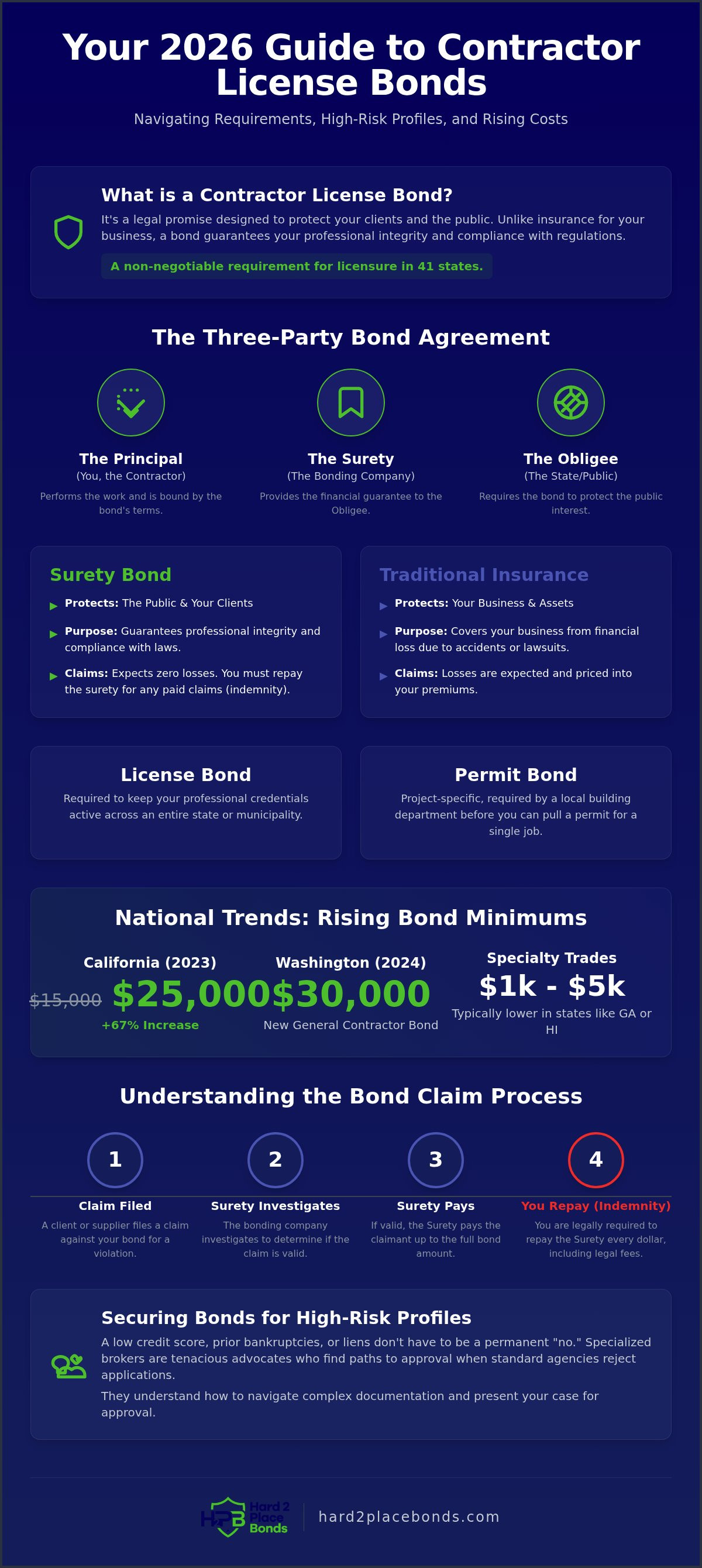
A Surety bond acts as a legal promise between you, the state, and the bonding company. Unlike standard insurance that protects your business from accidents, a contractor license bond is designed specifically to protect the consumer. Meeting contractor license bond requirements is a non-negotiable step for licensure in 41 states. If you fail to follow building codes or neglect to pay your suppliers, the bond provides a financial safety net for those you've harmed.

While many professionals use the terms interchangeably, there's a distinct regulatory difference between license bonds and permit bonds. A contractor license bond is required to keep your professional credentials active across the entire state or municipality. A permit bond is usually project-specific, required by a local building department before you can pull a permit for a single job. Understanding which one you need prevents delays in your application process.

To better understand this concept, watch this helpful video:

The Legal Framework of Surety Requirements

State statutes dictate the exact language and dollar amounts for these bonds. The "Obligee" is the government entity, such as a state licensing board, that sets these rules to safeguard the public interest. If a contractor commits a violation, the bond can be called upon to cover the damages. Common infractions that lead to bond claims include abandoning a contract before completion, failing to pay employee wages, or committing serious building code violations. Because the surety company expects you to pay them back for any claims, they look closely at your financial history during the application process.

National Trends in Bond Amounts for 2026

We're seeing a clear shift toward higher bond minimums across the country. In 2023, California increased its requirement from $15,000 to $25,000. Washington followed suit in 2024, raising its general contractor bond to $30,000. These changes often reflect a need to keep pace with inflation and the rising costs of construction materials. While specialty trades like plumbing or electrical work sometimes have lower bond ranges, often between $1,000 and $5,000 in states like Georgia or Hawaii, the trend is moving upward. The bond penalty is the maximum amount a surety will pay on a claim. Keeping an eye on these evolving contractor license bond requirements helps you plan your overhead costs more accurately as you grow your business.

How the Three-Party Bond Agreement Works

Think of a surety bond as a financial triangle. On one side is you, the Principal. You're the professional performing the work and meeting the contractor license bond requirements . On the other side is the Obligee, which is usually the state licensing board that protects the public interest. Connecting you both is the Surety, the financial institution providing the guarantee. This isn't a simple two-way contract like a car insurance policy. It's a specialized agreement where the Surety vouches for your professional integrity and financial reliability to the state.

Because the Surety is putting their reputation and capital on the line for you, they treat the bond more like a professional line of credit than a standard insurance policy. They're telling the state that you're capable of following the law and fulfilling your contracts. If you don't, the Surety is there to make the situation right for the consumer, up to the full amount of the bond.

The Principle of Indemnity

When a claim is filed against your bond, the Surety doesn't just pay out and close the file. They conduct a thorough investigation to determine if the claim is valid. However, if they do pay a claimant, the "principle of indemnity" kicks in. This means you're legally required to pay the Surety back every penny they spent, including legal fees. It's a serious obligation. A single paid claim that goes unreimbursed can lead to the immediate revocation of your license. Understanding the meaning of a surety bond and this indemnity requirement is vital before you sign any agreement.

Surety vs. Traditional Insurance

It's easy to confuse bonds with general liability insurance, but they serve opposite purposes. Traditional insurance protects your business assets from accidents or lawsuits. A bond, however, protects your customers from your mistakes or legal violations. While insurance premiums are based on the likelihood of a loss, bond premiums are more like a service fee for the Surety's guarantee. The Surety expects "zero loss" because they've vetted your ability to perform the work. For a deeper look at how these rules apply across different trades, you can reference this comprehensive guide to contractor license bonds.

Understanding this dynamic helps you see why underwriters are so cautious. They aren't just looking at the risk of an accident; they're looking at your character and financial stability. If you've struggled with credit in the past, traditional agencies might see you as a risk they aren't willing to take. We take a different approach by looking for the story behind the numbers to help you meet your state's contractor license bond requirements . If you're ready to see how we can advocate for your business, you can start your application today and get the support you need.

Factors That Determine Your Bond Approval and Cost

Underwriters don't just look at your business name when you apply for a bond. They're trying to predict the likelihood of a future claim. While meeting contractor license bond requirements is your immediate goal, the surety's goal is to ensure you won't leave them with a bill you can't pay. They use specific data points to measure your "moral hazard," which is the industry term for the risk that you'll walk away from a legal or financial obligation. By understanding these factors, you can present your business in the best possible light.

  • Credit Score: This is the primary indicator of your financial responsibility and the #1 factor in pricing.
  • Industry Experience: A proven track record of operating without claims builds significant trust with underwriters.
  • Financial Statements: For larger bonds or high-volume businesses, balance sheets prove you have the liquidity to handle project setbacks.
  • License History: Past bankruptcies or disciplinary actions are scrutinized, but they aren't always deal-breakers with the right advocate.

One common mistake is conflating these regulatory bonds with project-specific guarantees. A license bond is a baseline requirement to keep your business legal across an entire state. In contrast, performance bonds are tied to a specific contract. Confusing the two can lead you to miscalculate your overhead or miss a filing deadline. We focus on getting you through the licensing hurdle so you can focus on the work itself.

The Role of Credit Scores in Underwriting

Many contractors are surprised to find that their personal credit score dictates their bond pricing. Standard carriers typically auto-decline applicants with scores below 650. They view lower scores as a higher risk for indemnity failure. If your score falls between 500 and 600, you've entered the "hard-to-place" category. While a contractor with a 720 score might pay a premium of 1% to 2% of the bond amount, someone in the high-risk bracket might see rates closer to 10%. We specialize in these scenarios, finding paths for professionals the standard market ignores.

Calculating the Total Cost of Compliance

The price you pay is a calculation of the bond's total value multiplied by your assigned risk rate. Beyond the annual premium, you should also account for potential state filing fees. It's vital to have your contractor license bonds in place before you start bidding, as a gap in coverage can lead to fines or license suspension. Because these costs are recurring, finding a broker who can secure a competitive rate despite credit challenges is essential for your long-term profitability. We help you navigate these contractor license bond requirements without the stress of constant rejection.

Meeting Requirements with Bad Credit or High-Risk Profiles

Receiving a rejection letter from a standard bond agency feels like a dead end for your business. It's a common experience for contractors who have faced financial setbacks, but it doesn't mean you can't meet your state's contractor license bond requirements . While traditional carriers use rigid algorithms that auto-decline based on a single number, specialized underwriting looks for the story behind the credit score. If you're ready to secure your license despite past hurdles, follow these four strategic steps.

  • Step 1: Document the Context. Gather full records regarding past bankruptcies, tax liens, or legal settlements. Providing a clear explanation of how these issues were resolved shows underwriters that you're proactive and transparent.
  • Step 2: Choose a Specialist. A general insurance agent often lacks access to the niche markets required for high-risk profiles. You need a broker who specializes in contractor license bonds for credit-challenged applicants.
  • Step 3: Prove Current Stability. If your credit score is low, you can offset the risk by demonstrating liquid assets or providing a strong co-signer. Showing that you have cash reserves to handle potential claims makes you a much more attractive candidate.
  • Step 4: Access "Hard-to-Place" Programs. These programs are specifically designed for non-standard risks. They may have higher premiums, but they provide the essential guarantee you need to stay legal and keep working.

Overcoming a Bond Denial

Most bond denials happen because of tax liens, lack of industry experience, or credit scores that fall below the 650 threshold. However, many of these "hard" rejections can be overturned through a "Second Look" process. This is where a human underwriter reviews your full financial picture rather than relying on an automated system. If you've been told "no" elsewhere, it's often because that agency didn't have the tools to advocate for your specific situation. You can learn more about this process in our guide on securing a contract surety bond with bad credit.

The Value of Specialized Underwriting

Instant online quotes are convenient, but they're built for the "perfect" applicant. When you have a high-risk profile, those systems will fail you every time. The advocacy model in surety placement is different. It involves a broker fighting on your behalf to find a carrier willing to accept your risk level. Over time, as you maintain your bond without claims, you'll build a "bondability" profile. This track record of reliability eventually leads to lower premiums and easier renewals in the future. Don't let a standard refusal stop your progress. If you're facing a tough bonding situation, start your application today and let us find a path forward for you.

Securing Your License with Hard 2 Place Bonds

Finding a broker who understands your business is just as important as the bond itself. Many agencies operate on a volume-based model, where any deviation from a perfect credit profile results in an automatic "no." We take the opposite approach. At Hard 2 Place Bonds, we act as tenacious advocates for contractors who have been sidelined by traditional systems. Whether you're a general contractor in Washington facing recent increases or a specialty trade in a state with lower minimums, we help you meet your contractor license bond requirements with speed and clarity. We provide national coverage, ensuring that your business stays compliant in any US state where you choose to operate.

Our process is designed to reduce the friction that often stops talented professionals from getting licensed. We don't just provide a quote; we offer a consultative experience that focuses on solutions rather than limitations. This means we look at your current assets, your industry experience, and your potential for growth instead of just your past setbacks. By positioning your business as a manageable risk to our network of carriers, we open doors that other agencies have already closed. It's about moving from a place of frustration to a place of professional momentum.

Why Contractors Choose Us for Hard-to-Place Risks

We've built our reputation by providing access to niche markets and specialized surety carriers that standard insurance agents simply can't reach. If you're dealing with a credit score in the 500 to 600 range, you don't need a computer-generated quote; you need a human underwriter who will review your full financial history. Our team specializes in these complex cases, finding creative paths to approval when other brokers have given up. This consultative process means we explain the options and help you choose the best path forward for your specific financial situation. When you're ready to stop the cycle of rejection, you can start your bond application with a partner who values your expertise over your FICO score.

Moving Beyond Licensing: Contract and Performance Bonds

Securing your license is the first step, but it's rarely the last. As your business grows, you'll find yourself bidding on larger municipal or commercial projects that require more than just a baseline license bond. We're here to facilitate that transition, helping you secure payment and performance bonds that allow you to compete for high-value contracts. We understand that the jump from small residential jobs to major commercial work can be stressful. That's why we focus on building your profile from day one, preparing you for the stricter underwriting that comes with larger project guarantees. Our team works as your long-term bonding partner to ensure you always have the backing needed to scale your operations. We stay ahead of shifting contractor license bond requirements so you can focus on what you do best: building the future.

Build Your Future with the Right Bonding Partner

Meeting your contractor license bond requirements shouldn't feel like an impossible climb. We've explored how these bonds function as a financial guarantee for the state and why your credit score plays such a pivotal role in the underwriting process. While standard agencies might turn you away for a low score or a past bankruptcy, there are specialized paths available to keep your business moving forward. You don't have to navigate these complex regulations alone or settle for a "no" from a computer algorithm.

As national surety bond specialists, we focus on providing expert underwriting for hard-to-place risks that others simply won't touch. Whether you're working with a credit score in the 500s or managing a complex financial history, we look for the possibilities in your profile. We're here to help you secure the credentials you need to bid on bigger projects and grow your professional reputation. It's time to stop worrying about rejection and start focusing on your next job site.

Get Your Contractor License Bond Approved Today and take the next step toward a successful 2026. Your professional future is waiting.

Frequently Asked Questions

What happens if I don't meet my contractor license bond requirements?

Failing to meet your contractor license bond requirements results in the immediate denial or suspension of your state license. Without an active bond, you can't legally pull permits or bid on new projects. Most states also impose significant administrative fines for operating without a bond. Since 41 states mandate these guarantees, staying compliant is essential to avoid being barred from the industry and facing personal financial liability for any legal claims.

Can I get a contractor license bond with a 500 credit score?

Yes, you can secure a bond with a 500 credit score by working with a specialized surety broker rather than a standard insurance agent. While traditional carriers often auto-decline scores below 650, we utilize niche underwriting programs designed specifically for high-risk profiles. You may face higher premiums or be asked for additional documentation, but a low score is not a permanent barrier to obtaining your professional license and starting your business.

How much does a $15,000 contractor license bond cost?

The annual premium for a $15,000 bond typically ranges from 1% to 10% of the total bond amount. Contractors with excellent credit might pay between $150 and $450 per year. However, if you have credit challenges or previous financial setbacks, your premium will likely be higher. These rates are determined by your unique risk profile. Finding a tenacious advocate can help you secure the most competitive rate available in the non-standard market.

Is a contractor license bond the same as general liability insurance?

No, a bond and general liability insurance serve two different purposes. Insurance protects your business from financial loss due to accidents, property damage, or injuries. A bond, however, is a financial guarantee for the public. It ensures that you follow state laws and building codes. If you violate these rules, the bond pays the claimant, and you're legally required to reimburse the surety company for every dollar they spent on the claim.

How long does it take to get a bond once I apply?

Most applications for standard license bonds are processed within 24 to 48 hours. If you have a high-risk profile or a credit score below 600, the process may take slightly longer because it requires a manual review by an underwriter. Gathering your financial documentation and past settlement records ahead of time helps speed up the approval. Once approved and paid, your bond is typically filed electronically with the state board for immediate compliance.

Do I need a separate bond for every state where I work?

Yes, each state has its own unique contractor license bond requirements and legal statutes. Because bonding is regulated at the state level, a bond issued for Oregon won't fulfill the licensing mandates in Washington. If you operate in multiple states, you must maintain separate bonds for each jurisdiction. We provide national coverage, making it easier for you to manage multiple bonds through a single point of contact as you expand your business.

What is a disciplinary bond, and do I need one?

A disciplinary bond is a specific type of surety bond required to reinstate a contractor license that was revoked or suspended due to violations. These bonds are often much larger than standard license bonds. For example, the California CSLB requires a minimum disciplinary bond of $25,000. You only need this bond if your state board mandates it as a condition for returning to good standing after a formal disciplinary action.

Can my bond be canceled if my credit score drops?

Your bond is typically not canceled mid-term solely because of a credit score drop. However, a lower score will significantly impact your renewal terms and your annual premium. If the surety company decides your risk level has become too high, they may choose not to renew the bond at the end of the year. This is why building a bondability profile through consistent, claim-free work is vital for your long-term licensing stability.

Share:

Recent Posts

By cinchweb August 17, 2026
Confused about payment bond vs performance bond? Our 2026 guide explains the differences, Miller Act rules, and how to get bonded with less-than-perfect credit.
By cinchweb August 16, 2026
Worried about the freight broker bond cost with bad credit? Our 2026 guide shows you how to get your $75,000 BMC-84 bond approved despite a low score.
By cinchweb August 15, 2026
Struggling to get payment and performance bonds due to credit? Our 2026 guide covers the Miller Act and non-standard underwriting to get your contract approved.
By cinchweb August 14, 2026
Secure a solar PPA security bond without cash collateral. Our 2026 guide helps developers & investors navigate underwriting to protect capital & launch proje...
By cinchweb August 14, 2026
Learn the 2026 performance bond cost for high risk contractors. This guide breaks down premiums, SBA programs, and actionable steps to get approved and lower...
By cinchweb August 13, 2026
Wondering can you get a bid bond with bad credit? Yes! Our 2026 guide shows how specialty programs help contractors with low scores win lucrative contracts.
By cinchweb August 11, 2026
Struggling to get a contract surety bond with bad credit? Our 2026 guide reveals how to leverage your project history and SBA programs to get approved.
By cinchweb August 11, 2026
Don't let bad credit stop you. Our 2026 guide shows how to get a bid surety bond for high-stakes contracts, even with underwriting hurdles. Win more jobs.
By cinchweb August 9, 2026
Struggling to get a surety bond for bankruptcy history? Our 2026 guide shows how to get approved, navigate high-risk rates, and secure your business license.