
What if the only thing standing between your company and a career-defining federal contract isn't your crew's skill, but a simple misunderstanding of the paperwork? Many contractors find themselves stalled when a project owner demands a payment bond vs performance bond, especially when they aren't sure why both are necessary or how to secure them with a less-than-perfect credit history. It's a high-stakes hurdle that can make even the most seasoned builder feel like an outsider looking in.
We know that the pressure to perform is already high without the added anxiety of bonding terminology and the fear of a sudden rejection. This 2026 guide clears the fog by explaining the critical differences between these two protections and how they work together to satisfy the $150,000 Miller Act threshold. You'll discover that a low credit score doesn't have to be a dead end for your business goals. We'll walk through the specific roles of each bond, current regulatory requirements, and the exact steps you can take to get your application approved so you can focus on the job site.
Key Takeaways
- Learn the fundamental differences in a payment bond vs performance bond comparison to ensure you're protecting both your subcontractors and your project owner.
- Understand the current 2026 Miller Act requirements for federal contracts exceeding $150,000 so you never miss a compliance deadline.
- Discover how alternative underwriting looks at your industry experience and character rather than just a credit score.
- Find out why payment bonds are essential for preventing mechanics' liens and keeping your supply chain moving.
- Get practical steps to secure hard-to-place bonds even if you've been turned down by traditional sureties in the past.
The Fundamentals of Contract Surety Bonds in 2026
A contract surety bond is a three-way agreement that ensures a project gets finished and the bills get paid. It's a financial guarantee, but it's not a standard insurance policy. Think of it as a specialized line of credit that protects the project owner, not the contractor. If you're weighing a payment bond vs performance bond, you're essentially looking at two different layers of protection within a single contract surety bond package. The surety company steps in to shift the financial risk away from the project owner, providing a safety net that keeps the construction industry moving forward.
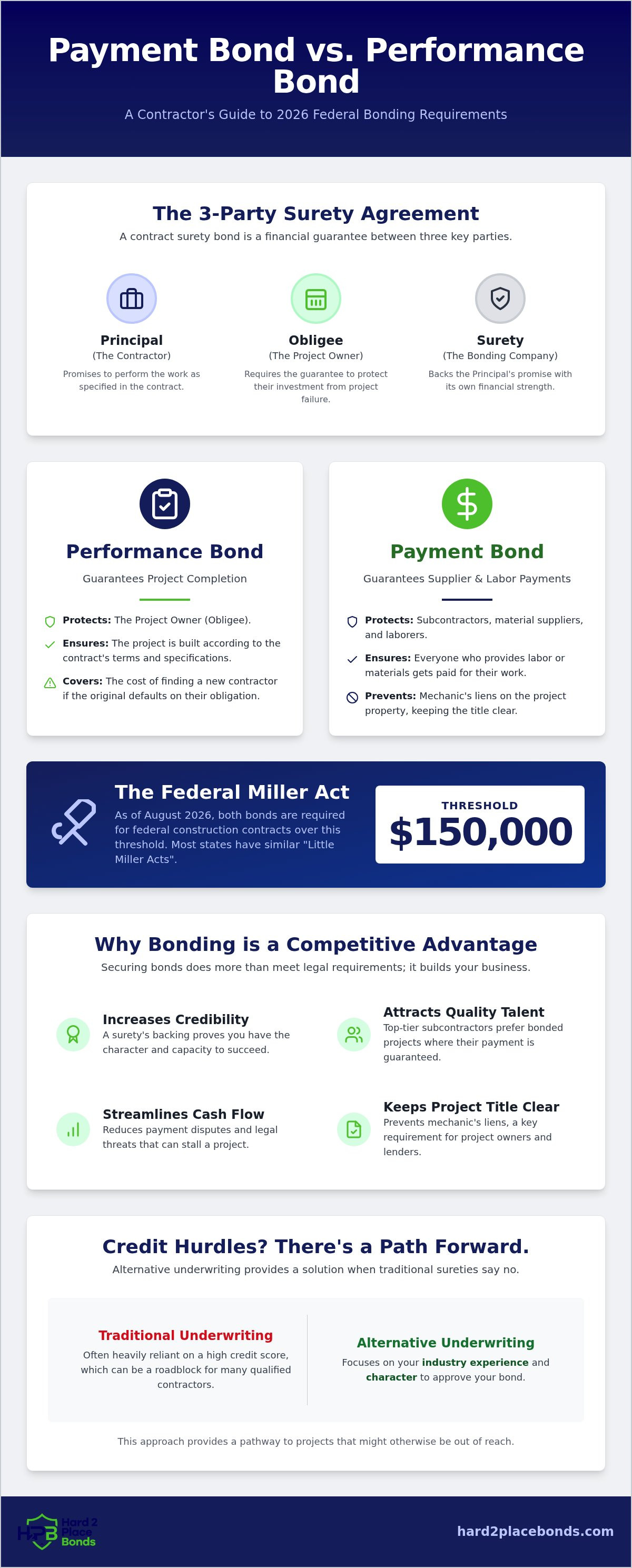
This relationship involves three distinct parties working in tandem. First, the Principal is the contractor who promises to perform the work. Second, the Obligee is the project owner who requires the guarantee to protect their investment. Finally, the Surety is the company that backs your promise with its own financial strength. Unlike insurance, which expects losses and spreads risk across a pool, surety companies operate on the assumption of zero loss. They expect you to fulfill every line of your contract. If a claim is paid out, you're legally responsible for reimbursing the surety for every dollar spent.
The Role of the Surety as a Risk Partner
A surety company doesn't just sign a piece of paper; they become your risk partner. Before issuing a bond, they perform deep pre-qualification. They look at your past performance, financial health, and equipment capacity. This rigorous vetting process is exactly why having a bond increases your professional credibility. When a surety backs you, they're telling the project owner that you have the tools and the character to succeed. They want the project to cross the finish line because their capital is at risk. For contractors with credit hurdles, this partnership is even more vital, as it provides a pathway to projects that would otherwise be out of reach.
Common Scenarios Requiring Bonding
Federal law makes bonding mandatory for a wide range of projects. Under the Federal Miller Act, any federal construction contract exceeding $150,000 requires both a payment and a Performance bond as of August 2026. This threshold ensures that taxpayer money is protected and that workers get paid. Private developers often follow these same standards, as their lenders require these guarantees to secure financing. General contractors also use bonds to manage risk when hiring subcontractors. By requiring a bond, a GC ensures that a single subcontractor's failure won't derail the entire project schedule or lead to costly delays.
What is a Payment Bond? Protecting the Supply Chain
A payment bond is a guarantee that everyone who contributes labor or materials to a project will receive their agreed-upon compensation. While the performance bond focuses on the physical completion of the work, the payment bond focuses on the financial health of the supply chain. In the ongoing debate of payment bond vs performance bond importance, the former is often what keeps your subcontractors from walking off the job site. It serves as a vital substitute for mechanics' liens. Because you can't place a lien on public property like a school or a federal building, the bond provides a specific financial fund that unpaid parties can claim against instead.
The hierarchy of protection under a standard surety bond typically covers first-tier subcontractors and material suppliers. It also extends to second-tier subcontractors who have a direct contract with a first-tier provider. If a payment dispute arises, the claimant must follow strict notice requirements to file a claim against the bond. For the contractor, a claim is a serious event that can halt future bonding capacity. The surety will investigate the claim thoroughly, and if they pay out, they'll look to the contractor for full reimbursement of all costs and legal fees.
The Miller Act and Little Miller Acts
The Federal Miller Act sets the standard for national infrastructure projects. As of August 2026, any federal construction contract exceeding $150,000 must include a payment bond. Most states have enacted their own "Little Miller Acts" to mirror these federal requirements for state-funded projects. These laws are essential for protecting lower-tier suppliers who might otherwise be left without recourse if a primary contractor experiences financial distress. Understanding these thresholds is the first step toward compliance on any public works project.
Benefits of Payment Bonds for Contractors
Bonding your projects isn't just a legal hurdle. It's a competitive advantage that helps you attract higher-quality subcontractors who feel secure in their compensation. This security streamlines project cash flow by reducing the frequency of payment disputes and legal threats. It also ensures the project title remains free of legal encumbrances, which is a key requirement for most project owners. If you're ready to secure your next big project but aren't sure where to begin, you can start your application with a team that looks beyond your credit score to find a path forward. Understanding the nuances of a payment bond vs performance bond setup will help you present a more professional and prepared face to potential project owners.
What is a Performance Bond? Guaranteeing Project Completion
A performance bond ensures that a project actually reaches the finish line. If a contractor defaults or abandons the job, the surety company steps in to make things right. It's the project owner's safety net, guaranteeing that the work will meet every specification laid out in the original contract. When you're looking at the requirements for a payment bond vs performance bond , the performance side is what secures the physical structure and the timeline. If a default occurs, the costs can skyrocket. The surety covers the "gap" between your original contract price and what it costs to hire a replacement to finish the work. Understanding these financial stakes is essential, and you can learn more about the cost of performance bonds to see how these premiums are calculated for different risk levels.
Defaulting on a contract is a nightmare scenario for any builder, but the bond provides a structured way to resolve the crisis. The surety's involvement provides a layer of protection that simple insurance cannot match. Because the surety expects the contractor to succeed, they've already vetted your company's ability to do the work. This pre-qualification process reduces the likelihood of failure before the first shovel hits the ground. It gives project owners the confidence to award large contracts to firms that might otherwise seem like a higher risk due to their size or credit history.
Surety Options in the Event of Default
If a contractor can't finish the job, the surety doesn't just write a check and walk away. They have several ways to resolve the situation. In a "Takeover" scenario, the surety assumes control of the project and manages the remaining work to completion. This often involves keeping the existing crew but providing the necessary oversight and funding. Another path is the "Tender" option, where the surety finds a qualified new contractor to take over the contract. Finally, the surety might choose a financial settlement, paying the project owner the penal sum of the bond so the owner can manage the completion themselves. Each path is designed to minimize delays and keep the project moving.
Why Owners Demand Performance Bonds
Project owners face massive risks, from contractor bankruptcy to simple abandonment. A performance bond mitigates these threats by shifting the financial burden to the surety. It's not just about the money; it's about quality. Because the surety has vetted the contractor's capacity and history, the bond acts as a seal of approval. For large-scale infrastructure and taxpayer-funded projects, these bonds are non-negotiable. They ensure that investor funds aren't lost to mismanagement or unforeseen financial collapse. Having this bond in place proves you're a reliable professional who can handle the pressures of a high-stakes job site.