
A credit score below 620 isn't a dead end for your freight brokerage dreams, even with the stricter FMCSA regulations that took effect in January 2026. You might feel like the system is rigged against you, especially when traditional carriers turn you away the moment they see a low score. It's frustrating to have the industry experience and the drive to succeed, only to be blocked by a financial hurdle from your past. You're likely anxious about the freight broker bond cost bad credit applicants are quoted, or worse, the fear of being denied your MC authority altogether.
We understand that a credit report doesn't tell your whole story. This guide shows you exactly how to secure your $75,000 BMC-84 bond and launch your brokerage, even if your financial history is less than perfect. You'll learn why the BMC-84 is your best weapon against 2026's new seven day replenishment rules and how specialized underwriting can help you minimize annual premiums. We will walk through the specific steps to move from rejection to approval so you can focus on moving freight and building your legacy.
Key Takeaways
- Understand the $75,000 FMCSA financial guarantee requirement and how the 2026 regulatory changes impact your path to approval.
- Discover strategies to manage your freight broker bond cost bad credit by using professional experience to balance out a lower personal credit score.
- Learn why a BMC-84 bond is often the smarter choice for high-risk applicants compared to a BMC-85 trust fund that requires $75,000 in liquid assets.
- Identify the specific documentation you need to prepare so a specialist underwriter can advocate for your business authority.
- Find out how to navigate the high-risk market with a partner who specializes in hard-to-place bonds and national service.
What is the BMC-84 Freight Broker Bond Requirement?
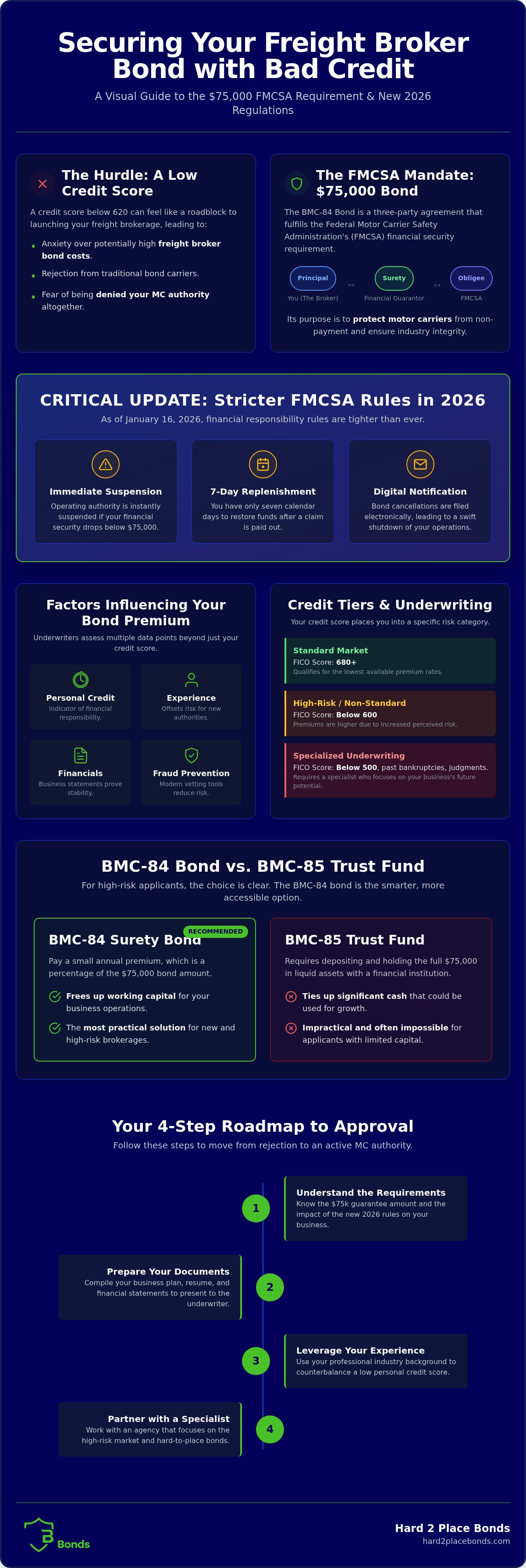
Every freight broker and forwarder operating in the United States must follow a strict financial mandate set by the Federal Motor Carrier Safety Administration (FMCSA). This regulation requires you to maintain a $75,000 financial guarantee to ensure your business operates with transparency and accountability. Most brokers choose a BMC-84 freight broker surety bonds because it allows them to meet this requirement without tying up their own cash. This bond is a three-party agreement between you (the Principal), the FMCSA (the Obligee), and the surety company that provides the financial backing.
The primary purpose of this requirement is to protect the integrity of the logistics chain. If a broker fails to pay a motor carrier for services rendered or engages in fraudulent activity, the bond provides a pool of funds that those carriers can claim against. It acts as a safety net that keeps the wheels of commerce turning. Without this guarantee, shippers and carriers would face significantly higher risks when partnering with new or smaller brokerages. Once you secure your freight broker bonds, the surety provider files the proof electronically with the FMCSA. In 2026, this digital filing is nearly instantaneous, allowing your MC authority to move from "pending" to "active" as soon as your other requirements are met.
The Role of the FMCSA in 2026
As of January 16, 2026, the FMCSA has tightened the reins on financial responsibility. The new standards require immediate suspension of operating authority if your financial security drops below the $75,000 threshold. You now have only seven calendar days to replenish funds if a claim is paid out. This makes your bond a critical "seal of approval" for your business. If your bond is cancelled for any reason, the FMCSA receives a digital notification immediately, which can lead to a swift shutdown of your operations. Staying compliant is no longer just about the initial setup; it is about maintaining a constant, valid guarantee.
Why Credit Score Affects Your Eligibility
When you apply for a bond, underwriters look at your credit score as a window into your financial character. They believe that how you manage personal debts is a strong indicator of how you will handle carrier payments and business obligations. For those worried about the freight broker bond cost bad credit often brings, it is helpful to understand that the higher premium reflects the perceived risk of a future claim. Surety companies are cautious with freight risks in 2026 because the logistics industry faces increased volatility and a higher frequency of sophisticated fraud schemes.
Factors Influencing Your Freight Broker Bond Premium
Understanding the factors that drive your freight broker bond cost bad credit doesn't have to be overwhelming. Surety companies use a risk-adjusted premium model to determine your annual rate. This means they look at the likelihood of a claim being filed against your bond and your ability to reimburse them if it happens. While credit is a major piece of the puzzle, it isn't the only thing underwriters consider when they review your application.
In 2026, the "Fraud Factor" has become a significant driver of bond pricing. With the rise of sophisticated double-brokering schemes and identity theft in the logistics sector, surety carriers have increased their scrutiny of all applicants. They look for brokers who demonstrate a commitment to fraud prevention. If you can show that you use AI-enabled vetting tools or have strict carrier compliance protocols, you present a lower risk. Additionally, providing your recent business financial statements can often help lower your rate by proving you have the liquid assets to handle temporary cash flow gaps.
Risk Tiers and Credit Score Ranges
Underwriters generally categorize applicants into standard and non-standard risk tiers. If your FICO score is above 680, you typically qualify for standard market rates. However, if your score falls below the 600 or 500 threshold, you move into high-risk underwriting. In this category, past bankruptcies or civil judgments carry more weight. These marks on your record suggest a higher level of financial instability to a carrier. We know how frustrating it is to be defined by a past mistake; that's why we focus on your business's future potential instead. You can begin your application today to see which tier your business falls into.
New Authority vs. Established Brokerage
Experience acts as a powerful offset to a low credit score. A "Day 1" broker with no track record faces the highest level of scrutiny because they haven't yet proven they can manage carrier payments effectively. Underwriters often ask for a resume or a business plan to see if your industry background compensates for financial challenges. To meet the FMCSA broker authority requirements, new brokers must demonstrate they understand the operational side of logistics. As you build a history of on-time payments and a clean claim record, you'll qualify for significantly better rates in future years. Consistency is the key to moving from a high-risk premium to a standard market rate.
BMC-84 Bond vs. BMC-85 Trust Fund: Which is Better for High-Risk?
When you're dealing with a low credit score, the choice between a BMC-84 bond and a BMC-85 trust fund feels weighted. One requires a yearly fee, while the other demands a massive cash deposit. For most brokers, especially those rebuilding their financial standing, the BMC-84 bond is the superior strategic move. It allows you to keep your working capital accessible so you can actually run your business without the burden of a $75,000 upfront cost.
Liquidity and Cash Flow Considerations
A BMC-85 trust fund requires you to place the full $75,000 into a trust account where it sits untouched. For a startup, tying up that much cash can be devastating. You need those funds for carrier payments, AI tools, and office overhead. Beyond the $75k, trust funds often come with annual administration fees that add to your expenses. Perhaps the biggest drawback is the claims process. A trust provider usually pays out claims quickly to protect the fund; whereas a surety company investigates the validity of a claim. This professional defense protects you against baseless or fraudulent demands from carriers.
The Verdict for Bad Credit Applicants
Many high-risk applicants believe a trust fund is their only option because they've been rejected by standard bond carriers. This is a common misconception. While the freight broker bond cost bad credit applicants face is higher than average, it is often still more affordable than losing $75,000 in liquidity. Programs like the SBA Surety Bond Guarantee Program help bridge the gap for small businesses by reducing the risk for the surety. Specialized brokers know how to present your case to underwriters who look beyond just the credit score. You can learn more about obtaining a surety bond through these alternative paths.
Under the new January 2026 FMCSA rules, the BMC-85 trust is even riskier. If a claim is paid out, you have exactly seven calendar days to replenish that trust back to $75,000. If you don't have the cash on hand, your operating authority is suspended immediately. Additionally, loan and finance companies are no longer eligible providers for these trusts, further narrowing your options. A BMC-84 bond provides a buffer that a trust fund simply cannot match. It ensures your authority remains active while the surety handles the investigation and settlement process.