

August 15, 2026

Payment and Performance Bonds: A 2026 Guide to Contract Surety

You've spent weeks perfecting a bid for a federal contract, only to realize your personal credit score might keep you from getting the required payment and performance bonds. It's a frustrating wall to hit when you know your team can handle the job, but the standard surety market says no. We understand that a credit number doesn't tell your whole story, and the anxiety of potentially losing a project over a bond application is real.

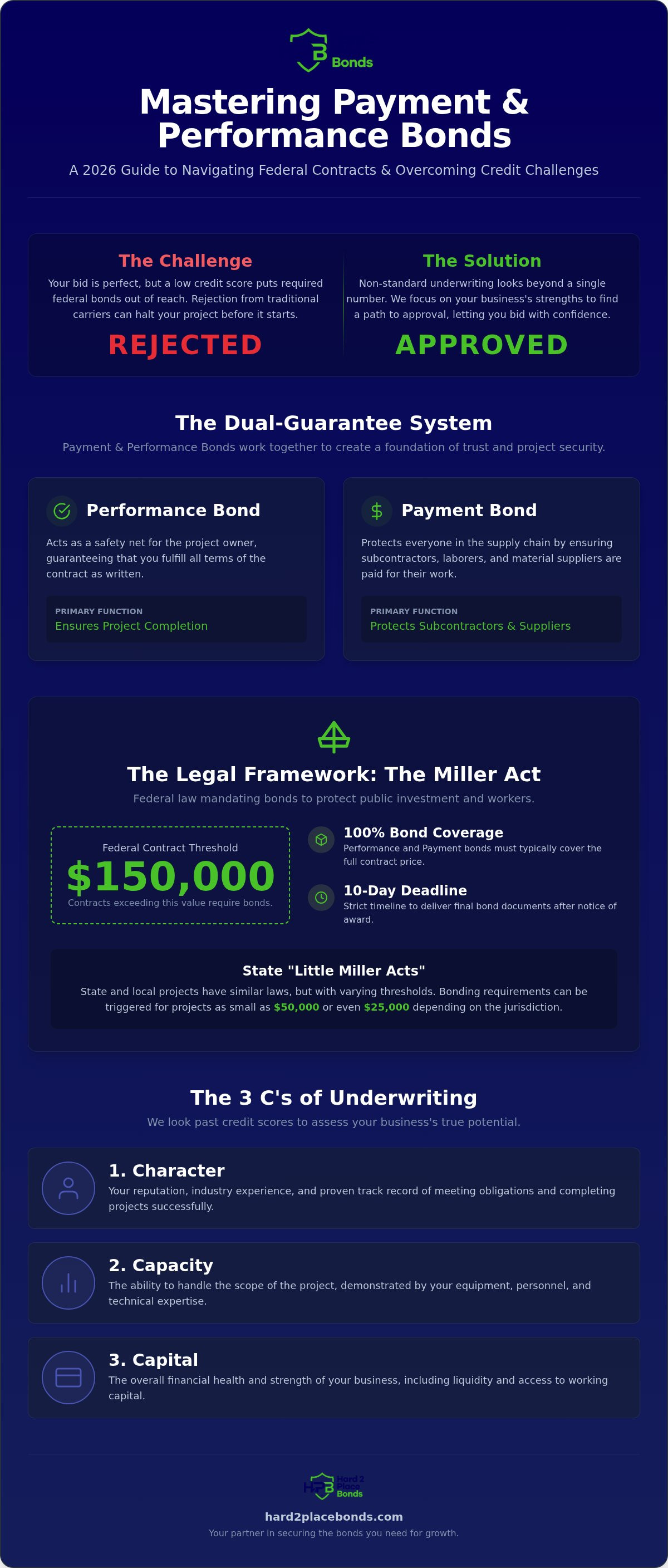
The good news is that rejection from a traditional carrier isn't the end of the road. This 2026 guide is designed to help you master the essentials of payment and performance bonds, from understanding the $150,000 Miller Act threshold to securing approval through non-standard underwriting. You'll learn how to leverage your business's strengths to overcome personal credit challenges and submit your bids with confidence. We'll show you that there's always a path forward when you have the right partner in your corner.

We will walk you through the current premium landscapes, explain why 2026 underwriters are focusing on the Three Cs of Character, Capacity, and Capital, and show you exactly how to access the specialized markets that look past a standard refusal to see your actual potential.

Key Takeaways

  • Understand the dual-guarantee system of payment and performance bonds to ensure you meet contract obligations while protecting your subcontractors and suppliers.
  • Navigate the federal Miller Act requirements with clarity, including the mandatory $150,000 bonding threshold for public works projects.
  • Discover how non-standard underwriting provides a viable path to approval for contractors who have faced rejection from traditional surety carriers due to credit challenges.
  • Identify the "Three Cs" of underwriting-Character, Capacity, and Capital-to strengthen your application and demonstrate your business's true potential.
  • Prepare your financial documentation with confidence using our 2026 roadmap designed to streamline the bond application process for high-risk profiles.

What are Payment and Performance Bonds? Definitions and Core Functions

In the construction industry, your reputation is everything, but a contract often requires a financial guarantee to back it up. Payment and performance bonds form a dual-guarantee system that serves as the bedrock of project security. They aren't just bureaucratic hurdles; they're tools that build trust between you and the project owner. By securing these bonds, you demonstrate that your business is capable, reliable, and financially sound enough to handle the scope of the work.

This system functions through a three-party relationship. You are the Principal , the contractor responsible for performing the work. The project owner is the Obligee , the party who receives the bond's protection. Finally, the Surety is the partner providing the financial backing. While standard insurance protects you from loss, a surety bond protects the Obligee from your potential failure to perform. It's a credit-based commitment that proves you have the capacity to see a job through to the end.

The Performance Bond: Ensuring Project Completion

A performance bond acts as the owner's safety net for project delivery. It guarantees that you'll fulfill every term of the contract as written. If a default occurs, the surety doesn't just walk away. They step in to find a solution. This might involve providing the capital needed to finish the work, hiring a replacement contractor, or paying the owner for the cost of completion. This layer of protection is why most public and large-scale private owners won't break ground without one.

The Payment Bond: Protecting Subcontractors and Suppliers

While the performance side focuses on the structure, the payment bond focuses on the people. It ensures that every subcontractor, laborer, and material supplier gets paid for their contributions. This is vital because you can't place a mechanic's lien on public property. The payment bond serves as the alternative remedy, giving lower-tier participants a clear path to recover funds if the prime contractor faces a financial crisis. It keeps the project's supply chain healthy and protects you from the legal fallout of unpaid bills.

Securing these bonds can feel daunting if your credit history isn't perfect. Traditional carriers often look at a low score and see a risk they aren't willing to take. We take a different approach, looking at your business's overall capacity rather than just a single number. Understanding these core functions is the first step toward showing an underwriter that you're a professional partner ready for growth.

Federal construction projects operate under a unique set of rules because you can't place a lien on government-owned property. This is why the Federal Miller Act exists. It requires prime contractors to provide payment and performance bonds for any federal construction contract exceeding $150,000. This threshold, verified for 2026, ensures that both the government's investment and the subcontractors' livelihoods are protected. Without these bonds, the project simply cannot proceed, and the contract cannot be signed.

Compliance with Federal Acquisition Regulations (FAR)

Specific clauses like FAR 52.228-15 provide the operational teeth for these laws. This regulation generally mandates that performance bonds cover 100% of the original contract price, with payment bonds matching that same 100% mark. Timelines are strict. You'll usually have 10 days from the notice of award to deliver the final bond documents. If you fail to meet this deadline, the government can terminate the contract for default before you ever break ground. You can find the full text of these requirements in the Federal Acquisition Regulation on bonds.

State-Level Protections and Little Miller Acts

State-level projects follow a similar logic through "Little Miller Acts." These statutes ensure that local schools, roads, and municipal buildings have the same protections as federal sites. However, dollar thresholds vary significantly across the country. While the federal limit is $150,000, some states trigger bond requirements for projects as small as $50,000 or even $25,000. Understanding these local nuances is critical for your bidding strategy. It's your responsibility to know the specific bond mandates for the jurisdiction where you're working.

The legal landscape is complex, but it shouldn't be a barrier to your business growth. Even if a standard carrier has turned you down because of your financial profile, options exist. We specialize in helping contractors meet these exact legal requirements for payment and performance bonds through non-standard underwriting. If you need to secure your spot on a public project, you can start your application today and let us help you navigate the compliance hurdles with confidence.

Payment vs. Performance Bonds: Key Differences and Synergy

While they serve different purposes, payment and performance bonds are almost always issued as a single package. Owners view them as two sides of the same coin. One ensures the building gets finished, while the other ensures the bills get paid. This combined approach protects the project's financial liquidity and its physical completion. Without both, a project faces significant risks of work stoppage or legal entanglements that could derail the entire timeline.

Comparing Obligations and Beneficiaries

Each bond targets a specific group of stakeholders. The performance bond is the owner's primary protection, featuring a "satisfaction" clause that requires the work to meet the exact quality and timeline standards specified in the contract. If you don't meet those standards, the owner has a direct path to a remedy. Conversely, the payment bond shields you from the legal fallout of unpaid bills by providing a mechanism for lower-tier participants to seek compensation without disrupting the job site.

Bond Type Primary Beneficiary Core Function
Performance Bond Project Owner (Obligee) Guarantees completion of contract terms.
Payment Bond Subcontractors and Suppliers Guarantees payment for labor and materials.

The Synergy of the Bond Package

Underwriters prefer to review both bonds simultaneously because the risks are intertwined. If a contractor can't pay their suppliers, they likely won't finish the project. By bundling them, the surety gets a holistic view of the project's health. For contractors with credit challenges, the SBA Surety Bond Guarantee Program can be a vital resource. This program offers a 0.6% fee on top of the regular premium to help secure these essential guarantees when standard markets are hesitant.

The cost of the bond set is typically calculated as a single premium based on the contract total. While well-qualified contractors might see rates between 1% and 3%, those with credit scores below 650 may face rates closer to 3.6%. This investment secures your ability to bid on larger projects and provides a professional edge that unbonded competitors lack. Learn more about the various types of contract surety bonds to see which options fit your specific project needs and how they can support your business's growth.
Navigating High-Risk Underwriting for Contract Surety Bonds

"Can I get a bond with bad credit?" It's the question we hear most often from contractors who feel sidelined by traditional markets. Standard surety carriers often rely on rigid, automated credit scoring models that don't account for the complexities of running a construction business. If you've faced rejection because of a low score, it's easy to feel like your growth has hit a dead end. However, high-risk underwriting operates on a different logic. It's designed to find a path to approval for payment and performance bonds when traditional markets only see a risk.

Specialized brokers understand that financial setbacks like past bankruptcies or tax liens don't define your future performance. While a standard underwriter might issue an automatic denial, a high-risk partner looks for context. They want to see how you've managed those challenges and what steps you've taken to stabilize your operations. This human-centered approach is what makes hard-to-place bonds possible for contractors who are otherwise fully capable of completing the work.

Underwriting Criteria for Challenged Credit

When your credit score is a hurdle, your experience becomes your greatest asset. Underwriters in this space prioritize your project capacity and historical performance over pure financial metrics. They need to see that you have the equipment, the crew, and the technical expertise to handle the contract. Financial transparency is vital here. Providing clear, honest documentation helps build the trust necessary for a positive decision. See our guide on securing performance bonds with bad credit for a deeper look at this process.

Mitigating Risk for the Surety

To bridge the gap between a high-risk profile and a bond approval, sureties often use specific risk-management tools. These might include:

  • Funds Control: A third-party manages project disbursements to ensure suppliers and subcontractors are paid first.
  • Collateral: Using cash or assets to back the bond, which can often be released as the project progresses.
  • Strong Project Resumes: A documented history of finishing similar jobs on time and under budget.

Specialized underwriting looks at the whole business, not just a credit number. By focusing on your track record, we can often offset financial weaknesses that would stop a standard application in its tracks. Don't let a past mistake keep you from future opportunities. If you're ready to secure your next project, start your application and let our team advocate for your business.

How to Secure Your Bonds in 2026: The Path to Approval

Securing approval for payment and performance bonds in 2026 requires more than just a decent credit score. It's about presenting a complete picture of your business's health and operational readiness. When you're dealing with non-standard underwriting, your application package is your most powerful tool to prove that you can handle the work, regardless of past financial hiccups. This final step in the process turns your potential into a bonded reality.

Preparing Your Application Package

Underwriters look for specific documents that demonstrate your capacity. Your work-in-progress (WIP) report is the most critical piece of the puzzle. It shows how you manage current projects and your ability to take on new ones. You'll also need personal financial statements to provide a full view of your financial standing. For contractors who are just starting or looking to scale rapidly, a professional business plan can make a world of difference. It shows the surety that you have a clear strategy for growth and risk management. Start your bond application today by gathering these records early to avoid delays.

Partnering with Hard 2 Place Bonds

Choosing the right partner is just as important as the paperwork. Many traditional agencies will simply tell you "no" if your credit doesn't meet their baseline. We take a different approach. As a division of Hako Risk & Insurance, we specialize in non-standard surety underwriting across all US states. We understand the frustration of being marginalized by traditional systems, and we're here to act as your advocate. Our team focuses on finding alternative paths to approval, ensuring that you can meet Miller Act requirements and compete for high-value federal and state contracts.

The timeline from your initial inquiry to bond issuance depends on the complexity of your profile, but having a complete package speeds up the process significantly. Once you have your bonds in hand, you're no longer limited to small, private jobs. You can confidently bid on lucrative public works projects, knowing that your bonding capacity is a tool for growth, not a barrier. Get your payment and performance bonds through our specialized portal and take the next step toward scaling your construction business.

Secure Your Competitive Edge in 2026

Your next big project is within reach, and a credit score shouldn't be the thing that holds you back. We've explored how payment and performance bonds protect both the project owner and your subcontractors, ensuring the financial and physical integrity of every job site. Whether you're navigating the $150,000 federal Miller Act threshold or local state requirements, the right bond package is your ticket to more lucrative contracts and business growth.

Standard market rejection is a setback, not a final answer. By focusing on your project capacity and historical performance, our non-standard underwriting provides a clear path forward for contractors with challenged credit. We specialize in these hard-to-place situations, offering solution-oriented underwriting and national expertise to help you stay competitive throughout 2026. Trust a partner who sees your business's true potential and advocates for your success.

Secure Your Performance and Payment Bonds Today and take the first step toward winning your next major bid. You have the skills to do the work; let us provide the financial backing to prove it.

Frequently Asked Questions

What happens if a contractor defaults on a performance bond?

If a contractor defaults, the surety company steps in to fulfill the contract's obligations. This process starts with a thorough investigation to confirm the default. Once verified, the surety might provide the current contractor with funds to finish, hire a new firm to take over, or pay the owner the cost of completion. It's a structured process designed to keep the project moving forward while protecting the owner's financial interests.

Can I get a payment and performance bond with a 500 credit score?

You can secure payment and performance bonds with a 500 credit score by working with a specialized surety partner. While traditional carriers often have a 650 cutoff, non-standard underwriters look at your entire business profile. They focus on your project experience and technical capacity rather than just a number. This approach allows capable contractors to get the bonding they need even if their personal credit isn't perfect.

How much do payment and performance bonds cost in 2026?

The cost of these bonds in 2026 depends on the contract size and the contractor's specific risk profile. Underwriters use the Three Cs, Character, Capacity, and Capital, to determine the premium. Your financial transparency and project history play a major role in this calculation. Contractors with lower credit scores or higher risk profiles will typically see rates that reflect the additional oversight and risk management the surety must provide.

Is a payment bond the same as a labor and material bond?

A payment bond is the same as a labor and material bond. These terms are used interchangeably to describe the guarantee that subcontractors and suppliers will receive payment for their work. This is a vital protection on public projects where mechanic's liens aren't allowed. It ensures the project's supply chain remains stable and protects the general contractor from legal disputes related to unpaid lower-tier participants.

How long does it take to get a performance bond approved?

Approval for a performance bond typically takes between 24 hours and one week. The speed of the process depends on how quickly you can provide a complete application package, including work-in-progress reports and financial statements. For high-risk bonds or larger contracts, the underwriting review may take a few extra days. Having your documentation ready before you bid can significantly reduce the time it takes to get final issuance.

Do I need a performance bond for private construction projects?

You may need a performance bond for private projects if the owner or their lender requires it as a condition of the contract. While not mandated by federal law like public works, many private developers use these bonds to manage risk on large commercial developments. It provides the owner with a guarantee that the project will be completed according to the agreed terms even if the contractor faces financial difficulty.

Can a project owner waive the requirement for payment bonds?

A project owner cannot waive payment bond requirements on federal projects over $150,000 due to the Miller Act. State-level projects also have mandatory thresholds defined by Little Miller Acts that must be respected. On private projects, the owner can choose to waive bonding, but they do so at their own risk. This leaves them vulnerable to liens and financial loss if the contractor fails to pay their suppliers.

What is the difference between a bid bond and a performance bond?

A bid bond guarantees you'll sign the contract if you win, while payment and performance bonds guarantee you'll finish the work and pay your bills. The bid bond is a pre-qualification tool used during the proposal phase. Once you are awarded the contract, the owner will require the final bond set to provide long-term protection throughout the construction and payment phases of the project.

Share:

Recent Posts

By cinchweb August 14, 2026
Secure a solar PPA security bond without cash collateral. Our 2026 guide helps developers & investors navigate underwriting to protect capital & launch proje...
By cinchweb August 14, 2026
Learn the 2026 performance bond cost for high risk contractors. This guide breaks down premiums, SBA programs, and actionable steps to get approved and lower...
By cinchweb August 13, 2026
Wondering can you get a bid bond with bad credit? Yes! Our 2026 guide shows how specialty programs help contractors with low scores win lucrative contracts.
By cinchweb August 11, 2026
Struggling to get a contract surety bond with bad credit? Our 2026 guide reveals how to leverage your project history and SBA programs to get approved.
By cinchweb August 11, 2026
Don't let bad credit stop you. Our 2026 guide shows how to get a bid surety bond for high-stakes contracts, even with underwriting hurdles. Win more jobs.
By cinchweb August 9, 2026
Struggling to get a surety bond for bankruptcy history? Our 2026 guide shows how to get approved, navigate high-risk rates, and secure your business license.
By cinchweb August 8, 2026
What's the surety bond cost with bad credit? Our 2026 guide reveals rates (5-15%) and shows how to lower your premium to get bonded and back to work.
By cinchweb August 7, 2026
Learn how do I get a bad credit surety bond with our 2026 guide. We offer a step-by-step path to approval, focusing on your business, not just your score.
By cinchweb August 6, 2026
Wondering, can I get a sales tax bond with bad credit? Yes! Our 2026 guide shows you how to get approved and find affordable premiums. Learn the steps now.