

August 14, 2026

Solar PPA Security Bonds: A 2026 Guide for Developers and Investors

What if you could satisfy your off-taker's security requirements without locking up millions in cash or waiting months for a bank's Letter of Credit? Securing a solar PPA security bond is often the final, most stressful hurdle for developers who want to keep their capital working for them. It's frustrating to have a viable site and a solid contract ready, only to be sidelined because a traditional lender doesn't understand the nuances of renewable energy risk. You've likely felt the pressure of trying to bond a newly formed SPE with no financial history while the clock ticks on your interconnection agreement.

We believe that financial guarantees should be a tool for progress, not a barrier to entry. This 2026 guide shows you how to navigate complex underwriting requirements and secure the necessary bonds even for high-risk projects. You'll discover how to protect your investments, minimize the impact on your cash flow, and find a partner who fights for your approval when others say no. We'll walk through the current regulatory landscape and the specific steps to satisfy off-takers without draining your project's capital reserves.

Key Takeaways

  • Understand how the three-party relationship between the developer, off-taker, and surety protects your contract without requiring massive cash collateral.
  • Compare the liquidity benefits of a solar PPA security bond against traditional Letters of Credit to keep your bank lines open for future project expansion.
  • Learn the specific underwriting requirements for newly formed SPEs and high-risk projects to navigate the path from application to approval.
  • Discover how specialized bonds cover critical phases including construction milestones, interconnection deadlines, and long-term energy delivery shortfalls.
  • Identify the documentation needed to satisfy 2026 industry standards and secure your PPA contract even if you've been turned down elsewhere.

What is a Solar PPA Security Bond and Why Is It Required?

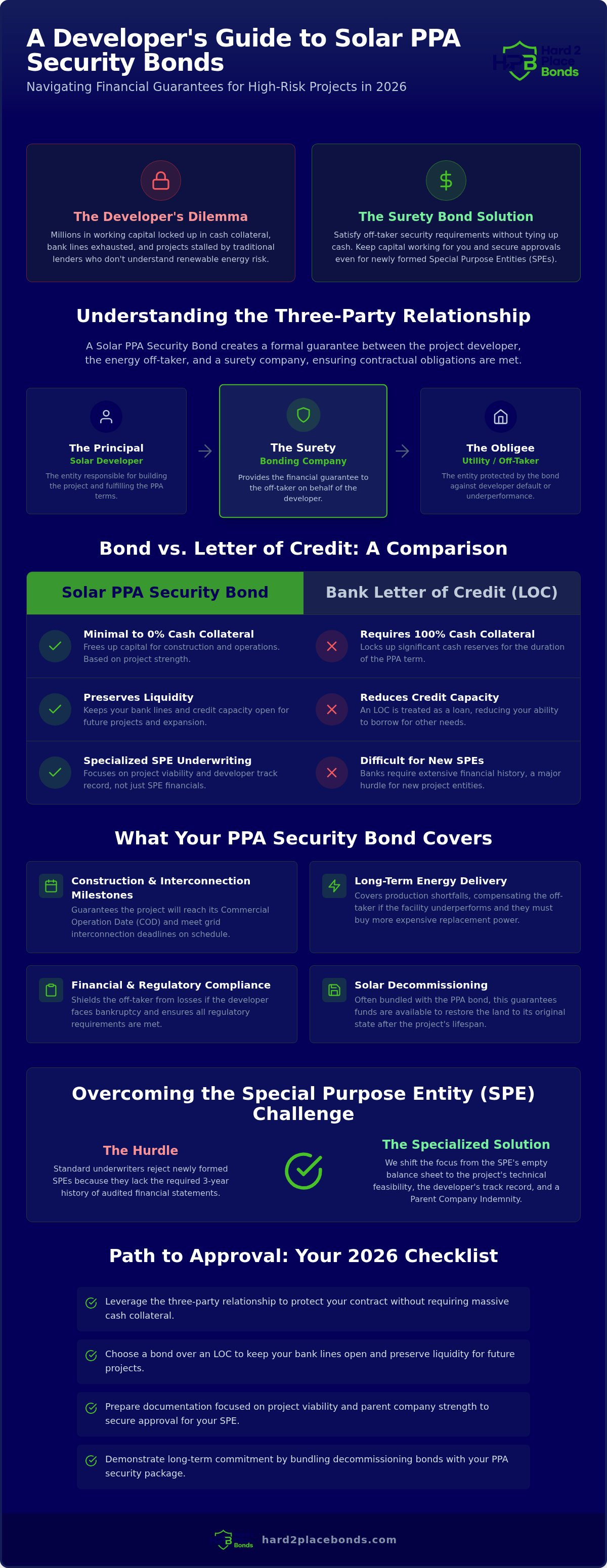
A solar PPA security bond is a specialized financial instrument that guarantees a developer will fulfill the terms of their Power Purchase Agreement (PPA). It creates a formal three-party relationship where the developer, known as the principal, and the surety company provide a financial guarantee to the utility or off-taker, known as the obligee. If the developer fails to meet specific milestones or energy delivery targets, the bond provides the financial recourse the off-taker needs to cover their losses without the delay of a standard legal battle.

Off-takers demand this security because they're making long-term commitments to integrate your power into the grid. They face significant risks if a project stalls during construction or fails to produce the promised kilowatt-hours. By 2026, regulatory pressure on grid stability has intensified, making these bonds a non-negotiable requirement for almost every utility-scale project. Utilities need to know that if you can't deliver the energy as promised, they'll have the immediate funds to procure replacement power from more expensive sources.

The Role of PPA Bonds in Project Finance

Bonds act as a vital credit enhancement, especially for Special Purpose Entities (SPEs) that may not have a decades-long balance sheet to show. Investors and lenders often prefer a contract surety bond over a corporate guarantee because it shifts the risk to a third-party insurer with a high credit rating. A solar PPA security bond preserves your liquidity by allowing you to satisfy security requirements without tying up the massive cash reserves you need for construction or equipment procurement.

Production Guarantees vs. Performance Obligations

It's helpful to distinguish between the different layers of protection these bonds provide. Performance obligations usually relate to the "how" and "when" of the project, such as hitting commercial operation dates (COD) and meeting interconnection deadlines. Production guarantees focus on the "how much" over the life of the contract. If the facility fails to meet specific capacity thresholds, the bond can reimburse the off-taker for the cost of purchasing replacement power.

This distinction is critical during the underwriting process. A technical failure, like a major equipment breakdown, is handled differently than a financial default where the developer lacks the funds to maintain operations. The bond ensures that regardless of the cause, the off-taker isn't left vulnerable when the sun is shining but the project isn't delivering. It provides a layer of certainty that allows complex energy deals to move forward with confidence.

Key Components of Solar Energy Security Bonds

A solar PPA security bond isn't a static document. It's a dynamic guarantee that evolves through the project's lifecycle. While the previous section defined the bond's purpose, understanding its moving parts is essential for developers who need to satisfy rigorous utility requirements. These bonds typically cover four critical areas: construction milestones, energy delivery shortfalls, financial indemnity, and regulatory compliance. If a developer fails to hit the Commercial Operation Date (COD) or misses interconnectivity deadlines, the bond provides the liquid capital the off-taker needs to manage the resulting grid instability.

Protection extends far beyond the initial build. Most PPA contracts span 15 to 25 years. Throughout this term, the utility relies on a consistent flow of renewable energy to meet its own green energy mandates. If the facility underperforms, the bond compensates the off-taker for the price difference when they're forced to buy power from the spot market. This financial safety net also shields the utility if the developer faces bankruptcy, ensuring the project remains viable or can be transitioned to a new operator without leaving the off-taker with a massive financial hole.

The Special Purpose Entity (SPE) Challenge

Most solar projects are structured as Special Purpose Entities (SPEs) to isolate financial risk. This presents a major hurdle for standard bond brokers. Because an SPE is a newly formed "shell" company, it lacks the three-year history of audited financial statements that traditional underwriters demand. We solve this by shifting the focus from the SPE's balance sheet to the project's technical feasibility and the developer's track record. Specialized underwriters often require a Parent Company indemnity to bridge the gap, allowing a solar PPA security bond to be issued based on the strength of the larger organization rather than the empty history of the SPE.

Linking PPA Security to Solar Decommissioning Bonds

Off-takers are increasingly looking at the end of a project's life before it even begins. Many utilities now require developers to bundle land restoration guarantees into their initial security package. This ensures that once the PPA term expires, the site is returned to its original state. By integrating solar decommissioning bonds into your overall strategy, you demonstrate a commitment to long-term site viability. This proactive approach often makes the underwriting process smoother for the primary PPA bond. If you're struggling to meet these combined requirements, you can submit your project details for review to see how we can structure a solution that satisfies your off-taker's specific demands.

Solar PPA Security Bonds vs. Letters of Credit (LC)

Choosing between a solar PPA security bond and a bank Letter of Credit (LC) is often a choice between project growth and financial stagnation. While both satisfy the off-taker's need for security, they impact your balance sheet and liquidity in vastly different ways. A bank LC typically reduces your borrowing capacity dollar-for-dollar, effectively freezing the capital you need for equipment and labor during the most critical phases of development.

Surety bonds are off-balance-sheet obligations. They don't tie up your bank lines, which allows you to scale your portfolio without hitting a credit ceiling. Cost analysis also favors the surety route for most renewable projects. Banks often charge high annual fees and might demand 100% cash collateral from a new SPE. Bond premiums represent a fraction of the total bond amount, and because they don't require the same level of liquidity lock-up, the opportunity cost is much lower.

Bonds offer more stability regarding renewal risks. LCs come with expiration hurdles; if your bank's appetite for energy risk changes in 2026, you could find yourself without the required security mid-contract. Many surety bonds can be structured as "evergreen" or with easier renewal processes that match the 15 to 25-year life of your Power Purchase Agreement.

Why Developers are Moving Away from Bank Collateral

Preserving working capital is the lifeblood of solar development. Traditional banks are often bogged down by bureaucracy and may require exhaustive financial history that a newly formed solar farm simply hasn't established yet. The surety market moves faster, focusing on the project's technical viability and your technical expertise rather than just your liquid assets. This speed allows you to move from a signed PPA to a secured bond in a timeframe that keeps your construction schedule on track.

Surety-Backed Letters of Credit: A Hybrid Solution

Sometimes an off-taker is rigid and insists on the specific format of a Letter of Credit. In these cases, we can facilitate a hybrid arrangement where a surety company fronts the LC through a bank partner. This gives the utility the exact document they want while giving you the flexible terms and lower collateral requirements of a bond. If you're stuck in a bank's waiting room, learning about obtaining a surety bond could be the key to unlocking your next site and keeping your momentum going.

Underwriting Requirements for Hard-to-Place Solar Projects

Many developers hit a wall when they realize traditional underwriters treat a solar SPE like a standard small business. It's not. Getting a solar PPA security bond approved for a high-risk project requires a broker who understands that the value lies in the contract and the infrastructure, not just a balance sheet. We focus on the essential documentation first: your signed PPA, firm interconnection agreements, and fully executed site leases. These documents prove the project's viability and provide the foundation for the risk assessment.

Underwriters also look closely at your track record in the renewable sector. If you've successfully brought projects to Commercial Operation Date (COD) before, that experience carries significant weight in the approval process. For hard-to-place risks, a Technical Assessment is often the deciding factor. This deep dive into the engineering and procurement plan helps the surety company understand the actual likelihood of energy delivery shortfalls, which is far more relevant than a thin credit file or a lack of corporate history.

Overcoming Credit Challenges in Solar Development

Don't let a credit score below 600 stop your project's progress. We act as a tenacious advocate for developers who have faced prior business setbacks or simply haven't built a massive personal credit profile yet. By highlighting project feasibility and the financial strength of your utility off-taker, we can often secure the necessary guarantees. If you're concerned about your financial history, read our guide on how to secure a contract surety bond with bad credit to see how we pivot the conversation toward project-based solutions.

Preparing Your Solar Bond Application for 2026

Success in 2026 depends on preparation and a clear narrative. Your application package should include detailed project pro-formas and current financial statements for any indemnitors. However, the numbers only tell half the story. You need to explain the specific project risks and your mitigation strategies directly to the underwriter. Navigating the rigid requirements of renewable energy bonding requires a specialized broker who speaks the language of both high-stakes engineering and niche risk management. When you're ready to move past the rejections and get your project bonded, you can apply for a solar PPA security bond online to begin our specialized review process.

Securing Your Solar Future with Hard 2 Place Bonds

Why settle for a standard refusal when your project's viability is on the line? At Hard 2 Place Bonds, we act as a tenacious advocate for developers who find themselves sidelined by traditional banking and insurance systems. We specialize in commercial surety bonds for complex infrastructure and energy projects across the nation. Our team understands that a solar PPA security bond requires more than just a cursory glance at a credit score; it requires a deep dive into the technical and contractual merits of your solar investment.

We know the specific hurdles that newly formed SPEs and high-risk applicants face. Most brokers see a lack of financial history or a prior business setback and immediately close the file. We do the opposite. We look for the path forward by leveraging our relationships with niche underwriters who specialize in renewable energy risk. Our goal is to move you from application to approval with the speed and professional competence your project demands, ensuring you meet your utility's requirements without sacrificing your liquidity.

Why Specialized Underwriting Makes the Difference

Generic insurance agents often lack the specialized knowledge to present a complex solar project to a surety company effectively. This lack of expertise usually leads to a "standard refusal" that can stall your project for months. By partnering with us, you gain access to markets that actually understand solar energy production risks and the long-term nature of PPA contracts. We translate your project's technical strengths into a language that underwriters trust. When you are ready to stop fighting the system and start building your site, you can start your application through our secure portal.

Ready to Bond Your Next Solar Project?

Time is the one resource a solar developer can't afford to waste. If you are facing tight interconnection deadlines or struggling with off-taker collateral demands, you need a partner who moves with urgency. Rejection from a traditional bank or a standard broker doesn't mean your project is unbondable; it just means you haven't found the right advocate yet. We believe in the future of renewable energy and are committed to helping you secure the guarantees you need to succeed. Take the final step toward project completion and secure your solar PPA bond today with a team that doesn't give up on hard-to-place risks.

Power Your Project with Confidence

Securing your energy future shouldn't mean draining your bank accounts today. We've explored how a solar PPA security bond offers a superior alternative to restrictive bank collateral, especially for SPEs that lack traditional financial history. By focusing on project feasibility and technical track records, you can keep your capital working on the site while satisfying even the most demanding utility off-takers. You've worked too hard on your site plans to let a rigid banking requirement slow you down.

Our team at Hard 2 Place Bonds acts as a tenacious advocate for developers who've been turned away by standard insurers. We provide national coverage for renewable energy projects and specialize in finding solutions for hard-to-place risks. Whether you're navigating 2026 regulatory changes or overcoming credit hurdles, there's a path to approval that doesn't involve locking up your liquidity. You have the contract; now get the financial guarantee that matches your ambition. Start your solar PPA bond application now to partner with specialists who understand the nuances of renewable risk. We're ready to help you break ground.

Frequently Asked Questions

What is the difference between a solar PPA bond and a performance bond?

A solar PPA security bond specifically guarantees the financial and energy delivery obligations outlined in a Power Purchase Agreement, whereas a standard performance bond ensures the physical completion of a construction contract. While they overlap, the PPA bond focuses on the long-term relationship with the utility off-taker. It covers specific risks like commercial operation deadlines and production thresholds that a general performance bond might miss.

Can a newly formed SPE get a solar PPA security bond without three years of financials?

You can absolutely secure a bond for a newly formed SPE without three years of financial history. We focus on the project's technical feasibility, the strength of the off-taker, and your professional experience in the renewable sector. Traditional underwriters might walk away, but we look at the contract's value and the project's projected cash flow to build a case for approval.

How much does a solar PPA security bond typically cost in 2026?

Bond costs vary based on the total bond amount, the project's risk profile, and the financial strength of the indemnitors. Generally, you'll pay an annual premium that is a small percentage of the total bond value. Unlike a bank Letter of Credit, which often requires 100% cash collateral, the bond premium represents your total out-of-pocket expense for the security, preserving your capital for project expenses.

Will a low personal credit score prevent me from getting a solar decommissioning bond?

A low personal credit score won't automatically disqualify you from obtaining a solar decommissioning bond. We specialize in hard-to-place risks and bad credit solutions that prioritize project viability over a simple credit number. By demonstrating a solid decommissioning plan and leveraging the project's assets, we can often find a path to approval for developers who have been rejected elsewhere.

What happens if my solar project under-delivers on the energy promised in the PPA?

If your project under-delivers, the bond provides financial indemnity to the off-taker to cover the price difference of purchasing replacement power from the grid. This ensures the utility meets its energy mandates without financial loss. The surety company pays the claim up to the bond's limit, and the developer is then responsible for reimbursing the surety based on the indemnity agreement.

Is a surety bond better than a Letter of Credit for a solar farm developer?

A surety bond is generally superior for developers because it's an off-balance-sheet obligation that doesn't tie up your bank lines of credit. Banks usually require significant collateral for LCs, which can stall your ability to fund future projects. Using a bond keeps your borrowing capacity intact and offers more flexible terms tailored to the 20-year lifecycle of a typical solar farm.

How long does the approval process take for high-risk solar bonds?

The approval process for high-risk solar bonds typically takes a few weeks, depending on the complexity of the project and the quality of your documentation. While standard insurance agents might take months or fail entirely, our specialized approach streamlines the underwriting. Having your PPA, site leases, and interconnection agreements ready will significantly accelerate the timeline and help us secure your approval faster.

Share:

Recent Posts

By cinchweb August 14, 2026
Learn the 2026 performance bond cost for high risk contractors. This guide breaks down premiums, SBA programs, and actionable steps to get approved and lower...
By cinchweb August 13, 2026
Wondering can you get a bid bond with bad credit? Yes! Our 2026 guide shows how specialty programs help contractors with low scores win lucrative contracts.
By cinchweb August 11, 2026
Struggling to get a contract surety bond with bad credit? Our 2026 guide reveals how to leverage your project history and SBA programs to get approved.
By cinchweb August 11, 2026
Don't let bad credit stop you. Our 2026 guide shows how to get a bid surety bond for high-stakes contracts, even with underwriting hurdles. Win more jobs.
By cinchweb August 9, 2026
Struggling to get a surety bond for bankruptcy history? Our 2026 guide shows how to get approved, navigate high-risk rates, and secure your business license.
By cinchweb August 8, 2026
What's the surety bond cost with bad credit? Our 2026 guide reveals rates (5-15%) and shows how to lower your premium to get bonded and back to work.
By cinchweb August 7, 2026
Learn how do I get a bad credit surety bond with our 2026 guide. We offer a step-by-step path to approval, focusing on your business, not just your score.
By cinchweb August 6, 2026
Wondering, can I get a sales tax bond with bad credit? Yes! Our 2026 guide shows you how to get approved and find affordable premiums. Learn the steps now.
By cinchweb August 5, 2026
Learn how to get a surety bond for 500 credit score applicants. Our 2026 guide shows you how to bypass automated denials and secure the bond you need.