
A "high-risk" label from a surety company isn't a final rejection; it's simply a different starting point for a professional conversation. It's incredibly frustrating to watch your project profits shrink because of high premium quotes or to feel sidelined from lucrative public contracts due to past credit challenges. You shouldn't have to choose between growing your business and maintaining your margins just because of a credit score or a lean financial year. Understanding the performance bond cost for high risk contractors is the first step toward regaining control over your bidding strategy in 2026.
We'll break down exactly how these costs are determined and how tools like the SBA Surety Bond Guarantee Program, which now supports projects up to $14 million on federal contracts, can work in your favor. This guide provides a clear path to approval and outlines specific, actionable steps you can take to lower your premiums over time. You'll move from confusion over collateral requirements to a position of calm competence, ready to secure the bonds you need to build your future.
Key Takeaways
- Identify the specific financial triggers beyond credit scores that define a "high-risk" label and learn how to address them proactively.
- Gain clarity on how the performance bond cost for high risk contractors is calculated, including the impact of project duration and contract value on your premium.
- Compare the structural differences between standard and specialty bonding to understand why certain terms, such as funds control or collateral, may be required.
- Learn how to compile a "Decision-Ready" application that highlights your project history and capacity to offset financial or credit challenges.
- Discover a consultative approach to bonding that focuses on finding alternative paths to approval rather than accepting a standard refusal.
What Defines a "High Risk" Contractor in the Surety Industry?
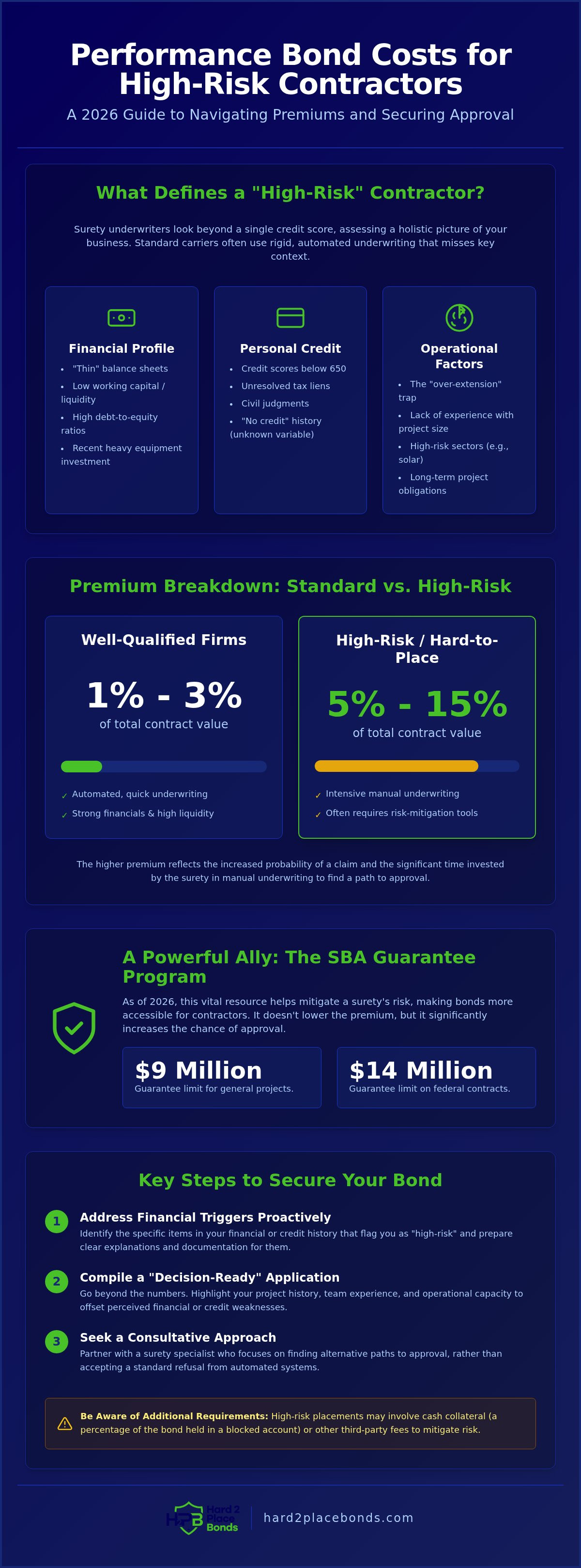
Being labeled "high risk" by a surety carrier often feels like a door slamming shut on your company's growth. It's a frustrating experience, especially when you know your team has the technical skill to deliver the work. However, this label is rarely about a single factor. While many believe it's strictly a credit score issue, underwriters look at a holistic picture of your business. Standard carriers often rely on rigid, automated underwriting that doesn't account for the nuances of your specific situation. This is why understanding the performance bond cost for high risk contractors starts with knowing exactly what triggers that red flag.
Traditional insurers look for high liquidity and low debt to equity ratios. If your business is new or you've recently invested heavily in equipment, your balance sheet might look "thin" to them. This hard to place status can prevent you from bidding on essential government contracts that require a performance bond. When standard markets say no, it's usually because their internal guidelines don't allow for any deviation from "perfect" financials. They prioritize safety over solutions, leaving many capable contractors searching for a path forward.
The Role of Personal Credit in Performance Bonding
For many small to mid-sized firms, personal credit is the primary lens for risk assessment. Generally, credit scores below 650 trigger high risk underwriting protocols. Underwriters aren't just looking at the number; they're looking for the "why" behind it. Unresolved tax liens or civil judgments suggest a level of risk that traditional carriers won't touch. There's also a significant difference between "bad credit" and "no credit." Bad credit shows a history of challenges that need explanation, while no credit represents an unknown variable that requires a different approach to secure payment & performance bonds. We focus on the progress you've made rather than just the setbacks in your file.
Operational Risks That Increase Bond Premiums
Operational factors can be just as impactful as financial ones. A lack of experience with a specific project size or type is a major trigger. For example, a contractor moving from $500,000 projects to a $5 million contract faces the "over-extension" trap. Underwriters worry you might lack the capital or management structure to support such a jump. Certain sectors, such as those requiring solar decommissioning bonds, are viewed as higher risk because they involve long term obligations or specialized environmental requirements. These complexities naturally increase the performance bond cost for high risk contractors as the surety must account for the specialized nature of the work and the potential for project delays.
How Performance Bond Costs are Calculated for High-Risk Applicants
Many online resources claim a standard 1% rate for surety products, but this is often misleading for businesses with credit or financial hurdles. For well-qualified firms with strong financials, premiums typically sit between 1% and 3%. However, the performance bond cost for high risk contractors often ranges from 5% to 15% of the total contract value. This isn't just a random markup; it's a calculated response to the increased probability of a claim. When a surety takes on a "hard-to-place" account, they invest significantly more time in manual underwriting to find a path to "yes."
The calculation process follows a logical sequence. First, underwriters evaluate the contract amount and project duration. A project spanning two years carries far more uncertainty than one lasting two months. Second, they assess the financial "gap" in your balance sheet, specifically looking for low working capital or high debt. Third, they determine which risk-mitigation tools are necessary to protect the project. Finally, they apply a high-risk multiplier based on your specific profile, including credit history and past project performance. If you're ready to see how these factors apply to your specific project, you can start your application today and let our team advocate for your approval.
Understanding the High-Risk Premium Multiplier
High-risk bonds require intensive manual underwriting because they don't fit into standard automated systems. The surety must carefully balance the risk of default against the premium collected. For federal projects, the SBA Bond Guarantee Program is a vital resource. As of 2026, the SBA has increased guarantee limits to $9 million for all projects and up to $14 million on federal contracts. This program helps mitigate the surety's risk, which can make the bond more accessible even if the premium remains higher than standard rates. This is especially relevant when navigating the complexities of Miller Act Bonding: Requirements and Waiver, which governs performance bond mandates on federal construction work.
Hidden Costs: Collateral and Third-Party Fees
Beyond the base premium, high-risk placements often involve additional financial components. A surety might require cash collateral, which is a percentage of the bond amount held in a blocked account. While this ties up liquidity, it's often the only way to secure a bond when credit is severely challenged. You may also encounter Funds Control fees. In this arrangement, a third party manages project disbursements to ensure subcontractors and suppliers are paid. While it adds a fee, paying for this oversight can actually save the deal by providing the surety with the security they need to move forward. Non-standard placements also typically involve administrative and application fees that aren't found in standard "A-rated" bond quotes.
Standard vs. High-Risk Bonding: Comparing Structures and Terms
Standard bonding is built for contractors who check every traditional box: high credit scores, deep liquid reserves, and decades of documented experience. These "A-rated" carriers offer low premiums and rarely ask for collateral because they rely on the "three Cs" of underwriting: character, capacity, and capital. However, when you're navigating the performance bond cost for high risk contractors, the deal structure changes significantly. High-risk bonding shifts the focus from your personal credit history to the specific safety and management of the project at hand. While standard carriers look at where you've been, specialty carriers look at how the current project is protected.
The structure of the bond matters just as much as the price. A deal might have a higher premium but more flexible terms, or a lower premium paired with strict oversight. This distinction is particularly evident when meeting Federal Acquisition Regulation (FAR) requirements for performance bonds, where the mandate for protection is absolute. In these high-stakes environments, the way a bond is structured determines whether you can actually afford to take the job or if the requirements will drain your working capital before you even break ground.
Funds Control: The High-Risk Contractor’s Best Friend
Think of funds control as a project-specific safety net that benefits both you and the surety. In this arrangement, an independent third party manages project disbursements to ensure that subcontractors and suppliers are paid before any profits are released. This drastically lowers the surety's risk because it prevents project funds from being diverted to other company overhead. By agreeing to funds control, you often secure a more competitive rate on your performance bond cost for high risk contractors. It's a professional way to prove your reliability and capacity without needing a perfect balance sheet, making it a far better alternative than tying up your own cash in heavy collateral.
Collateral Requirements: What to Expect
While some anecdotal reports suggest you'll always need 100% cash down for a high-risk bond, that's rarely the case when working with a specialized advocate. You might be asked for a percentage of the bond amount in cash or an Irrevocable Letter of Credit (ILOC) from your bank. This collateral acts as a "skin in the game" guarantee for the surety. It's important to remember that this capital isn't gone forever; it's typically held until the project is finalized and the warranty period ends. Understanding these specific payment and performance bonds requirements helps you plan your project's cash flow more effectively and ensures there are no surprises during the bidding process.