What if a single number on a credit report didn't have the power to kill your next big project? Many contractors believe that a low score is an automatic disqualifier for public works, but the reality is far more optimistic. If you've been asking can you get a bid bond with bad credit in 2026, the answer is a definitive yes. It isn't about whether you can get bonded; it's about finding the right path and the right advocate to present your case to specialized underwriters who look beyond the score.
We understand the frustration of being sidelined by traditional agencies that only look at a spreadsheet. It's exhausting to feel like past financial mistakes are blocking your future growth, especially when you know your crew is ready for the work. This guide provides the exact steps and specialty programs available to help you secure bid bonds even with significant credit challenges. We'll explore the SBA Surety Bond Guarantee Program, which backed a record $10.6 billion in bonds recently, and outline a clear roadmap to getting your first approval. You'll learn how to minimize the impact of your credit score and start winning the lucrative contracts your business deserves.
Key Takeaways
- Stop wondering can you get a bid bond with bad credit and learn how specialty programs provide a definitive path to approval for scores as low as 500.
- Understand the "Three Cs" of surety-Character, Capacity, and Capital-to shift an underwriter's focus from your credit report to your professional track record.
- Identify the critical differences between standard and specialty bond markets to find the most flexible terms for your specific financial situation.
- Master the five-step roadmap for building a professional "Bond Kit" that demonstrates project readiness and offsets the impact of past financial setbacks.
- Learn why securing a bid bond is the essential first step toward performance bond approval and long-term growth in the public works sector.
The Reality of Getting a Bid Bond with Credit Challenges
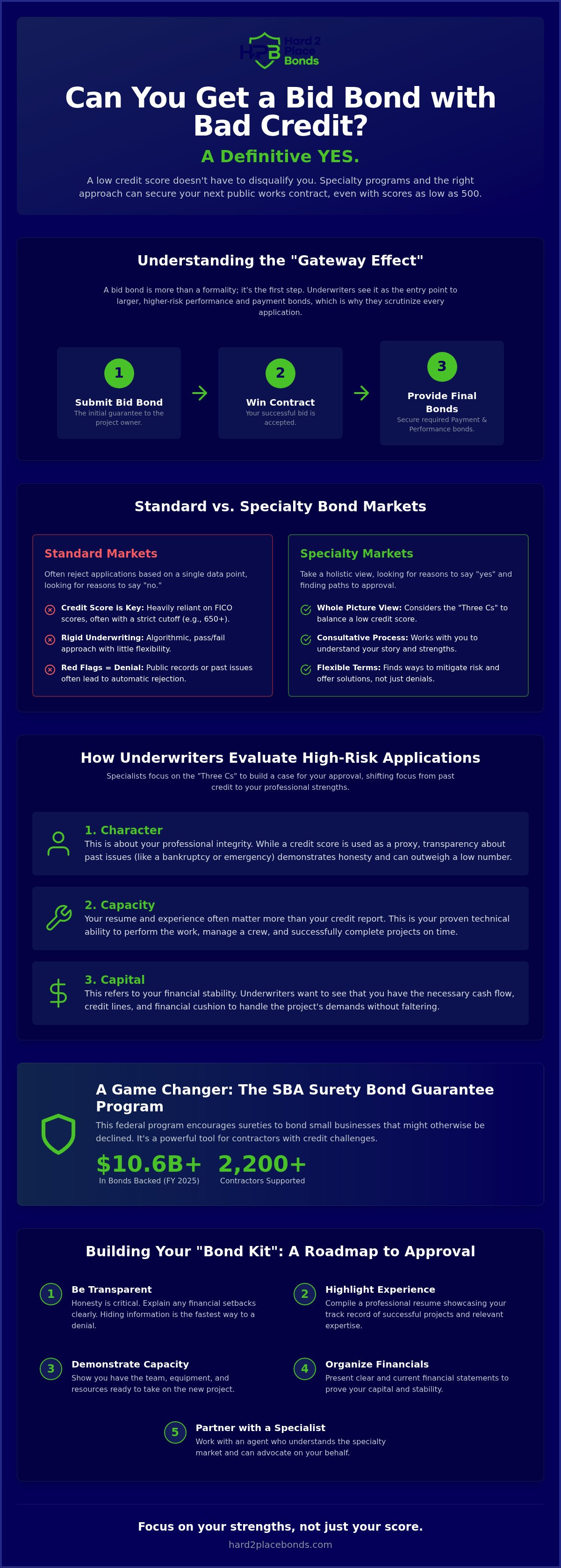
To understand your options, you first need to understand what a bid bond is and why it exists. A bid bond is a legal guarantee provided by a surety company to a project owner (the obligee). It ensures that if you win the bid, you will actually sign the contract and provide the required follow-up bonds. If you've been asking can you get a bid bond with bad credit , you've likely encountered the "Gateway Effect." Underwriters rarely view a bid bond as an isolated document. Instead, they see it as a precursor to the payment and performance bonds that will be required once the project starts. Since those bonds involve much higher financial stakes, the scrutiny begins the moment you submit your bid bond application.
Many contractors feel frustrated because a bid bond is typically offered at no cost. It feels like a simple formality, so why does a personal credit score matter so much? The reality is that the surety is backing your professional word with their financial reputation. If you've struggled with credit in the past, standard insurance agencies might turn you away immediately. However, securing a bid bond with bad credit is entirely possible through specialty markets. These non-standard underwriters look beyond a simple FICO score to find reasons to say "yes" rather than looking for excuses to say "no."
Why Surety Companies Care About Your Credit Score
In the surety world, your credit score is used as a proxy for character. Underwriters use it to gauge how you manage your financial obligations under pressure. The relationship involves three parties: the Principal (you), the Obligee (the project owner), and the Surety. If you default on a contract, the surety is on the hook to ensure the project is finished. They view past financial management as a predictor of future project success. However, a tenacious advocate can help explain the context behind a low score, whether it was a one-time medical emergency or a temporary business downturn, to show the underwriter your true capacity to perform.
Common Credit Issues That Impact Bid Bond Approval
While every underwriter has different thresholds, certain "red flags" usually trigger a move from standard to specialty markets. These include:
- Low FICO Scores: Scores below 650 often fall outside the "standard" box.
- Public Records: Unresolved tax liens, civil judgments, or a history of bankruptcy can make traditional sureties nervous.
- Thin Credit Files: New contractors who haven't established business credit may face challenges because there isn't enough data to prove reliability.
Even if you're dealing with these issues, the question of can you get a bid bond with bad credit remains a "yes." It simply requires a shift in strategy toward underwriters who specialize in hard-to-place bonds and look at the whole picture of your business.
How Underwriters Evaluate High-Risk Bid Bond Applications
High-risk underwriting for bid bonds doesn't rely on a simple pass/fail algorithm. Instead, specialists treat it as a consultative process where they evaluate the "Three Cs" of surety: Character, Capacity, and Capital. While your credit score reflects Character, a specialist underwriter looks for compensating factors to balance out a low FICO. They want to see that you have the technical ability and the financial cushion to handle the job. This is where the SBA's Surety Bond Guarantee program becomes a game changer. In fiscal year 2025, this program supported over 2,200 contractors, backing a record $10.6 billion in bonds for small businesses that might have been rejected elsewhere.
If you are wondering can you get a bid bond with bad credit , the answer often hinges on your willingness to be transparent. Hiding a past bankruptcy or a civil judgment is the fastest way to get a denial. Underwriters value honesty because it demonstrates professional character. If you've had a setback, explain it. When you share your full story, you give an advocate the tools needed to fight for your approval. Even if your financial history is messy, the question isn't just can you get a bid bond with bad credit , but how you present your current stability to the surety.
The Role of Professional Experience
Your resume often carries more weight than your credit report in a high-risk scenario. Underwriters want to know if you've successfully completed projects of a similar size and scope. If you are bidding on a $500,000 infrastructure project, having a track record of five $400,000 projects proves your Capacity. Specialized knowledge in niche fields like solar decommissioning or heavy civil works can also act as a significant compensating factor. It shows the surety that you aren't just a "paper contractor," but a skilled professional who understands the specific risks of the job.
Financial Transparency and Liquidity
While personal credit is a starting point, your business financials often tell a more compelling story for larger bids. Underwriters look for "Cash on Hand" and other liquid assets that can act as a safety net. Following the proper steps for obtaining a surety bond involves organizing your balance sheets and profit/loss statements to highlight your Capital. If your business is profitable and has strong liquidity, it can often override a poor personal credit score. This financial transparency proves you have the resources to keep the project moving even if unexpected costs arise.
Comparing Your Options: Standard Markets vs. Specialty Programs
When you ask can you get a bid bond with bad credit , you're really asking which market you belong in. Standard surety markets are built for speed and low risk. They prioritize contractors with credit scores of 700 or higher and clean financial histories. If you fit this profile, you'll likely secure the lowest possible premiums. However, for contractors with scores between 500 and 650, the standard market usually offers a quick rejection. This is where specialty, or hard-to-place markets, step in. These programs are designed for resilience. While the premiums for the subsequent performance bonds may be higher, often between 5% and 10% for those with poor credit, these markets provide the actual opportunity to compete for work that standard agencies ignore.
In some cases, a surety might require collateral to bridge the gap. This usually involves a cash deposit or a letter of credit to secure the bond. While not ideal for every contractor, it is a definitive way to prove your commitment and secure a "yes" on a high-stakes project. It acts as a physical guarantee of your capital when your credit score doesn't yet reflect your business's true strength. It's a strategic move to build the track record needed to eventually move back into standard markets.
The SBA Bond Guarantee Program Explained
The SBA Bond Guarantee Program acts as a powerful government-backed safety net. Think of the SBA as a "co-signer" for your business. For 2026, the program has set contract limits of up to $9 million for non-federal projects and up to $14 million for federal contracts. By guaranteeing 80% to 90% of the surety's potential loss, the SBA makes it much easier for a bonding company to approve a contractor with credit challenges. It's important to recognize that while bid bonds are exempt from the SBA's 0.6% guarantee fee, you should factor this cost into your project budget for the performance and payment bonds that follow. This program is often the launchpad that allows small businesses to graduate to the standard surety market.
Working with a Non-Standard Surety Specialist
Your local "all-in-one" insurance agent likely lacks the deep relationships needed to navigate these niche markets. They often only have access to standard carriers who use automated algorithms. To overcome significant credit hurdles, you need Specialized Surety Bond Placement. A specialist knows how to "package" your story. They don't just submit a credit score; they present your project history, your resume, and your current liquidity to an underwriter. This human-to-human advocacy is often the deciding factor in whether you get the green light to bid. It transforms a cold application into a compelling business case for approval, ensuring the question of can you get a bid bond with bad credit ends with a successful submission.
5 Steps to Secure a Bid Bond with Bad Credit
Preparation is the difference between a quick "no" and a conditional "yes." When you're dealing with credit challenges, you can't rely on a standard application to tell your story. You need a structured approach that emphasizes your business's strengths while addressing weaknesses transparently. If you've been asking can you get a bid bond with bad credit , follow these five steps to maximize your chances of approval.
- Step 1: Gather your "Bond Kit." This isn't just a basic form. It's a professional portfolio including your resume, a detailed project history, and current financial statements.
- Step 2: Address credit issues head-on. Don't wait for the underwriter to find the tax lien or the low FICO score. Provide a written explanation of past setbacks and, more importantly, what you've done to fix them.
- Step 3: Target the right project size. Don't overreach on your first bonded bid. Sureties are more likely to approve a project that aligns with your previous experience rather than a massive jump in contract value.
- Step 4: Secure a specialist broker. Work with an advocate who understands the nuances of Bid Surety Bonds. They have access to non-standard markets that local insurance agents simply don't.
- Step 5: Review bid requirements early. Check for "hidden" bond traps, such as unusual liquid damage clauses or onerous indemnity requirements that might scare off a high-risk underwriter.
Strengthening Your "Bond Kit"
Your Bond Kit is your primary marketing tool. Start with a one-sentence summary of your most successful project to date to give the underwriter immediate context of your capability. Include letters of recommendation from previous project owners or suppliers to prove your reliability. Finally, organize your work-on-hand report to show you have the capacity to take on the new job without over-extending your crew or your cash flow. This level of organization signals that you're a professional who takes financial responsibility seriously.
Addressing the "Credit Letter"
The "Credit Letter" is your opportunity to humanize the data. Explain bankruptcies or judgments without making excuses; stick to the facts of the event. Focus on "rehabilitation" by showing what you've done since the credit event to stabilize your business, such as hiring a new controller or paying down debt. Explicitly state how the profit from the project you're bidding on will further stabilize your company's financial health. When you're ready to move forward, start your application today and let a specialist present your case.
Moving from Bid Bond to Performance Bond Approval
Winning the contract award is a massive milestone for any contractor. However, it's vital to recognize that the bid bond was simply the entry ticket. Once you're awarded the job, the real work of securing Performance Bond Approval begins. Sureties rarely issue a bid bond if they aren't already willing to issue the subsequent performance and payment bonds. They've already vetted your credit and capacity during the initial application. If they've given you the green light to bid, they've essentially signaled that they're prepared to back you for the full duration of the project, provided your financial position remains stable.
These Payment and Performance Bonds are the backbone of the construction lifecycle. They protect the project owner from financial loss and ensure subcontractors and suppliers receive payment. If you were worried and asked can you get a bid bond with bad credit , you've already cleared the highest hurdle by finding a specialty market. Now, the focus shifts to managing the costs and conditions that come with high-risk bonding to ensure the project remains a profitable venture for your company.
Budgeting for Higher Premiums
You must prepare for the increased costs associated with non-standard risk. While bid bonds are typically free, the performance and payment bonds that follow carry a premium based on the contract value. For contractors with poor credit (scores below 640), premiums often range from 5% to 10% of the contract total. You must factor these higher costs into your bid from the very beginning. If you don't, the bond premium could eat your entire profit margin. Don't just hunt for the "cheapest" bond; some low-cost options come with restrictive conditions, such as mandatory funds control or heavy collateral requirements, that could stifle your cash flow mid-project.
Your Next Steps to a Winning Bid
Don't let a credit score stop your business growth in 2026. The demand for infrastructure and renewable energy projects is rising, and there's significant room for contractors who can prove their technical capacity despite past financial setbacks. Start the process early. High-risk underwriting is a manual, human-driven process that takes much longer than standard, automated bonds. Give your advocate the time needed to negotiate the best terms and explain your story to the underwriter. When you're ready to compete for the contracts your business deserves, Start your application for a high-risk bid bond today.
Take the Next Step Toward Winning Lucrative Contracts
Winning a public contract in 2026 requires more than just a low bid; it requires the right bonding partner. We've shown that the answer to can you get a bid bond with bad credit is a resounding yes when you use the right strategy. By focusing on your professional project history, leveraging the SBA Bond Guarantee Program, and preparing a comprehensive Bond Kit, you can overcome past financial hurdles. Success depends on presenting a complete picture of your business capacity rather than relying on an automated credit score.
Hard 2 Place Bonds serves as your tenacious advocate in a complex market. We are specialists in high-risk and hard-to-place surety underwriting with national coverage across all 50 states. Our team provides expert guidance for contractors dealing with bankruptcies or judgments, ensuring your application reaches the right non-standard underwriters. Don't let a standard rejection letter from a traditional agency sideline your growth.
Secure your bid bond, even with bad credit, by starting your application here.
Your professional track record is your greatest asset. We are ready to help you prove that value to underwriters and secure the contracts your business deserves.
Frequently Asked Questions
Can I get a bid bond with a 500 credit score?
Yes, you can secure a bond with a score as low as 500. While standard markets typically stop at 650, specialty underwriters look at the context of your situation. They prioritize your professional track record and current business liquidity over a single number. This approach allows contractors to continue bidding while they work on credit rehabilitation. It simply requires more detailed documentation of your company's performance.
Do bid bonds require a hard credit pull?
Yes, most surety companies perform a hard credit pull to assess financial responsibility. Since a bid bond is a precursor to a performance bond, underwriters need a full picture of your credit history. This helps them determine if you qualify for the non-standard programs mentioned earlier. It's a standard part of the risk assessment process for any contract surety bond application you submit.
What happens to my bid bond if I am denied for the performance bond later?
If you win a bid but cannot secure the performance bond, you may forfeit your bid deposit or face a claim against the bid bond. This is why specialist brokers ensure you are pre-qualified for the performance bond before issuing the bid bond. It prevents legal and financial disasters. We work to ensure the surety is committed to the entire project lifecycle from the start.
Are bid bonds more expensive if I have bad credit?
Bid bonds themselves are usually free, regardless of your credit score. The price difference appears in the performance and payment bonds that follow. Contractors asking can you get a bid bond with bad credit should prepare for higher premiums on those subsequent bonds. These costs can range between 5% and 10% for high-risk applicants, so you must include them in your project estimates to remain profitable.
Can a new contractor with no credit history get a bid bond?
Yes, contractors with thin credit files can still get bonded. Underwriters will look closely at your personal resume and professional experience in the field. Providing proof of successful past projects as an employee or foreman can help bridge the gap for a new business entity. Showing a strong work history demonstrates the capacity to perform even without an established business credit score.
Will a past bankruptcy prevent me from getting a bid bond in 2026?
A past bankruptcy does not automatically disqualify you from the bidding process. Underwriters look for rehabilitated credit, meaning you've remained financially stable since the discharge. Providing a clear explanation of the circumstances and showing current business profitability are key steps to securing approval in the specialty market. It is about proving that your financial management has improved and your business is now on solid ground.
How long does it take to get a bid bond with bad credit?
You should allow at least 5 to 10 business days for the underwriting process. High-risk applications require a manual review that cannot be rushed by an algorithm. If you're wondering can you get a bid bond with bad credit on a tight deadline, start the process immediately. Gathering your financial documents early ensures your advocate has enough time to negotiate terms before the bid date.
Is collateral always required for bad credit bid bonds?
No, collateral is not always a requirement for approval. While it can help bridge the gap for very high-risk applications, many specialty programs approve bonds based on project experience and cash flow. Underwriters only request collateral, such as a letter of credit, when other compensating factors aren't strong enough to offset the risk. We always explore every other path to approval before discussing collateral options.