What if your ability to build wasn't defined by a three-digit number on a credit report? For many contractors, a single financial setback creates a wall of "no" from traditional providers when they try to secure a contract surety bond with bad credit. It's incredibly frustrating to watch lucrative government or private contracts slip away because a "big box" surety saw a low FICO score and ignored your years of field experience. You know your business is capable, but you're stuck in a system that feels designed to hold you back. We believe your project history is your true proof of performance, not just a snapshot of your personal finances.
This 2026 guide changes the narrative by showing you how to navigate high-risk underwriting and leverage new SBA guarantee programs to win the work you want. We'll explore the specific requirements for subprime bonds, how to address financial red flags proactively, and how recent NCUA regulation changes are opening new doors for contractor bonding. You'll discover a clear path to approval that bypasses automated rejections, allowing you to secure the bid and performance bonds necessary to grow your company despite past credit challenges.
Key Takeaways
- Learn why your project history and industry tenure carry more weight than a three-digit score when working with specialized underwriters.
- Discover the specific documentation required to successfully secure a contract surety bond with bad credit for upcoming 2026 projects.
- Understand the vital roles of bid and performance bonds in helping you compete for and win high-stakes government contracts.
- Identify the four essential steps to bypass automated rejections and find a path to approval through tenacious surety advocates.
- Explore how a consultative approach can turn a standard "no" into a strategic "yes" for your construction business.
Understanding Contract Surety Bonds and the Credit Score Barrier
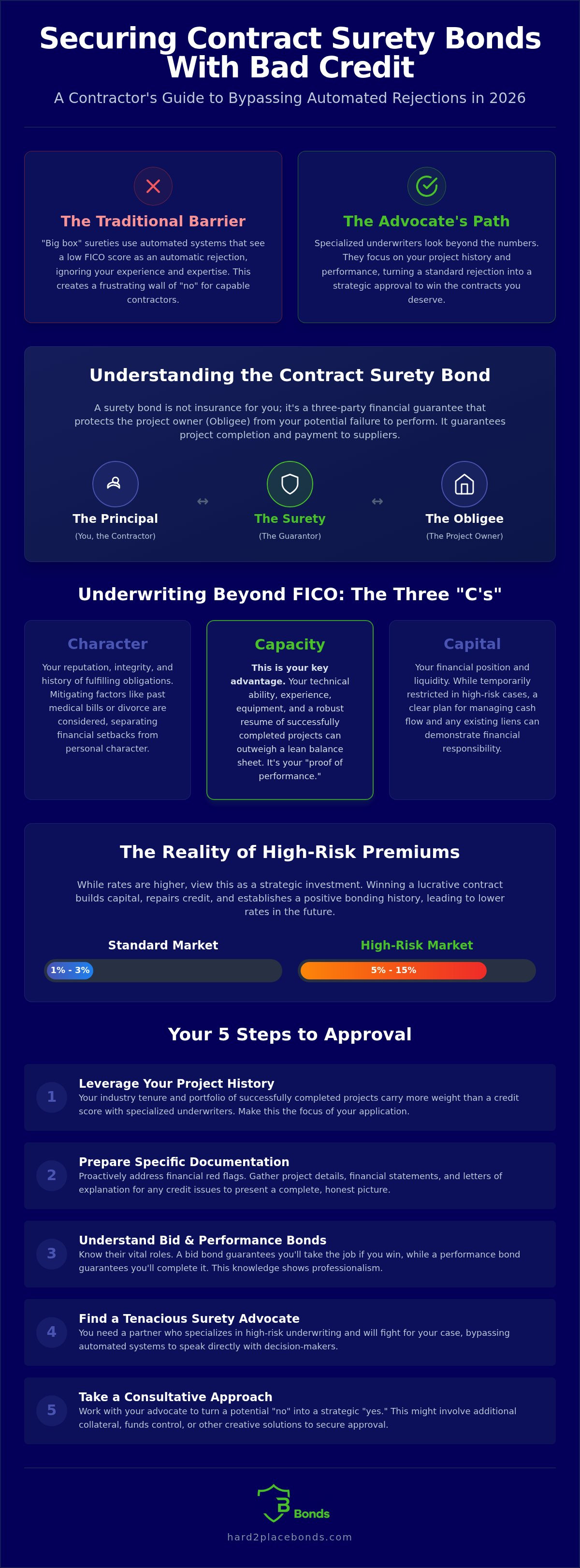
A contract surety bond isn't just a piece of paper; it's a financial guarantee that a specific written agreement will be fulfilled. If you're a contractor, this bond is often the only thing standing between you and a major contract award. Understanding Contract Surety Bonds involves looking at a unique three-party relationship. You are the principal, the project owner is the obligee, and the surety company acts as the guarantor. Unlike insurance, which protects you from loss, a surety bond protects the project owner from your potential failure to perform.
Why does personal credit matter so much in this equation? Underwriters view your credit score as a proxy for your financial character and liquidity. They want to see that you have the discipline to manage obligations and the cash flow to keep a project moving if a payment is delayed. It's essential to recognize that a contract surety bond carries significantly more risk than a standard contractor license bond. While a license bond might cover minor regulatory infractions, a contract bond guarantees the entire project's completion and the payment of every supplier. This depth of risk is why traditional carriers are so selective.
The Role of the Surety in Construction
Sureties act as the glue in the construction industry, providing project owners with the peace of mind that the work will be completed exactly as specified. They don't just protect the owner; they protect the entire ecosystem of your project. This is achieved through several key functions:
- Ensuring Completion: Guaranteeing that the project reaches the finish line even if the contractor faces insolvency.
- Protecting Suppliers: Payment bonds ensure that subcontractors and material providers get paid, preventing mechanics' liens on the property.
- Building Trust: For government entities, these bonds are a legal requirement that ensures public funds are handled by responsible, vetted professionals.
Why Traditional Sureties Say No
Most "big box" surety companies rely on automated underwriting systems. These algorithms are programmed to flag any score below a certain threshold as an automatic rejection. They don't look at your twenty years of clean project history or your specialized technical skills. They simply see a number and walk away. This lack of expertise in evaluating non-standard financial histories means many capable contractors are left in the cold when they try to secure a contract surety bond with bad credit .
Traditional carriers have a very low appetite for risk in the construction sector. They prefer "easy" files over the hard work of manual underwriting. If you've been searching for a contract surety bond with bad credit, you've likely hit this wall before. It's a systemic hurdle, but it doesn't mean your business has reached a dead end. It simply means you need an advocate who looks beyond the score to the strength of your performance.
Why a 500 Credit Score Doesn't Mean You Can't Get Bonded
A low FICO score often feels like a scarlet letter in the construction industry. However, savvy underwriters know that a 500 credit score is a snapshot of your past, not a prophecy of your future project performance. There's a vital distinction between "bad credit" and "bad character." Financial setbacks like medical bills, a past divorce, or a previous business failure don't necessarily mean you lack the integrity to finish a job. When you seek a contract surety bond with bad credit , specialized providers look for mitigating factors such as your specific project experience and industry tenure. Even significant hurdles like past bankruptcies or open tax liens aren't automatic deal-breakers if they're older or being actively managed through a payment plan.
Underwriting Beyond the FICO Score
Manual underwriting focuses on the "Three Cs": Character, Capacity, and Capital. While your capital might be temporarily restricted, your capacity-your technical ability to execute the work-can carry the day. A robust resume detailing successfully completed projects of similar scope can often offset a lean balance sheet. This project-specific risk assessment is exactly what Navigating Hard-to-Place Bonds with a National Advocate through the SBA program allows. By focusing on your ability to perform the work rather than just your personal debt-to-income ratio, these programs facilitate business growth that traditional banks would ignore. Specialty underwriters in 2026 are increasingly looking at your "proof of performance" as the primary indicator of risk.
The Reality of High-Risk Premiums
It's vital to be realistic about costs when your credit is challenged. High-risk contract bonds typically carry premium rates ranging from 5% to 15% of the bond amount, which is notably higher than the 1% to 3% range seen in standard markets. While this cost is higher, it's a strategic investment in your company's scaling. Winning a lucrative project allows you to build liquidity, pay down existing debts, and establish a positive bonding history. Think of the higher premium as a bridge to a better financial future. As you complete projects and improve your credit profile, your rates will likely decrease upon renewal. If you're ready to show an underwriter what you're truly capable of, you can begin the intake process today to see which programs fit your specific situation.
Essential Contract Bonds for High-Risk Contractors in 2026
Securing a contract surety bond with bad credit requires understanding that different project phases demand different types of financial protection. It's not a one-size-fits-all product. For a contractor in 2026, the bonding process functions like a ladder. You start with the bid bond to get your foot in the door, move to performance and payment bonds once the contract is awarded, and finally, utilize a warranty bond to cover the post-construction period. Each of these serves a distinct purpose in reassuring the project owner that your financial past won't jeopardize their future asset.
Winning the Bid: High-Risk Bid Bonds
A bid bond is your "ticket to the game." It provides the project owner with a financial guarantee that, if you are the low bidder, you will actually sign the contract and provide the required final bonds. For those with credit challenges, this is often the most significant hurdle because it's the first time an underwriter scrutinizes your file. You can learn more about bid bonds for high-risk projects to see how a tenacious advocate positions your technical strengths to overcome credit weaknesses. Securing this initial approval is a powerful signal; it tells the obligee that a surety has already pre-qualified you for the full scope of the project.
Executing the Work: Performance and Payment Guarantees
Once the contract is yours, the focus shifts from winning to doing. This is where payment and performance bonds become essential. A performance bond guarantees you'll finish the job according to the contract terms, while the payment bond ensures your crew and material suppliers don't go unpaid. This dual protection is often bolstered by the SBA Surety Bond Guarantee Program. In 2026, the SBA continues to support small businesses by guaranteeing up to 90% of losses on contracts of $100,000 or less for disadvantaged individuals, providing the safety net needed to bypass automated denials.
Finally, warranty bonds (sometimes called maintenance bonds) provide a safety net after the tools are packed away. They typically cover defects in materials or workmanship for a specific period, often one year. For high-risk contractors, successfully transitioning through these project stages proves to the market that you are a reliable partner. It turns your history of credit challenges into a new story of resilience and successful delivery.
4 Steps to Secure a Contract Bond with Challenged Credit
Securing a contract surety bond with bad credit requires a shift in strategy. You aren't just filling out an application; you're building a case for your business's reliability. While a traditional surety might stop at your credit score, a specialized underwriter wants to see the full picture of your operational strength. By following a structured approach, you can move past automated rejections and demonstrate that you are a low-risk partner despite a difficult financial history. This process is about proving your capacity to perform and settling any doubts before they lead to a denial.
Documenting Your Success
Your goal is to prove that you can finish what you start. Underwriters need to see a "Project Completion" portfolio that highlights your technical expertise. This documentation serves as a counterweight to a weak balance sheet. Focus on gathering the following items:
- Project History: A detailed list of completed jobs over the last three to five years, including contract values and client contact information.
- Professional Resumes: Highlight the experience of your key personnel and their specific roles in past successful builds.
- Letters of Recommendation: Direct praise from past obligees or project owners can be the deciding factor in a manual underwriting review.
- Interim Financials: Provide up-to-date profit and loss statements to show your current liquidity and cash flow management.
Transparency is your greatest asset during this phase. If you have past tax liens or a bankruptcy, be upfront about them. Underwriters value honesty because it demonstrates character. Explain what happened, how you resolved it, and what systems you've put in place to ensure it doesn't happen again. Hiding financial red flags usually leads to an immediate "no" once they're discovered during the background check.
The Power of Professional Advocacy
Choosing a specialist in contract surety bonds is the most critical step in the process. A standard insurance agent might not have access to the subprime-friendly carriers that handle non-standard risk. A professional advocate knows how to "sell" your story to an underwriter, framing your credit challenges as a temporary setback rather than a permanent character flaw. They can help you prepare a mitigation plan that might include funds control or collateral for larger projects.
In 2026, many high-risk bonds utilize funds control to reduce the surety's exposure. This involves a third party managing project disbursements to ensure subcontractors and suppliers are paid first. While it adds a layer of oversight, it also significantly increases your chances of approval. If you're ready to move forward, you can begin your intake process with a specialist advocate to see which risk-mitigation tools will work best for your next bid.
Navigating Hard-to-Place Bonds with a National Advocate
A standard insurance broker might see a low credit score as a dead end, but we see it as a challenge to be solved. Hard 2 Place Bonds has built a reputation as the preferred choice for contractors nationwide because we specialize in the "hard" cases. As a dedicated division of Hako Risk & Insurance, we leverage deep industry relationships and a specialized focus on high-risk underwriting. This connection gives us the leverage needed to represent your interests to carriers who are willing to look beyond automated scores. We're committed to finding creative solutions where others only see risk, ensuring that your technical skills aren't sidelined by financial history.
Our approach is fundamentally consultative. Instead of letting an algorithm decide your company's fate, we conduct a manual review of your entire profile. This allows us to move from application to approval with a speed that matches the urgency of the construction industry. We understand that a bid deadline is a hard stop; our team works with a sense of urgency to ensure you have the necessary documentation in hand before the clock runs out. Securing a contract surety bond with bad credit is a process that requires persistence, and that's exactly what we provide. We don't just process files; we fight for your right to compete.
National Reach, Specialized Expertise
We provide national service coverage, supporting contractors across all 50 states without geographic limitations. This wide reach is particularly valuable for specialized industries that operate in niche sectors. From solar decommissioning bonds to site improvement and subdivision projects, our expertise spans the full spectrum of high-risk contract surety. You can explore our full range of specialized surety services to see how we tailor our advocacy to your specific trade. We understand the unique regulatory environments of different states, allowing us to navigate local bond requirements with ease.
Take the First Step Toward Your Next Contract
Your business momentum shouldn't be held hostage by a credit report. Every successful project you complete is a step toward rebuilding your financial standing and lowering your future premium rates. We invite you to consult with one of our surety experts today to explore a customized path to approval. Start Your Surety Bond Application Now and let a tenacious advocate help you win the contracts you deserve.
Build Your Business Future Beyond the Credit Score
Your past financial hurdles don't have to dictate your company's growth in 2026. By focusing on your technical capacity and project history, you can bypass the automated rejections common in traditional markets. We've shown that manual underwriting and SBA programs provide the tools you need to secure a contract surety bond with bad credit , allowing you to focus on winning and executing the work. It's about presenting a complete picture of your operational strength rather than a single credit report.
Hard 2 Place Bonds is a specialized division of Hako Risk & Insurance, offering national underwriting expertise for contractors who face standard refusals. We're specialists in hard-to-place and bad credit solutions, acting as tenacious advocates for your business success. You've already built the skills to lead your projects; now it's time to build the bonding capacity that matches your ambition. We believe every capable contractor deserves a path to the job site.
Take the decisive step toward your next project award. Secure your contract bond today; start your application here . Your next big contract is waiting; let's get you bonded and back to work.
Frequently Asked Questions
Can I get a contract surety bond with a 500 credit score?
Yes, you can secure a contract surety bond with bad credit even with a score in the 500s. Specialized underwriters prioritize your technical expertise and your history of finishing jobs on time rather than just a credit report. While a low score might trigger an automatic rejection at a standard agency, we look at your capacity and character to find a path forward. Your experience in the field is often more persuasive than a snapshot of your personal finances.
How much more does a contract bond cost with bad credit?
Industry data suggests that high-risk premium rates typically range from 5% to 15% of the bond's face value. This is higher than the standard market rates of 1% to 3% because the surety is taking on more risk. You should view this extra cost as a necessary investment to win projects that build your business liquidity. As your credit profile improves over time, your annual renewal rates will likely decrease as you prove your reliability.
Do I need to provide collateral for a high-risk performance bond?
Collateral isn't always mandatory, but it's a common tool used to secure larger high-risk performance bonds. In many cases, we can utilize funds control as a more manageable alternative. This involves a third-party service that ensures project funds are paid directly to subcontractors and suppliers first. It reduces the surety's risk without requiring you to tie up significant amounts of your own cash as collateral, keeping your working capital free.
Can I get a bid bond if I have a past bankruptcy?
You can still obtain a bid bond after a bankruptcy, provided the filing is fully discharged and you've shown financial stability since. Underwriters will want to see the circumstances surrounding the bankruptcy and evidence of your current project performance. We act as your advocate to explain the story behind the numbers, focusing on your resilience and your ability to execute the specific contract at hand despite past financial setbacks.
How long does it take to get approved for a bad credit surety bond?
Most initial reviews for a contract surety bond with bad credit are completed within 24 to 48 hours. However, the final approval for a complex contract file can take longer because it requires a thorough manual review of your project history and financials. It's best to start the process as soon as you identify a project you want to bid on. Early preparation ensures you don't miss any critical deadlines during the bidding phase.
Will my bond premium decrease if my credit score improves?
Yes, your premium will likely decrease as your credit score and bonding history improve. Surety bonds are usually renewed annually, giving you the chance to qualify for better rates every year. By consistently finishing projects without claims and managing your debts, you demonstrate reduced risk to the underwriter. This progress eventually allows you to transition from high-risk programs into standard, lower-cost bonding markets as your business matures.
What documents are required for a high-risk contract bond application?
You'll need to provide a project history, key personnel resumes, and current financial statements. For contract-specific bonds, the underwriter also requires the bid invitation or the specific contract terms you're looking to guarantee. Including letters of recommendation from past project owners can significantly strengthen your case. Having these documents ready before you apply helps speed up the manual underwriting process and shows your professional readiness to the surety carrier.
Is there a limit to the bond amount I can get with poor credit?
Your bond limit is primarily determined by your largest successfully completed projects and your current capacity. While poor credit might limit your initial bonding line, programs like the SBA Surety Bond Guarantee can support contracts up to $9 million for small businesses. We work to maximize your bonding capacity by highlighting your field experience and technical skills. This ensures you aren't held back from bidding on larger, more lucrative opportunities as you grow.