
A low credit score is a pricing variable, not a permanent barrier to your next contract. If you've been told that your financial history makes you unbondable, you've likely been talking to the wrong providers. While it's true that your surety bond cost with bad credit will be higher than the standard market rate, the gap isn't as wide as you might fear. Most applicants with scores below 600 can still secure the guarantees they need to stay in business without sacrificing their entire profit margin.
We understand the frustration of seeing a high premium quote right when you're trying to grow your company. It feels like a penalty for past mistakes rather than a reflection of your current capabilities. This 2026 pricing guide breaks down exactly how rates are calculated and highlights recent SBA program updates that favor small businesses. You'll discover how to secure an approval that fits your budget and learn specific strategies to lower your premium today. We're moving past the "why" of credit checks to focus on the "how" of getting you bonded and back to work.
Key Takeaways
- Recognize that bad credit shifts your application into a non-standard risk category where specialist underwriting can still secure the approval you need to grow.
- Learn how your surety bond cost with bad credit is calculated as a percentage of the bond's face value, with 2026 benchmarks typically ranging from 5% to 15% for high-risk applicants.
- Move beyond the FICO score by addressing specific financial red flags with a proactive narrative that demonstrates your current business stability to underwriters.
- Implement "underwriting optimization" techniques, including transparency and strong financial documentation, to lower your premium and increase your total bonding capacity.
- Discover how partnering with a tenacious advocate can unlock access to essential bid, performance, and license bonds that traditional agencies often reject.
The Reality of Bad Credit Surety Bond Pricing in 2026
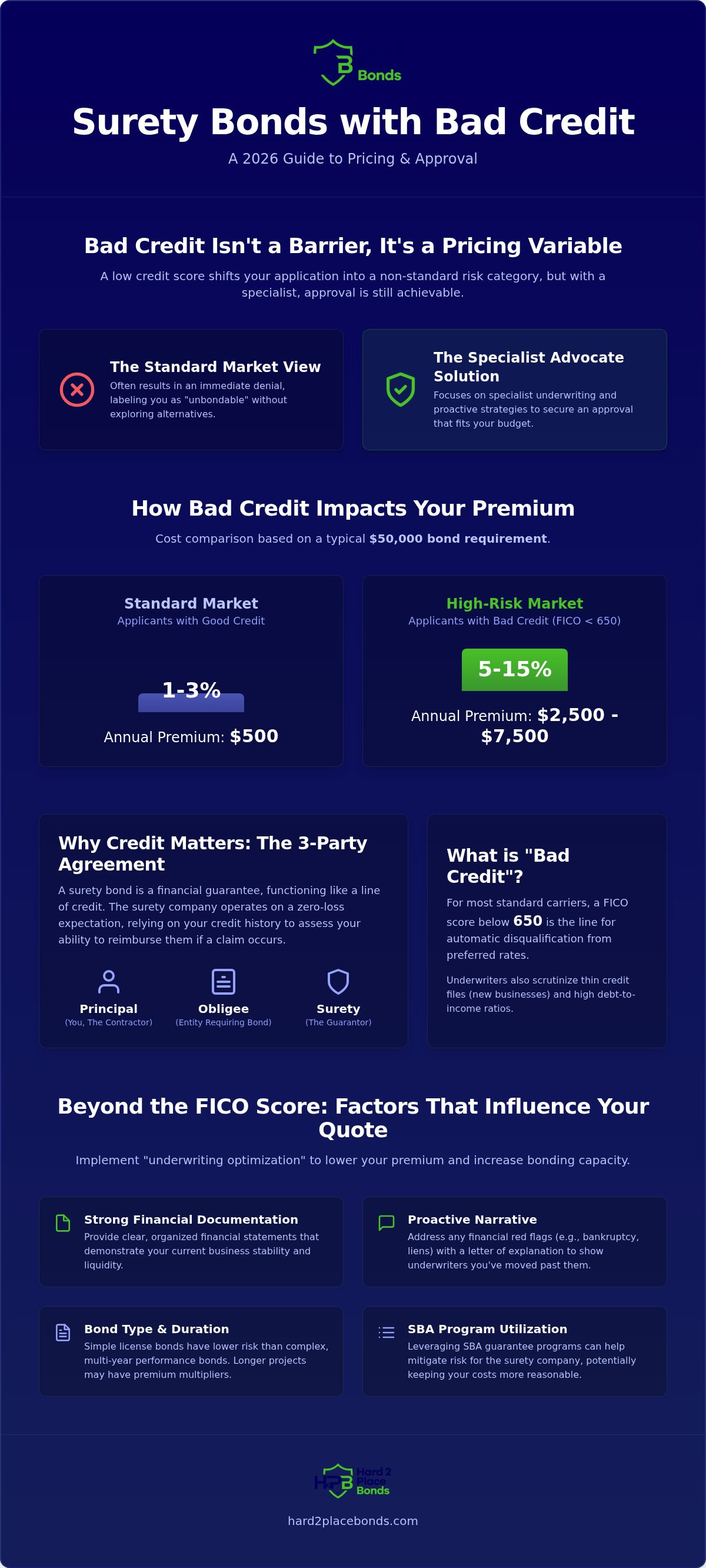
Securing a bond when your credit score isn't perfect can feel like hitting a brick wall. Most traditional carriers see a low FICO score and immediately issue a denial, leaving you unable to bid on projects or maintain your license. In the industry, this is known as the non-standard risk category. While standard market rates typically hover between 1% and 3% of the bond amount, your surety bond cost with bad credit will be higher because the underwriter is taking on a greater perceived risk. This doesn't mean you're unbondable; it just means you need a different approach to underwriting.
Underwriters view your credit history as a proxy for two things: character and capital. They want to see that you honor your financial commitments and that you have the liquidity to handle a claim if one arises. Rejection from a standard agent can be emotionally draining, but it's often just a sign that you're knocking on the wrong door. We view these challenges as hurdles to be cleared rather than permanent stop signs. By shifting the focus from the "no" to the available alternatives, we help you secure the bonding necessary to keep your business moving forward.
What Counts as 'Bad Credit' in the Surety Industry?
For most standard carriers, a FICO score of 650 is the hard line in the sand. If you fall below this threshold, you're often automatically disqualified from preferred pricing. This also affects new business owners with thin files who haven't had time to build a robust credit history. In 2026, underwriters have become even more sensitive to debt-to-income ratios. They are looking beyond the raw score to see how much of your monthly revenue is tied up in existing obligations, making it harder for some to qualify for standard contractor license bonds without a specialist's help.
The Three-Party Agreement: Why Your Risk Matters
To understand the price, you have to understand what a surety bond is and how it functions. It's a three-party agreement between the Principal (you), the Obligee (the entity requiring the bond), and the Surety (the company providing the guarantee). Unlike traditional insurance, where the company expects to pay out a certain percentage of claims, the surety company operates on a zero loss expectation. They expect you to fulfill your obligations or reimburse them for any claims paid out. A surety bond is a line of credit, not an insurance policy. Your credit score serves as a primary indicator of your ability to make the surety whole if a dispute occurs.
Premium Breakdown: What You Will Actually Pay
Understanding your total surety bond cost with bad credit starts with one critical distinction: you pay a percentage of the bond's face value, not the total contract price. If a project requires a $100,000 performance bond, your premium is based on that $100,000 figure. For high-risk applicants in 2026, benchmark ranges typically fall between 5% and 15%. While this is higher than the standard 1% to 3% rate, it's a manageable expense when factored into your project overhead.
The pricing floor also shifts based on the specific bond type. Simple license bonds often have lower entry points, while complex contract bonds require more intensive underwriting. Some niche bonds even carry fixed minimum premiums. This means that regardless of your credit score, there's a baseline cost to cover administrative and filing fees. It's often helpful to look at how the SBA guarantees surety bonds for small businesses, as these programs can sometimes help mitigate the risk for the surety and keep your costs within a reasonable range.
Cost Comparison: Standard vs. Bad Credit Quotes
The price difference between standard and high-risk quotes can be significant. For a $50,000 bond, an applicant with excellent credit might pay a $500 annual premium. In contrast, an individual with a score below 600 might see quotes ranging from $2,500 to $7,500. Specific "hard-to-place" requirements, such as freight broker bonds, have their own unique pricing structures due to higher historical claim rates in that industry. You should also consider whether the premium is annual or multi-year, as paying upfront for a longer term can sometimes reduce the effective yearly rate.
High-Limit Contract Bonds and Bad Credit
When you're dealing with high-limit bid, payment, and performance bonds, underwriting becomes more granular. Project duration plays a massive role here. If a job is expected to last three years instead of six months, the surety company may apply a premium multiplier to account for the extended risk period. This is often where the "Bad Credit Surcharge" appears. It's an additional fee layered on top of the base premium to compensate for the extra monitoring required for high-risk accounts. If you're ready to see how these variables apply to your specific situation, you can get a personalized quote to lock in your project costs.
Beyond the FICO Score: Factors That Influence Your Quote
Your FICO score is the starting point of an underwriting conversation, but it's rarely the final word. Underwriters use your score as an initial risk filter, yet they dig much deeper to understand the story behind the numbers. While the Credit Practices Rule provides a framework for how financial data is handled, surety companies focus on the "Big Three" red flags: bankruptcies, tax liens, and civil judgments. These items suggest a history of unresolved financial obligations, which carries more weight than a few late credit card payments. If these exist on your report, be prepared to provide discharge papers or proof of a payment plan to keep your surety bond cost with bad credit from spiraling.
Experience acts as a powerful counterbalance to a struggling credit score. If you've spent twenty years in your trade without a single claim, that professional maturity matters. Underwriters are often willing to provide more favorable terms to a seasoned veteran than to a newcomer with the same credit profile. Additionally, the entity requiring the bond, known as the obligee, significantly impacts your risk level. Some municipalities or state agencies have a reputation for being highly litigious or having complex bond forms. If the obligee's requirements are unusually demanding, the surety company will price that extra risk into your premium.
The Weight of Financial Statements
Strong business liquidity is one of the most effective tools for lowering a high-risk premium. When you show a healthy cash-on-hand position, it proves you have the resources to resolve minor disputes before they turn into bond claims. We recommend reviewing our guide on obtaining a surety bond to learn how to organize your documents for the best possible impression. Keep in mind that "internally prepared" statements are often viewed with skepticism. Investing in CPA-reviewed or audited statements can provide the level of verification an underwriter needs to offer a lower rate, potentially saving you thousands in the long run.
Industry-Specific Risk Profiles
Not all industries carry the same level of risk in the eyes of a surety. For example, motor vehicle dealer bonds are high-volume and have well-established claim patterns, which can lead to more standardized pricing even for those with credit challenges. Conversely, solar decommissioning bonds are long-term obligations that may span decades. Because the risk is spread over such a long period, the underwriting is much stricter. A history of claims within your specific niche will always spike costs, as it suggests a systemic issue rather than a one-time financial setback. We help you navigate these industry-specific hurdles by positioning your business's strengths front and center.
Strategic Ways to Reduce Your Bond Cost with Poor Credit
Waiting months for a credit score to climb isn't always an option when a contract is on the line. Instead of focusing solely on long-term credit repair, you should focus on underwriting optimization. This involves presenting your business in the best possible light to convince an underwriter that your current financial habits are stronger than your past scores suggest. Managing your surety bond cost with bad credit requires total transparency with your broker. When we know the full story, we can advocate for you more effectively, using character references and professional certifications to offset the numbers on a screen.
A specialist broker does more than just fill out forms; they shop the high-risk market to find carriers that specialize in your specific situation. This targeted approach is the most direct way to manage your expenses. By highlighting your industry experience and recent financial wins, we move the conversation away from a standard refusal and toward a workable solution.
Step 1: Leverage Collateral or Funds Control
Adding a layer of security to the deal can significantly lower your premium. Funds control is a common tool used for performance bonds, where a third party manages the project's cash flow to ensure subcontractors and suppliers are paid first. You might also consider an Irrevocable Letter of Credit (ILOC) from your bank. While an ILOC ties up your bank credit, it often results in a much lower bond rate because it virtually eliminates the surety's risk. Collateral serves as a security deposit that lowers the surety's exposure, making them more comfortable offering a competitive quote.
Step 2: Provide a 'Letter of Explanation'
Underwriters are people, and they understand that life happens. A well-written letter of explanation can turn a "no" into a "yes" by providing context for a one-time financial setback like medical bills or a divorce. If you're working with a very low score, our guide on how to get a surety bond with a 500 credit score offers deeper insights into this process. Always include proof of any active payment plans for tax liens or judgments. Showing that you're proactively resolving past debts demonstrates the character that underwriters look for when assessing risk.
Step 3: Partner with a Specialized High-Risk Broker
General insurance agents often lack the deep relationships required to place difficult bonds. They might try one or two standard carriers and give up when they receive a rejection. Hard 2 Place Bonds operates differently. We maintain access to niche carriers that specifically design programs for non-standard risks. This market access allows us to find the pricing sweet spot that standard agents simply can't reach. If you're tired of hearing "no" from your current agent, you can start your application now to get a competitive high-risk quote that fits your project budget.
Securing Your Bond with Hard 2 Place Bonds
Finding a partner who understands the nuances of high-risk underwriting can be the difference between winning a contract and losing a business opportunity. Hard 2 Place Bonds functions as a tenacious advocate for professionals who have been marginalized by traditional bonding companies. We don't just generate quotes; we build cases for our clients. Whether you need bid bonds to enter a new market or site improvement bonds for a complex development, we navigate the hurdles that standard agents avoid.
Our quick-response culture is built for the reality of modern business. We know that when a deadline is approaching, waiting a week for an underwriter to call you back isn't an option. We treat credit challenges as a manageable hurdle rather than an impenetrable wall. By focusing on your current operational strengths, we help you manage your surety bond cost with bad credit while securing the legal guarantees your clients demand.
Our Specialized Underwriting Process
We look at the "whole person" and the "whole business" rather than just a three-digit score. Our underwriters consider your industry tenure, project history, and current cash flow to build a comprehensive risk profile. This holistic approach allows us to access carriers that specialize in contractor license bonds for high-risk profiles. As a specialized division of Hako Risk & Insurance, we possess the institutional depth and market relationships necessary to place bonds that others deem impossible. We move quickly from identifying your specific challenges to presenting a concrete path toward approval.
Ready to Move Forward?
Starting the process is straightforward and requires minimal documentation. To provide an accurate assessment of your surety bond cost with bad credit , we typically only need:
- A completed bond application
- A current personal or business credit report
- Basic financial statements or project details
Most high-risk approvals are processed within 24 to 48 hours, allowing you to meet your obligations without unnecessary delays. We focus on providing a transparent, efficient experience that reduces the friction of the bonding process. If you are ready for a consultative partner who values your business's future more than its credit history, submit your information today for a non-judgmental bond review.
Secure Your Project’s Future Today
A low credit score doesn't have to be the end of your expansion plans. As we've explored, your surety bond cost with bad credit is a manageable variable that can be optimized through transparency and strategic documentation. By focusing on your industry experience and providing context for past financial setbacks, you can move from a standard rejection to a concrete approval. We look beyond the numbers to find the potential in your business, offering national coverage for all commercial and contract bonds.
Hard 2 Place Bonds is a dedicated advocate for professionals facing standard market refusals. We specialize in securing approvals for credit scores of 500 or higher and serve as specialists in hard-to-place niche industries. You don't have to navigate these complex hurdles alone. Our team provides the consultative partnership you need to turn a high-risk quote into a successful project start. Your next contract is within reach, and we're ready to help you seize it.
Secure your bond today; apply with the high-risk experts at Hard 2 Place Bonds .
Frequently Asked Questions
Can I get a surety bond with a 500 credit score?
Yes, you can secure an approval even with a score as low as 500. While traditional agencies often walk away at the first sign of a sub-650 score, we specialize in finding paths forward for these exact scenarios. Success often depends on providing a clear picture of your industry experience and business financials to offset the score. We focus on your current stability rather than past setbacks.
How much more does a bad credit surety bond cost compared to a standard one?
You should expect to pay a higher percentage than standard market applicants. Standard rates typically range from 1% to 3%, while the surety bond cost with bad credit often falls between 5% and 15% of the bond's face value. This increased premium compensates the surety company for the additional risk they assume by guaranteeing your work. It remains a manageable expense when factored into your overhead.
Will a bankruptcy prevent me from getting a contractor license bond?
A bankruptcy is a significant red flag, but it is not an automatic disqualification. Discharged bankruptcies are much easier to place than active ones. We recommend providing the discharge papers and a brief explanation of the circumstances. Underwriters are often willing to look past a previous failure if your current business trajectory shows consistent stability and growth. Transparency is your best tool for approval.
Do I have to pay the full bond amount or just the premium?
You only pay the premium, which is a small annual fee. You aren't required to pay the full face value of the bond unless a claim is filed and you fail to resolve it. Think of the premium as a service fee for the surety company's financial guarantee. This system allows you to meet project requirements without tying up your liquid capital or business cash flow.
Can I lower my premium if I improve my credit score next year?
Absolutely, your premium can be adjusted downward as your financial health improves. Most bonds are renewed annually, providing a fresh opportunity for underwriters to review your current FICO score and business history. If you demonstrate a year of clean operations and a higher credit score, we can often negotiate a lower rate for your next term. Progress is rewarded in the surety market.
What happens if I have an open tax lien but need a performance bond?
An open tax lien makes the process more complex, but it remains manageable if you have a formal payment plan in place. Underwriters want to see that you are actively addressing your obligations rather than ignoring them. In some cases, using funds control or providing collateral can help bridge the gap and secure the performance bond you need to keep your project moving.
Are there any bonds that don't require a credit check?
Some low-limit license bonds may be issued with minimal underwriting, but most business-critical guarantees require a credit review. This check allows the surety to assess the financial stability of your business. Rather than searching for bonds that skip this step, focus on partnering with an advocate who can present your case effectively to non-standard carriers who understand your specific industry challenges.
How long does it take to get a bad credit bond approved?
With a specialized broker, the approval process typically takes between 24 and 48 hours. General agents often take much longer because they lack direct access to high-risk markets. We focus on a quick-response culture to ensure your surety bond cost with bad credit is finalized in time for your project deadlines. Efficient communication helps us move from application to approval without unnecessary delays.