

What if the "declined" stamp on your bond application was actually just a sign you were talking to the wrong broker? For many entrepreneurs, the search for a surety bond for bankruptcy history feels like an endless cycle of rejection, leaving your business license and your livelihood hanging in the balance. It's incredibly frustrating to be judged solely by a court filing from years ago when you're ready to work today. We understand that a past bankruptcy is a chapter in your story, not the whole book.
You can secure the coverage you need to stay compliant and competitive in 2026. This guide promises to walk you through the specific steps to navigate high-risk underwriting and find the advocates who look at your character and capacity rather than just a credit score. We'll explore why a discharged bankruptcy is your green light for approval, what to expect regarding the 5% to 15% premium rates common for these cases, and how to position your financial recovery to get the best possible terms. It's time to stop worrying about standard market refusals and start focusing on your business growth.
Key Takeaways
- Understand why traditional markets view bankruptcy as high risk and how to pivot toward specialized underwriters who prioritize your current business capacity.
- Learn why a discharged Chapter 7 or an active Chapter 13 repayment plan can help prove your financial responsibility to niche sureties.
- Prepare a "Statement of Circumstances" to explain past financial setbacks, turning a credit report red flag into a story of resilience.
- Discover the specific documentation required to secure a surety bond for bankruptcy history in 2026, ensuring your business license remains active.
- Identify the benefits of manual underwriting over automated scoring to bypass standard declines and obtain hard-to-place bonds.
How a Past Bankruptcy Impacts Your Surety Bond Application
Many business owners are surprised to learn that a surety bond isn't a traditional insurance policy. Instead, it's a line of credit. When a surety company issues a bond, they're essentially co-signing for your business. This is why having a surety bond for bankruptcy history on your record creates such a significant hurdle. Underwriters view a past bankruptcy as a direct indicator that you've struggled to fulfill financial obligations. To understand the mechanics of this three-party agreement, it's helpful to review what a surety bond is and how it protects the obligee rather than the business owner.
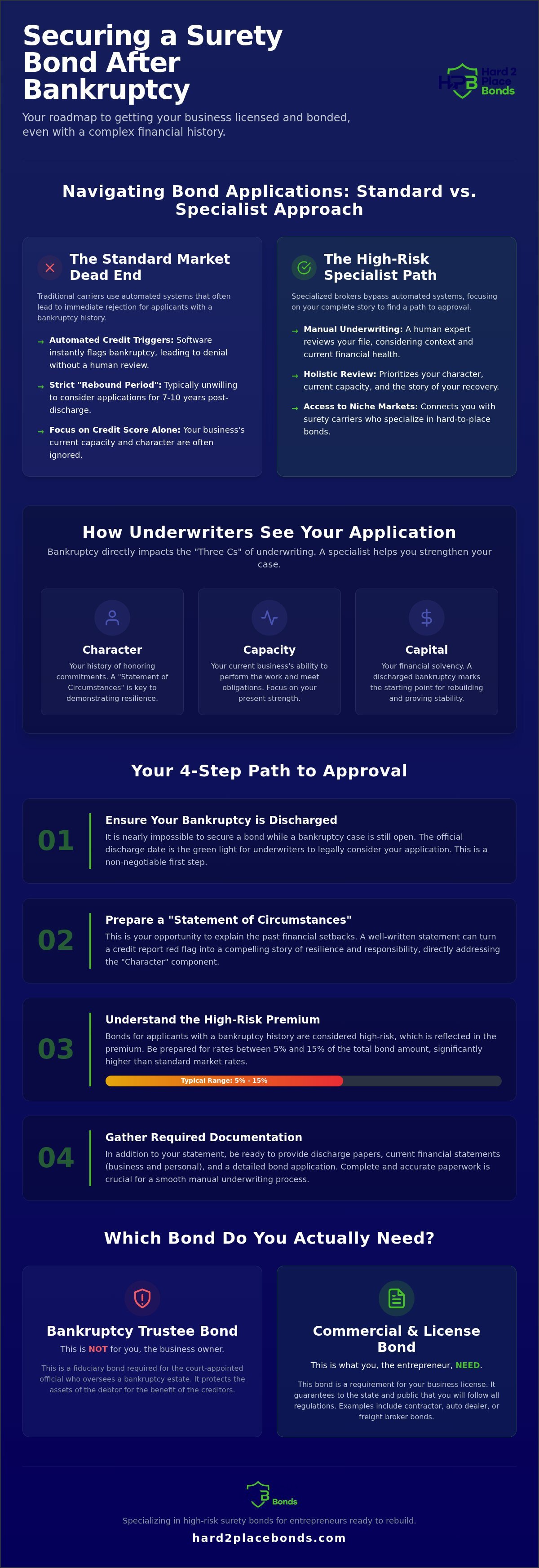
Traditional insurance companies operate on high-volume, low-risk models. To them, a bankruptcy history signals "high risk" because the assumption of no losses is the foundation of their pricing. If you've filed recently, you'll likely face a "rebound period." In the standard market, this period usually lasts seven to ten years after your discharge date. During this time, most standard carriers won't even look at your file. However, the most critical distinction is between an active case and a discharged one. It's almost impossible to secure a bond while a bankruptcy is still open in court; the case must be officially closed before any reputable carrier will consider your request.
Why Underwriters Care About Your Financial History
Underwriters evaluate every applicant using the "Three Cs": Character, Capacity, and Capital. Bankruptcy directly impacts two of these. It affects "Capital" because it indicates a period of financial insolvency, and it touches "Character" because underwriters look for a history of honoring commitments. They aren't trying to be judgmental; they're trying to predict the likelihood of a future claim. A bankruptcy discharge date acts as the official starting point for bond eligibility, marking the moment an underwriter can legally consider your application.
The Reality of Bond Rejection in Standard Markets
If you've tried to get a bond through a local insurance agent, you've probably faced an instant denial. This happens because standard carriers use automated credit triggers. Their software is programmed to reject any score below a certain threshold or any file containing a bankruptcy flag. These agents often lack access to niche markets that specialize in high-risk scenarios. Instead of a computer saying "no," you need a human underwriter who can review your "Statement of Circumstances." Securing a surety bond for bankruptcy history requires moving away from automated systems and toward manual underwriting. Understanding the path to overcoming surety bond rejection is about finding a partner who sees your business as more than just a credit score.
Bankruptcy Trustee Bonds vs. Commercial Bonds for Former Debtors
There is often significant confusion when business owners begin searching for a surety bond for bankruptcy history. If you search for "bankruptcy bonds," you'll likely find information regarding Bankruptcy Trustee Bonds. It's vital to recognize that these are two entirely different instruments serving different parties. One is a fiduciary requirement for court officials; the other is a commercial requirement for entrepreneurs looking to rebuild their professional lives. Misunderstanding this distinction can lead to wasted time and incorrect applications that result in further delays for your business licensing.
What is a Bankruptcy Trustee Bond?
A Bankruptcy Trustee Bond is a specific type of fiduciary bond required by the court for individuals appointed to oversee a bankruptcy estate. Whether the case falls under Chapter 7, 11, 12, or 13, the trustee must be bonded to protect the assets of the debtor for the benefit of the creditors. This bond guarantees that the trustee will perform their duties honestly and according to the law. Legal scholars often discuss the status of a bond as an executory contract in bankruptcy, highlighting the complex relationship between the court, the surety, and the estate. If you are the person who filed for bankruptcy, you aren't the one who needs this bond; the person managing your old assets does.
Commercial and License Bonds for the Rebounding Entrepreneur
As a business owner, you're likely looking for a commercial license bond. These are the tools that allow you to restart your career or maintain an existing company after a financial setback. Common examples include contractor license bonds, which are mandatory in many states to perform trade work. Other specialized requirements might include motor vehicle dealer bonds or freight broker bonds. These bonds don't protect you; they act as a guarantee to the public and the state that you'll follow all applicable regulations and statutes. Hard 2 Place Bonds focuses on these specific commercial needs for those with complex credit backgrounds.
When you speak with a broker, always identify the "obligee" requesting the bond. The obligee is the entity, such as a state licensing board or a government agency, that requires the financial guarantee. Providing this information immediately helps your broker distinguish between a court-mandated trustee bond and the commercial license you need to generate revenue. If you're ready to see which options are available for your specific situation, you can start your application today to get a professional review of your file. Clear communication about the bond type ensures that your application moves through the high-risk underwriting process as efficiently as possible.
Underwriting Reality: Chapter 7 vs. Chapter 13 Bankruptcy History
One of the biggest myths in the bonding industry is that you must wait seven to ten years for a filing to fall off your credit report before you can get approved. In the standard market, that might be true. However, specialized underwriters operate differently. Securing a surety bond for bankruptcy history is possible almost immediately after your case is finalized. The type of bankruptcy you filed determines how an underwriter views your risk level and what specific documents they'll need to see to offer a quote.
Your discharge papers are the most important documents in your entire application. These papers act as your financial "birth certificate," proving to the surety that the court has officially closed your case and you no longer have those specific legal liabilities. Without a discharge decree, most high-risk carriers will view your situation as an active risk that they cannot legally or financially touch. Keep these documents organized and ready to upload the moment you start your application.
Chapter 7: Navigating the Liquidation Path
Under Chapter 7, you receive a "clean slate" through the liquidation of assets. Underwriters generally prefer this filing because it represents a definitive end to your previous financial troubles. While you can often get bonded shortly after discharge, we've found that rates tend to improve significantly once you are 12 to 24 months past the discharge date. During this window, you've had time to prove you can manage new credit responsibly. If your credit score took a massive hit during the process, you should look into how to get a surety bond for 500 credit score to understand the specific pricing tiers available to you.
Chapter 13 and Chapter 11: The Reorganization Perspective
Reorganization filings like Chapter 13 or Chapter 11 are viewed through a different lens. Since these involve a three to five year repayment plan, you might still be in the middle of the process when you need a bond. The good news is that a history of on-time plan payments actually works in your favor. It demonstrates to the underwriter that you are disciplined and committed to fulfilling your financial obligations. This helps satisfy the "Character" portion of the underwriting assessment mentioned earlier.
If your case is still active, you'll likely need an "Order to Incur Debt" from the bankruptcy court. Because a surety bond is a form of credit, the court must give you permission to obtain one while you are under a repayment plan. Once you have this court order and can show a consistent payment history, a specialized broker can often find a path to approval that a standard agent would never even consider.
5 Steps to Secure a Surety Bond After a Financial Setback
Securing a surety bond for bankruptcy history requires a strategic approach rather than a standard application process. You aren't just a credit score to a specialized underwriter. You're a business owner with a story of resilience. Follow these five steps to maximize your chances of approval and get your license back on track.
- Gather your paperwork: Have your full bankruptcy petition and final discharge decree ready. These are the foundational documents for any high-risk application.
- Draft a statement: Write a concise "Statement of Circumstances." This explains why the filing occurred and what has changed since then.
- Show current stability: Provide recent bank statements and proof of income. Underwriters care more about your current cash flow than your past debts.
- Partner with a specialist: Work with a broker who has access to niche markets and understands manual underwriting.
- Prepare for initial costs: Be ready for higher premiums or potential collateral requirements in your first year.
The Power of Transparency
Hiding a past filing is the fastest way to receive a permanent denial. Underwriters have access to public records; they'll find the bankruptcy regardless of what you disclose. Being upfront allows you to frame the narrative. Distinguishing between extenuating circumstances, like unexpected medical bills or a divorce, and general financial mismanagement can humanize your application. A well-written narrative statement provides context that an automated credit check misses, turning a red flag into a manageable risk.
What to Expect in Terms of Pricing
While standard market rates typically hover between 1% and 3%, applicants with a bankruptcy history should expect high-risk market rates ranging from 5% to 15%. This increased cost reflects the higher risk the surety takes by co-signing for your business. Think of your first year as a "track record" period. By paying your premiums on time and avoiding claims, you demonstrate reliability. Over time, you can qualify for lower rates as your financial recovery matures. For a deeper dive into these numbers, review our surety bond cost with bad credit guide. If you're ready to get an exact quote for your situation, you should start your application with a specialist who knows how to advocate for your business.
Expert Placement: Navigating the Hard-to-Place Bond Market
A rejection from a standard insurance carrier isn't the end of your business. It's often just the result of a rigid algorithm that can't see the person behind the paperwork. At Hard 2 Place Bonds, we specialize in the high-risk market because we know that a credit score doesn't tell your whole story. While most agents only have access to standard markets, we maintain deep relationships with niche carriers that specifically look for a surety bond for bankruptcy history . We don't rely on a computer to make the final decision. Instead, we use manual underwriting to look at your current financial health and your professional capacity.
Our team acts as your advocate throughout the entire process. We know how to present a complex history in a way that makes sense to a carrier. We don't just submit a form; we package your application to highlight your recent financial wins and your current stability. This personalized approach is why we succeed where traditional brokers fail. We understand the high stakes involved in obtaining a license. We're committed to finding a path forward even when other agents have given up on your file.
Why a Specialist Broker Matters
A specialist broker understands the landscape of "bankruptcy-friendly" carriers. These companies are comfortable with risk because they know how to price it correctly for the 2026 market. We help you mitigate perceived risks by providing the right documentation and a clear narrative of your financial recovery. Our expertise simplifies the process of obtaining a surety bond, turning a stressful ordeal into a manageable business step. We've helped countless contractors and entrepreneurs who were told "no" by their local agents find the coverage they needed to thrive.
Ready to Move Forward?
Your past financial challenges shouldn't dictate your future success. As we move through 2026, more opportunities are opening up for rebounding entrepreneurs who have the right support. Our intake process is designed to be empathetic, professional, and efficient. We respect your time and your ambition. Don't let a past chapter stop your business growth. We're here to help you secure the bond you need to maintain your professional standing and your livelihood. Start your high-risk surety bond application now and see the difference that expert advocacy makes for your business.
Rebuild Your Business with Confidence
A past financial setback doesn't have to be the final word for your company. Securing a surety bond for bankruptcy history is entirely possible when you work with the right partner. Success in 2026 depends on understanding the difference between commercial and trustee bonds, gathering your discharge papers early, and choosing manual underwriting over automated systems. You have the resilience to move forward, and we have the tools to help you get there.
Hard 2 Place Bonds offers specialized high-risk underwriting expertise and direct access to non-standard bond markets that most local agents can't reach. With our national reach across all 50 states, we advocate for entrepreneurs who are ready to prove their current stability. Don't let a "declined" stamp stall your growth any longer. Our team is ready to review your file with the empathy and professional competence you deserve. Secure your bond and start your application today to see which options are available for your business. Your next chapter starts now.
Frequently Asked Questions
Can I get a surety bond while currently in an active Chapter 13 bankruptcy?
You can get bonded while in an active Chapter 13 bankruptcy, but you must obtain an "Order to Incur Debt" from the court first. Since a bond is a form of credit, the bankruptcy trustee needs to approve the new obligation. We specialize in these cases and can help you present your on-time payment history to a niche underwriter who understands reorganization plans. It's a complex process but manageable with the right court permissions.
How long after a Chapter 7 discharge can I apply for a business license bond?
You can apply for a business license bond immediately after your Chapter 7 discharge papers are signed by the court. While some standard markets want you to wait seven years, high-risk specialists can often secure a surety bond for bankruptcy history within days of the case closing. Rates typically start to improve once you are 12 to 24 months past the discharge date. This timing allows you to rebuild without waiting for credit report updates.
Will my surety bond premium always be high because of my bankruptcy history?
Your premiums won't stay high forever if you maintain a clean bonding record and improve your credit score. Initially, you'll likely pay between 5% and 15% of the bond amount to reflect the higher risk. However, as your bankruptcy ages and you demonstrate financial stability, you can often transition back to standard market rates. These standard rates typically range from 1% to 3% for qualified applicants who have rebuilt their financial standing.
Do I need to provide collateral if I have a bankruptcy on my record?
Collateral is not always required, especially for standard license bonds under $50,000. For larger contract bonds or higher-risk cases, a surety might ask for a letter of credit or cash collateral to mitigate the risk. We work to find markets that prioritize your current cash flow and character to avoid these requirements whenever possible. Each case is unique, so your current financial stability plays a huge role in the final underwriter decision.
What documents will a surety company ask for regarding my bankruptcy?
You'll need to provide your full bankruptcy petition, the discharge decree, and a brief statement explaining the circumstances of the filing. For bonds over $50,000, underwriters usually require current personal and business financial statements. Having these documents organized and ready can significantly speed up the approval process in the high-risk market. Transparency is key, as underwriters will verify all information against public records and credit reports during their manual review process.
Can a surety company cancel my bond if I file for bankruptcy after it's issued?
Yes, most surety bonds include a cancellation clause that allows the carrier to terminate the bond with 30 to 60 days' notice. Filing for bankruptcy is considered a material change in your financial condition. If this happens, the surety may choose to cancel the bond, though they must notify the obligee first. It's best to communicate with your broker immediately if you anticipate financial trouble to explore potential alternatives or reorganization options before cancellation occurs.
Is a personal bankruptcy different from a business bankruptcy for bonding purposes?
Both types impact your bondability, but personal bankruptcy is often more critical for small business owners and contractors. Underwriters view a personal filing as a reflection of how you manage financial obligations. If you are applying for a surety bond for bankruptcy history , the underwriter will review your personal credit regardless of whether the business was part of the filing. This is because most small business bonds require a personal indemnity from the owner.
Can I get a performance bond for a construction project with a past bankruptcy?
Yes, you can obtain performance bonds with a past bankruptcy, but the underwriting is much stricter than for a simple license bond. You'll likely need to show significant working capital and a strong track record of completed projects. Small Business Administration bond guarantee programs are often a great resource for contractors in this situation. These programs provide an extra layer of security that encourages sureties to offer bonding to businesses with previous financial challenges.